Department of Integrative Biology, University of Texas at Austin, Austin, Texas, United States of America.
PLoS Genet. 2022 May 6;18(5):e1010195. doi: 10.1371/journal.pgen.1010195. eCollection 2022 May.
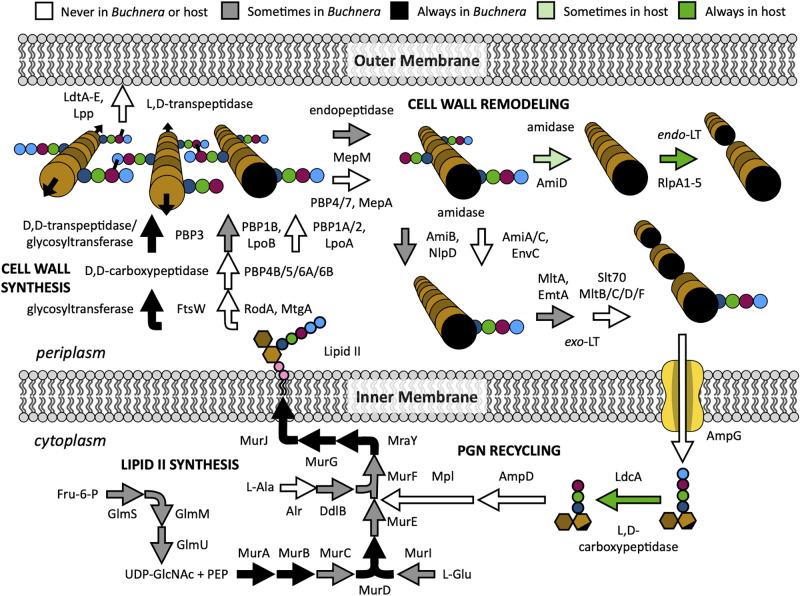
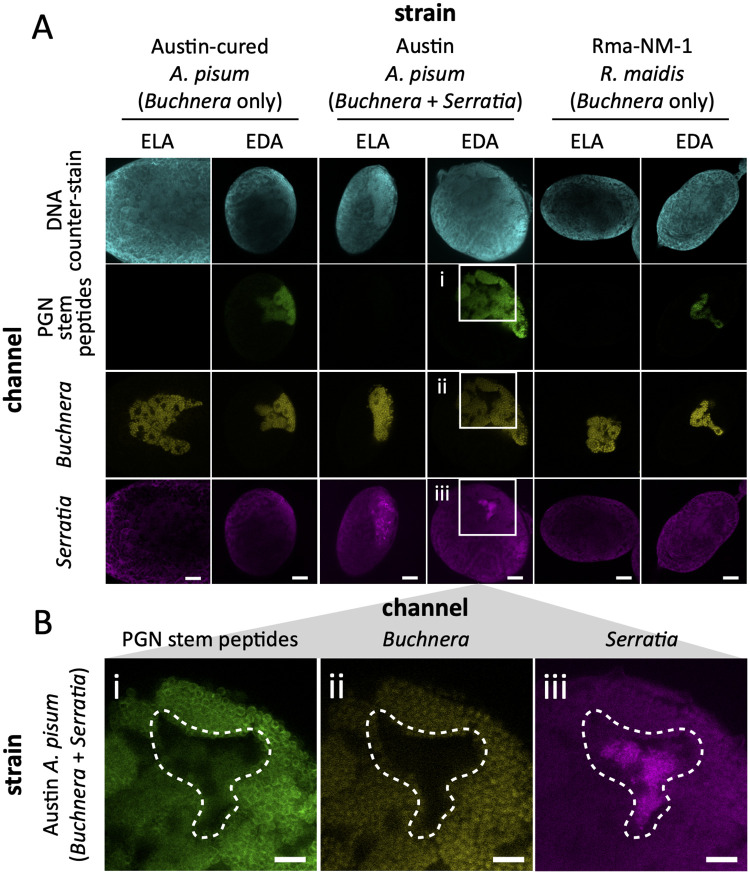
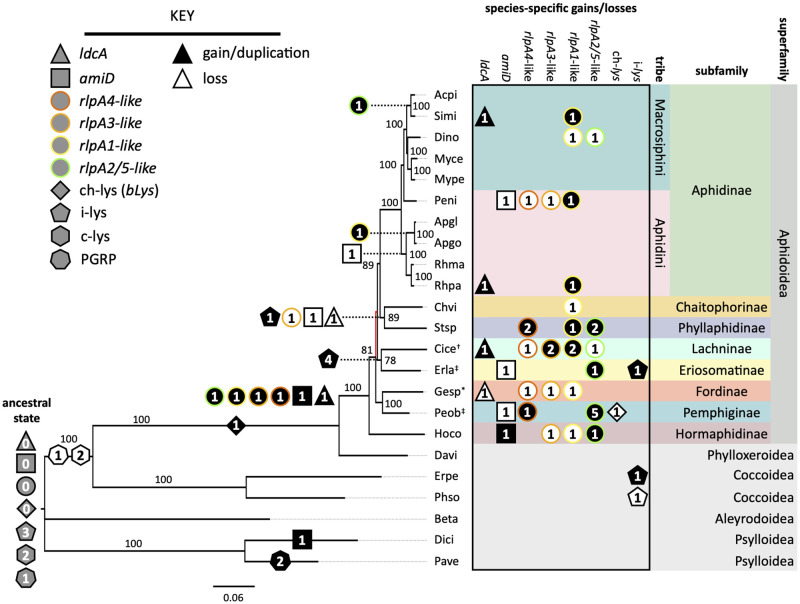
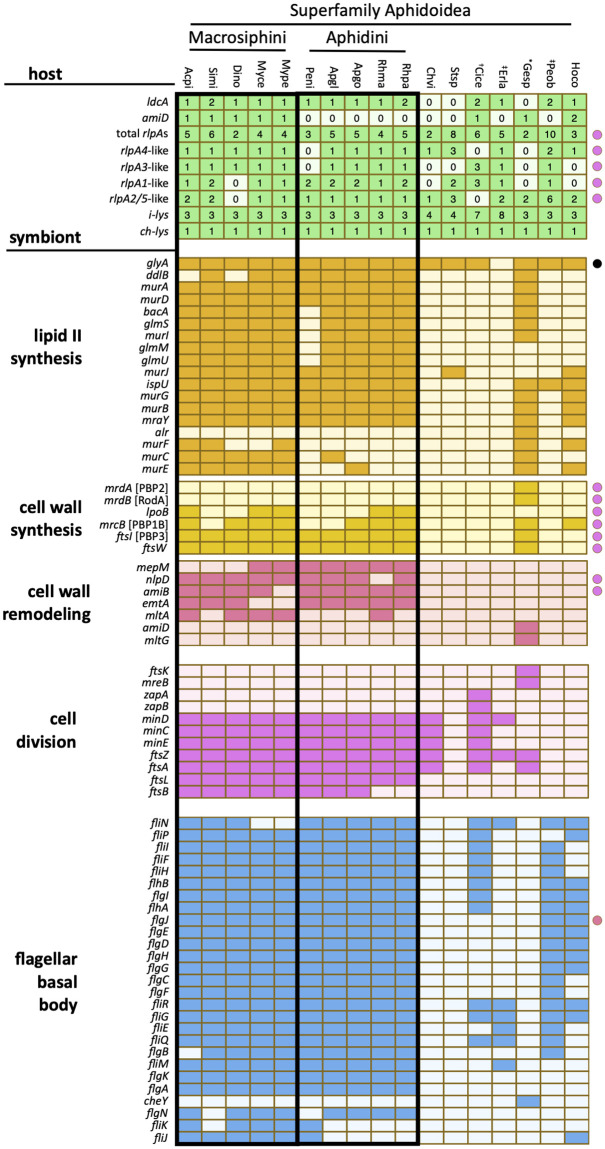
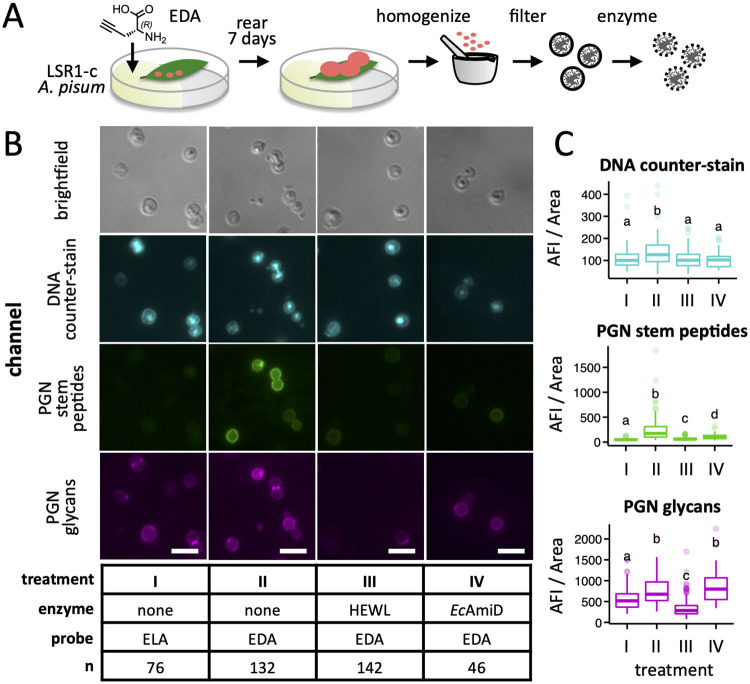
Pea aphids (Acyrthosiphon pisum) are insects containing genes of bacterial origin with putative functions in peptidoglycan (PGN) metabolism. Of these, rlpA1-5, amiD, and ldcA are highly expressed in bacteriocytes, specialized aphid cells that harbor the obligate bacterial symbiont Buchnera aphidicola, required for amino acid supplementation of the host's nutrient-poor diet. Despite genome reduction associated with endosymbiosis, pea aphid Buchnera retains genes for the synthesis of PGN while Buchnera of many other aphid species partially or completely lack these genes. To explore the evolution of aphid horizontally-transferred genes (HTGs) and to elucidate how host and symbiont genes contribute to PGN production, we sequenced genomes from four deeply branching lineages, such that paired aphid and Buchnera genomes are now available for 17 species representing eight subfamilies. We identified all host and symbiont genes putatively involved in PGN metabolism. Phylogenetic analyses indicate that each HTG family was present in the aphid shared ancestor, but that each underwent a unique pattern of gene loss or duplication in descendant lineages. While four aphid rlpA gene subfamilies show no relation to symbiont PGN gene repertoire, the loss of aphid amiD and ldcA HTGs coincides with the loss of symbiont PGN metabolism genes. In particular, the coincident loss of host amiD and symbiont murCEF in tribe Aphidini, in contrast to tribe Macrosiphini, suggests either 1) functional linkage between these host and symbiont genes, or 2) Aphidini has lost functional PGN synthesis and other retained PGN pathway genes are non-functional. To test these hypotheses experimentally, we used cell-wall labeling methods involving a d-alanine probe and found that both Macrosiphini and Aphidini retain Buchnera PGN synthesis. Our results imply that compensatory adaptations can preserve PGN synthesis despite the loss of some genes considered essential for this pathway, highlighting the importance of the cell wall in these symbioses.
豌豆蚜(Acyrthosiphon pisum)是一种含有细菌起源基因的昆虫,这些基因可能在肽聚糖(PGN)代谢中具有功能。其中,rlpA1-5、amiD 和 ldcA 在菌胞中高度表达,菌胞是专门容纳专性细菌共生体 Buchnera aphidicola 的蚜虫细胞,Buchnera aphidicola 是宿主营养贫乏饮食中氨基酸补充所必需的。尽管与内共生相关的基因组减少,豌豆蚜 Buchnera 保留了合成 PGN 的基因,而许多其他蚜虫物种的 Buchnera 部分或完全缺乏这些基因。为了探索蚜虫水平转移基因(HTGs)的进化,并阐明宿主和共生基因如何促进 PGN 的产生,我们对四个深度分支谱系进行了基因组测序,使得现在有 17 个代表 8 个亚科的物种的蚜虫和 Buchnera 基因组是配对的。我们鉴定了所有参与 PGN 代谢的宿主和共生基因。系统发育分析表明,每个 HTG 家族都存在于蚜虫共同祖先中,但在后代谱系中,每个家族都经历了独特的基因丢失或复制模式。虽然四个蚜虫 rlpA 基因亚家族与共生体 PGN 基因库没有关系,但蚜虫 amiD 和 ldcA HTGs 的丢失与共生体 PGN 代谢基因的丢失是一致的。特别是,在蚜虫族 Aphidini 中,宿主 amiD 和共生体 murCEF 的同时丢失,与族 Macrosiphini 相反,表明 1)这些宿主和共生基因之间存在功能联系,或 2)Aphidini 已经失去了功能性 PGN 合成,而其他保留的 PGN 途径基因是无功能的。为了通过实验检验这些假设,我们使用了涉及 D-丙氨酸探针的细胞壁标记方法,发现 Macrosiphini 和 Aphidini 都保留了 Buchnera PGN 合成。我们的结果表明,尽管一些被认为对该途径至关重要的基因丢失了,但代偿适应可以保留 PGN 合成,这突出了细胞壁在这些共生关系中的重要性。