Mündermann Lars, Corazza Stefano, Andriacchi Thomas P
Department of Mechanical Engineering, Stanford University, Stanford, CA, USA.
J Neuroeng Rehabil. 2006 Mar 15;3:6. doi: 10.1186/1743-0003-3-6.
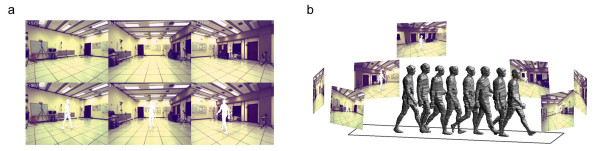
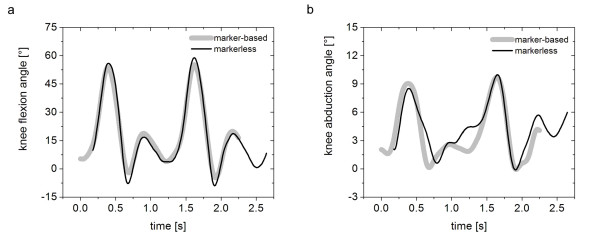
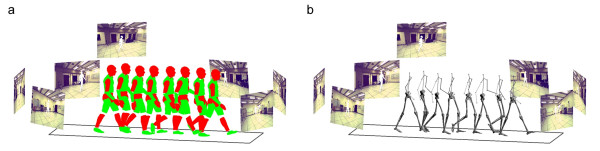
Over the centuries the evolution of methods for the capture of human movement has been motivated by the need for new information on the characteristics of normal and pathological human movement. This study was motivated in part by the need of new clinical approaches for the treatment and prevention of diseases that are influenced by subtle changes in the patterns movement. These clinical approaches require new methods to measure accurately patterns of locomotion without the risk of artificial stimulus producing unwanted artifacts that could mask the natural patterns of motion. Most common methods for accurate capture of three-dimensional human movement require a laboratory environment and the attachment of markers or fixtures to the body's segments. These laboratory conditions can cause unknown experimental artifacts. Thus, our understanding of normal and pathological human movement would be enhanced by a method that allows the capture of human movement without the constraint of markers or fixtures placed on the body. In this paper, the need for markerless human motion capture methods is discussed and the advancement of markerless approaches is considered in view of accurate capture of three-dimensional human movement for biomechanical applications. The role of choosing appropriate technical equipment and algorithms for accurate markerless motion capture is critical. The implementation of this new methodology offers the promise for simple, time-efficient, and potentially more meaningful assessments of human movement in research and clinical practice. The feasibility of accurately and precisely measuring 3D human body kinematics for the lower limbs using a markerless motion capture system on the basis of visual hulls is demonstrated.
几个世纪以来,人类运动捕捉方法的发展一直受到获取正常和病理人类运动特征新信息需求的推动。本研究部分是受新临床方法需求的推动,这些方法用于治疗和预防受运动模式细微变化影响的疾病。这些临床方法需要新的方法来准确测量运动模式,而不会因人工刺激产生可能掩盖自然运动模式的不必要伪影。准确捕捉三维人体运动的最常见方法需要实验室环境,并在身体各部位附着标记物或固定装置。这些实验室条件可能会导致未知的实验伪影。因此,一种能够在不依赖放置在身体上的标记物或固定装置的情况下捕捉人体运动的方法,将有助于增进我们对正常和病理人类运动的理解。本文讨论了对无标记人体运动捕捉方法的需求,并从生物力学应用中准确捕捉三维人体运动的角度考虑了无标记方法的进展。选择合适的技术设备和算法以进行准确的无标记运动捕捉至关重要。这种新方法的实施有望为研究和临床实践中的人体运动提供简单、高效且可能更有意义的评估。本文展示了基于视觉外壳的无标记运动捕捉系统准确精确测量下肢三维人体运动学的可行性。