Moore Francisco B-G, Hosey Michelle, Bagatto Brian
Department of Biology, University of Akron, Akron, Ohio, USA.
Front Zool. 2006 Mar 15;3:4. doi: 10.1186/1742-9994-3-4.
Genetic and environmental variation are both known to influence development. Evolution of a developmental response that is optimized to the environment (adaptive plasticity) requires the existence of genetic variation for that developmental response. In complex traits composed of integrated sets of subsidiary traits, the adaptive process may be slowed by the existence of multiple possible integrated responses. This study tests for family (sibship) specific differences in plastic response to hypoxia in an integrated set of cardiovascular traits in zebrafish.
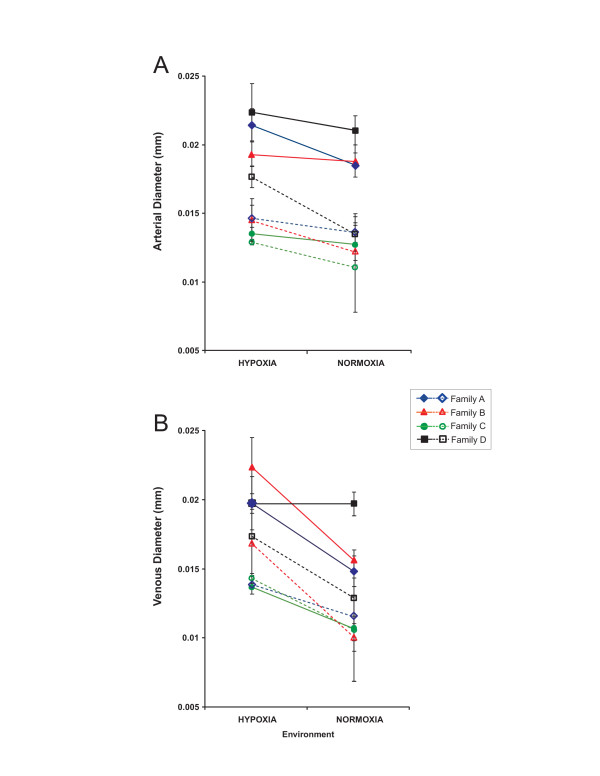
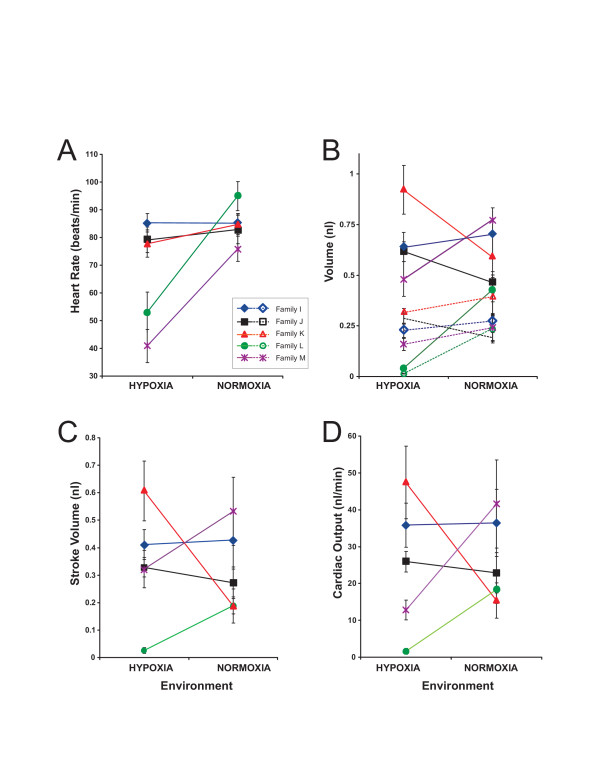
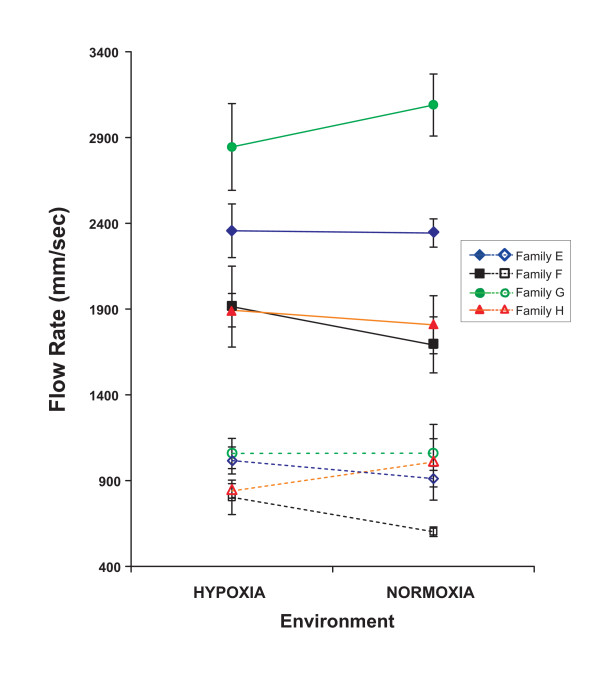
Cardiac output, which is the integrated product of several subsidiary traits, varied highly significantly between families, and families differed significantly in the degree and direction of response to developmental oxygen level. The cardiac output response to oxygen environment was entirely family specific with no significant overall trend due to oxygen level. Constituent physiological variables that contribute to cardiac output all showed significant family specific response to hypoxia. Traits that were not directly related to cardiac output, such as arterial and venous diameter, and red blood cell velocities did not respond to hypoxia in a family specific manner.
Zebrafish families vary in their plastic response to hypoxia. Genetic variation in plastic response to hypoxia may therefore provide the basic ingredient for adaptation to a variable environment. Considerable variation in the degree of familial response to hypoxia exists between different cardiovascular traits that may contribute to cardiac output. It is possible that the integration of several subsidiary traits into cardiac output allows the maintenance of genetic variance in cardiac response.
已知基因和环境变异都会影响发育。要进化出一种针对环境进行优化的发育反应(适应性可塑性),就需要该发育反应存在基因变异。在由一系列附属性状组成的复杂性状中,多种可能的综合反应的存在可能会减缓适应过程。本研究测试了斑马鱼一组心血管性状对缺氧的可塑性反应中家族(同胞关系)特异性差异。
心输出量是几个附属性状的综合产物,在不同家族之间差异极显著,并且家族在对发育氧水平的反应程度和方向上也存在显著差异。心输出量对氧环境的反应完全是家族特异性的,不存在因氧水平导致的显著总体趋势。构成心输出量的各个生理变量对缺氧均表现出显著的家族特异性反应。与心输出量无直接关系的性状,如动脉和静脉直径以及红细胞速度,对缺氧没有家族特异性反应。
斑马鱼家族对缺氧的可塑性反应存在差异。因此,对缺氧的可塑性反应中的基因变异可能为适应多变环境提供了基本要素。不同心血管性状对缺氧的家族反应程度存在相当大的差异,这些性状可能对心输出量有贡献。将几个附属性状整合到心输出量中有可能维持心脏反应中的遗传变异。