Yoo W, Martin M E, Folk W R
Department of Biochemistry, University of Missouri, Columbia 65212.
J Virol. 1991 Oct;65(10):5391-400. doi: 10.1128/JVI.65.10.5391-5400.1991.
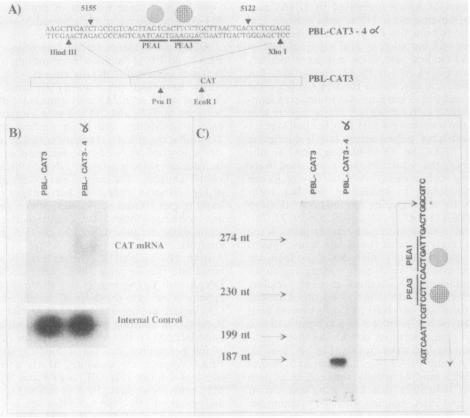
The circular polyomavirus genome is transcribed from divergent promoter regions. Early mRNAs are initiated from a transcription complex formed at a TATA motif, the site of binding of transcription factor TFIID. Early transcription is promoted at a distance by the viral enhancer, which includes DNA motifs bound by cellular proteins of the PEA1 and PEA3 families of transcription activators. In contrast, the predominant viral late mRNAs are initiated within the viral enhancer, which lacks a TATA motif, near the PEA1 and PEA3 DNA motifs. Here, we demonstrate that these PEA1 and PEA3 binding sites are primary components of an autonomous transcription initiator element (Inr). They cause transcription of most polyomavirus late mRNAs and can direct the transcription of heterologous reporter genes. Alternative roles of these DNA motifs as activators of early mRNA transcription and as an initiator element for late mRNA transcription help explain how polyomavirus gene expression is regulated during lytic growth and provides a model for cellular transcription during development.
环状多瘤病毒基因组从不同的启动子区域转录。早期mRNA从在TATA基序处形成的转录复合物起始,TATA基序是转录因子TFIID的结合位点。病毒增强子在远距离促进早期转录,该增强子包括由转录激活因子PEA1和PEA3家族的细胞蛋白结合的DNA基序。相比之下,主要的病毒晚期mRNA在缺乏TATA基序的病毒增强子内,靠近PEA1和PEA3 DNA基序处起始。在这里,我们证明这些PEA1和PEA3结合位点是自主转录起始元件(Inr)的主要成分。它们导致大多数多瘤病毒晚期mRNA的转录,并可指导异源报告基因的转录。这些DNA基序作为早期mRNA转录激活因子和晚期mRNA转录起始元件的不同作用,有助于解释多瘤病毒基因表达在裂解生长过程中是如何被调控的,并为发育过程中的细胞转录提供了一个模型。