Seya Tsukasa, Akazawa Takashi, Tsujita Tadayuki, Matsumoto Misako
Department of Microbiology and Immunology, Hokkaido University Graduate School of Medicine, Nishi, Sapporo, Japan.
Evid Based Complement Alternat Med. 2006 Mar;3(1):31-8; discussion 133-7. doi: 10.1093/ecam/nek010. Epub 2006 Jan 30.
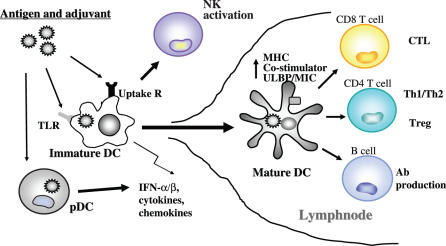
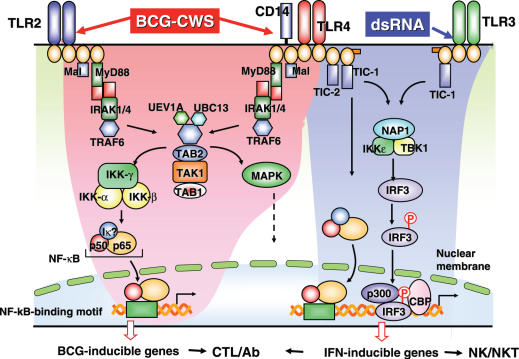
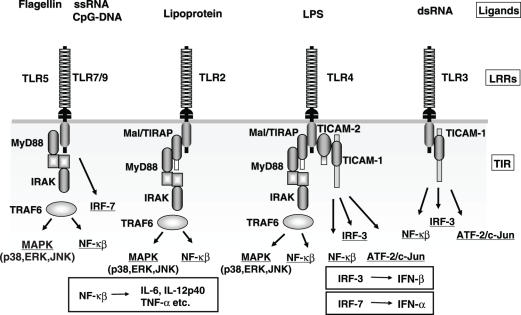
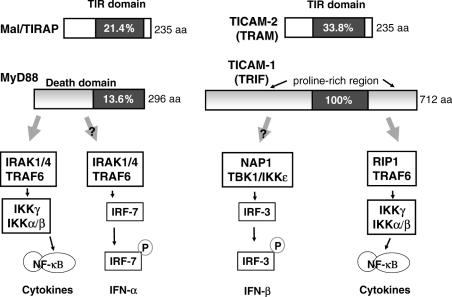
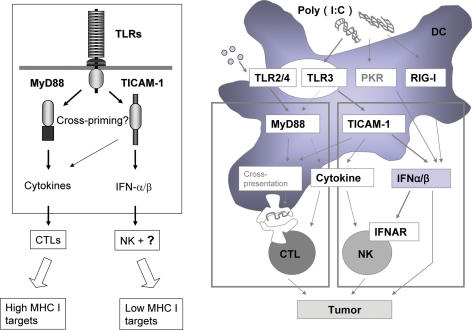
Effective therapeutic vaccines contain two primary constituents, antigen and adjuvant. Adjuvants consisting of microbial pattern molecules play a central role in vaccination. Successful vaccine requires efficient induction of antibody (Ab), type I interferons (IFN), cytokines/chemokines, cytotoxic T lymphocytes (CTL) and/or NK cells. Toll-like receptors (TLRs) in myeloid dendritic cells (mDC) essentially act as adjuvant receptors and sustain the molecular basis of adjuvant activity. Current consensus is that TLRs and their adapters introduce signals to preferentially induce IFN-alpha/beta, chemokines and proinflammatory cytokines, and mature mDC to augment antigen presentation. Although most of these data were obtained with mice, the results are presumed to be adaptable to humans. Whenever TLR pathway is activated in mDC, NK and/or CTL activation is promoted. For induction of antigen-specific CTL toward phagocytosed material, cross-priming must be induced in mDC, which is also sustained by TLR signaling in mDC. Since the TLR responses vary with different adjuvants, mDC functions are skewed depending on adjuvant-specific direction of mDC maturation. It appears that the directed maturation of mDC largely relies on selection of appropriate sets of TLRs and their adapter signaling pathways. Synthetic chimera molecules consisting of TLR agonists and target antigens are found to be effective in induction of CTL to eliminate target cells in vivo. Here, we review the role of human TLRs and adapters in a variety of host immune responses. We will also describe the relevance of adjuvants in the manipulation of receptors and adapters in vaccine therapy.
有效的治疗性疫苗包含两种主要成分,即抗原和佐剂。由微生物模式分子组成的佐剂在疫苗接种中起着核心作用。成功的疫苗需要高效诱导抗体(Ab)、I型干扰素(IFN)、细胞因子/趋化因子、细胞毒性T淋巴细胞(CTL)和/或自然杀伤细胞(NK细胞)。髓样树突状细胞(mDC)中的Toll样受体(TLR)本质上作为佐剂受体,并维持佐剂活性的分子基础。目前的共识是,TLR及其衔接蛋白引入信号以优先诱导IFN-α/β、趋化因子和促炎细胞因子,并使mDC成熟以增强抗原呈递。尽管这些数据大多是在小鼠身上获得的,但结果被认为适用于人类。每当mDC中的TLR途径被激活时,NK和/或CTL的激活就会得到促进。为了诱导针对吞噬物质的抗原特异性CTL,必须在mDC中诱导交叉呈递,这也由mDC中的TLR信号传导维持。由于TLR反应因不同佐剂而异,mDC的功能会根据佐剂特异性的mDC成熟方向而发生偏差。似乎mDC的定向成熟很大程度上依赖于选择合适的TLR及其衔接蛋白信号通路组合。由TLR激动剂和靶抗原组成的合成嵌合分子被发现可有效诱导CTL在体内消除靶细胞。在此,我们综述了人类TLR及其衔接蛋白在多种宿主免疫反应中的作用。我们还将描述佐剂在疫苗治疗中对受体和衔接蛋白的操纵方面的相关性。