
鉴定与维斯纳病毒结合的细胞膜蛋白。
Identification of cell membrane proteins that bind visna virus.
作者信息
Crane S E, Buzy J, Clements J E
机构信息
Department of Molecular Biology and Genetics, Johns Hopkins University School of Medicine, Baltimore, Maryland 21205.
出版信息
J Virol. 1991 Nov;65(11):6137-43. doi: 10.1128/JVI.65.11.6137-6143.1991.
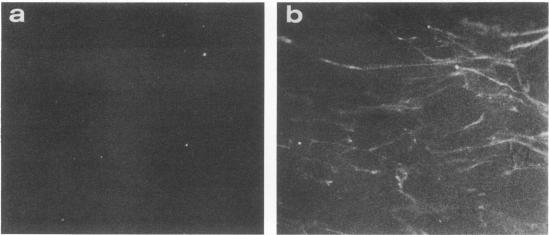
Visna virus infects cells of ovine origin by attaching to a cell surface receptor via its envelope glycoprotein. The identity of the visna virus receptor is not known. To identify the molecule responsible for binding the virus to target cells, virus overlay protein blot assays were used to examine the molecular weights of cell surface molecules which bind purified virus. Molecules on the surface of goat synovial membrane (GSM) cells and sheep choroid plexus (SCP) cells of approximately 15, 30, and 50 kDa bound to visna virus. The binding of visna virus to these proteins was reduced by preincubating virus with neutralizing antibodies. 125I-labeled cell membrane preparations of GSM and SCP cells were used to affinity purify these virus-binding proteins. These proteins were analyzed by sodium dodecyl sulfate-polyacrylamide gel electrophoresis and had molecular masses of 15, 30, and 50 kDa. Antibodies to the 50-kDa protein bound to the surface of both live SCP and GSM cells in immunofluorescence assays. In addition, antibodies to the 50-kDa protein blocked the binding of [35S]methionine-labeled visna virus to SCP cells in culture. Antibodies raised against the 15- and 30-kDa proteins did not block virus binding to cells. The blocking activity of antibody of the 50-kDa protein provided data that this protein is the molecule which visna virus recognizes and binds to on the surface of target cells.
维斯纳病毒通过其包膜糖蛋白附着于细胞表面受体来感染绵羊源细胞。目前尚不清楚维斯纳病毒受体的身份。为了鉴定负责病毒与靶细胞结合的分子,采用病毒覆盖蛋白印迹分析法来检测与纯化病毒结合的细胞表面分子的分子量。山羊滑膜(GSM)细胞和绵羊脉络丛(SCP)细胞表面分子量约为15、30和50 kDa的分子与维斯纳病毒结合。用中和抗体预先孵育病毒可降低维斯纳病毒与这些蛋白质的结合。用125I标记的GSM和SCP细胞膜制剂亲和纯化这些病毒结合蛋白。通过十二烷基硫酸钠-聚丙烯酰胺凝胶电泳分析这些蛋白质,其分子量分别为15、30和50 kDa。在免疫荧光试验中,针对50 kDa蛋白的抗体与活的SCP和GSM细胞表面结合。此外,针对50 kDa蛋白的抗体在培养中阻断了[35S]甲硫氨酸标记的维斯纳病毒与SCP细胞的结合。针对15 kDa和30 kDa蛋白产生的抗体不阻断病毒与细胞的结合。50 kDa蛋白抗体的阻断活性表明该蛋白是维斯纳病毒在靶细胞表面识别并结合的分子。


 Zotero 插件