Burstein H, Bizub D, Skalka A M
Fox Chase Cancer Center, Institute for Cancer Research, Philadelphia, Pennsylvania 19111.
J Virol. 1991 Nov;65(11):6165-72. doi: 10.1128/JVI.65.11.6165-6172.1991.
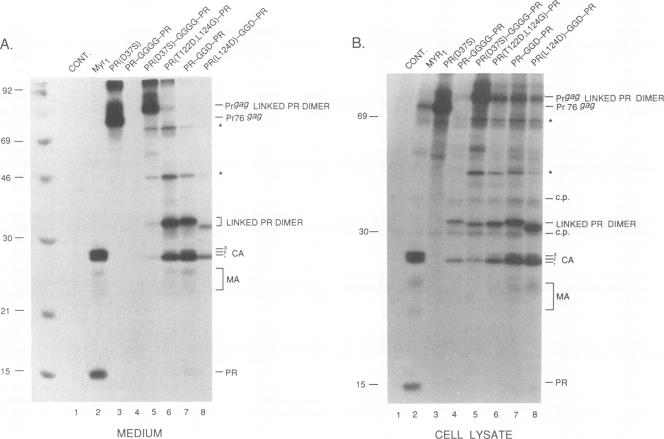
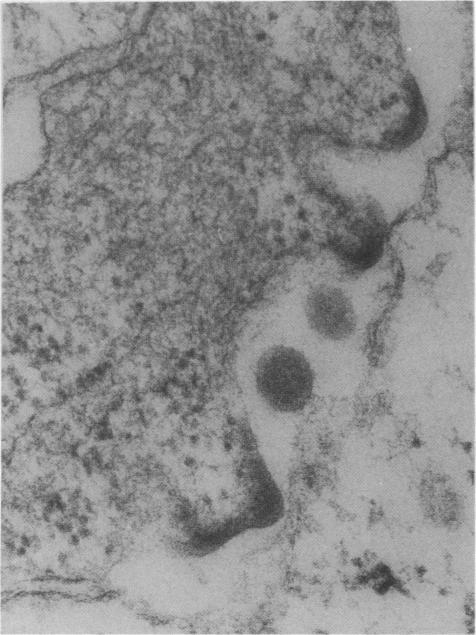
Assembly and maturation of retroviral particles requires the aggregation and controlled proteolytic cleavage of polyprotein core precursors by a precursor-encoded protease (PR). Active, mature retroviral PR is a dimer, and the accumulation of precursors at sites of assembly may facilitate subunit interaction and subsequent activation of this enzyme. In addition, it has been suggested that cellular cytoplasmic components act as inhibitors of PR activity, so that processing is delayed until the nascent virions leave this compartment and separate from the surface of host cells. To investigate the mechanisms that control PR activity during virus assembly, we studied the in vivo processing of retroviral gag precursors that contain tandemly linked PR subunits in which dimerization is concentration independent. Sequences encoding four different linked protease dimers were independently joined to the end of the Rous sarcoma virus (RSV) gag gene in a simian virus 40-based plasmid vector which expresses a myristoylated gag precursor upon transfection of COS-1 cells. Three of these plasmids produced gag precursors that were incorporated into viruslike particles and proteolytically cleaved by the dimers to mature core proteins that were indistinguishable from the processed products of wild-type gag. The amount of viral gag protein that was assembled and packaged in these transfections was inversely related to the relative proteolytic activities of the linked PR dimers. The fourth gag precursor, which contained the most active linked PR dimer, underwent rapid intracellular processing and did not form viruslike particles. In the absence of the plasma membrane targeting signal, processing of all four linked PR dimer-containing gag precursors was completed entirely within the cell. From these results, we conclude that the delay in polyprotein core precursor processing that occurs during normal virion assembly does not depend on a cytoplasmic inhibitor of PR activity. We suggest that dimer formation is not only necessary but may be sufficient for the initiation of PR-directed maturation of gag and gag-pol precursors.
逆转录病毒颗粒的组装和成熟需要前体编码蛋白酶(PR)对多蛋白核心前体进行聚集和可控的蛋白水解切割。活性成熟的逆转录病毒PR是一种二聚体,前体在组装位点的积累可能有助于亚基相互作用以及该酶的后续激活。此外,有人提出细胞胞质成分可作为PR活性的抑制剂,因此加工过程会延迟,直到新生病毒体离开这个区室并与宿主细胞表面分离。为了研究病毒组装过程中控制PR活性的机制,我们研究了含有串联连接的PR亚基的逆转录病毒gag前体的体内加工情况,其中二聚化与浓度无关。编码四种不同连接蛋白酶二聚体的序列被独立连接到基于猿猴病毒40的质粒载体中的劳斯肉瘤病毒(RSV)gag基因末端,该载体在转染COS-1细胞后表达一种肉豆蔻酰化的gag前体。这些质粒中的三个产生了gag前体,它们被整合到病毒样颗粒中,并被二聚体蛋白水解切割成成熟的核心蛋白,这些核心蛋白与野生型gag的加工产物无法区分。在这些转染中组装和包装的病毒gag蛋白的量与连接的PR二聚体的相对蛋白水解活性呈负相关。第四个gag前体包含最活跃的连接PR二聚体,经历了快速的细胞内加工,没有形成病毒样颗粒。在没有质膜靶向信号的情况下,所有四种含连接PR二聚体的gag前体的加工完全在细胞内完成。从这些结果中,我们得出结论,正常病毒体组装过程中多蛋白核心前体加工的延迟并不依赖于PR活性的胞质抑制剂。我们认为二聚体形成不仅是gag和gag-pol前体PR导向成熟起始所必需的,而且可能就足够了。