Missirlis Perseus I, Smailus Duane E, Holt Robert A
Genome Sciences Centre, BC Cancer Agency, Suite 100, 570 West 7th Ave, Vancouver, BC, V5Z 4S6, Canada.
BMC Genomics. 2006 Apr 4;7:73. doi: 10.1186/1471-2164-7-73.
Cre-loxP recombination refers to the process of site-specific recombination mediated by two loxP sequences and the Cre recombinase protein. Transgenic experiments exploit integrative recombination, where a donor plasmid carrying a loxP site and DNA of interest integrate into a recipient loxP site in a target genome. Unfortunately, integrative recombination is highly inefficient because the insert is flanked by two loxP sites, which themselves become targets for Cre and lead to subsequent excision of the insert. A small number of mutations have been discovered in parts of the loxP sequence, specifically the spacer and inverted repeat segments, that increase the efficiency of integrative recombination. In this study we introduce a high-throughput in vitro assay to rapidly detect novel loxP spacer mutants and describe the sequence characteristics of successful recombinants.
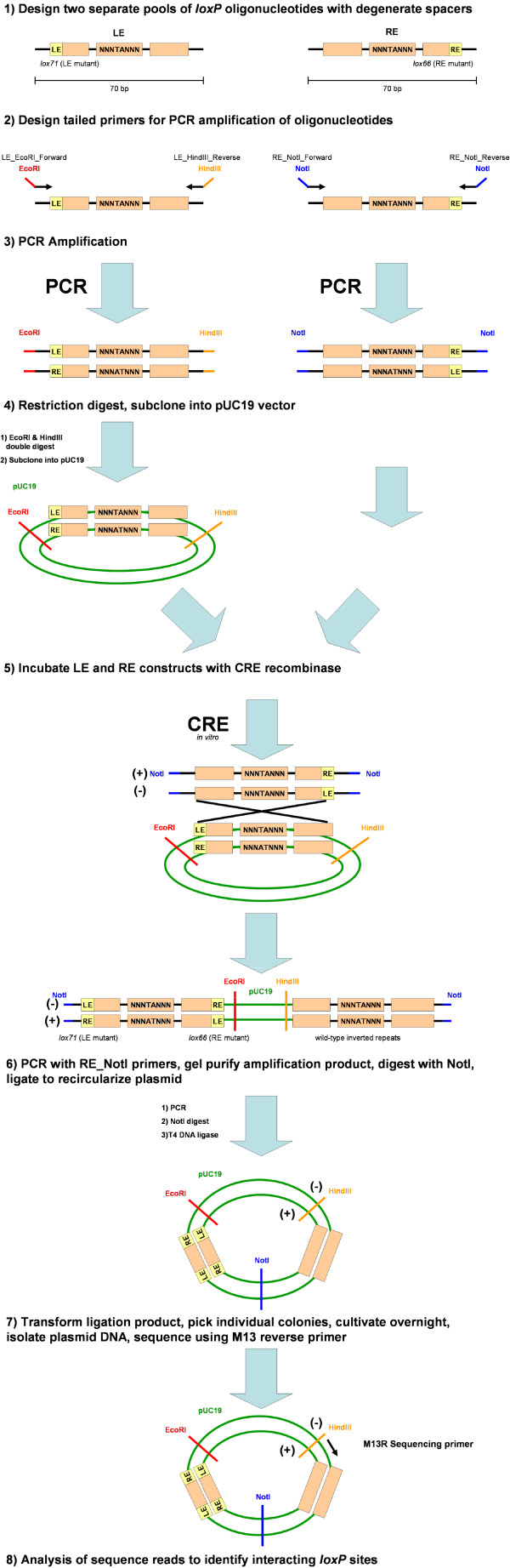
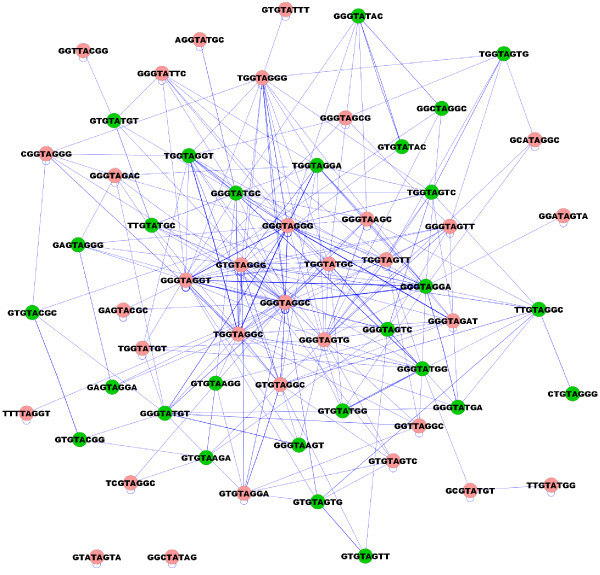
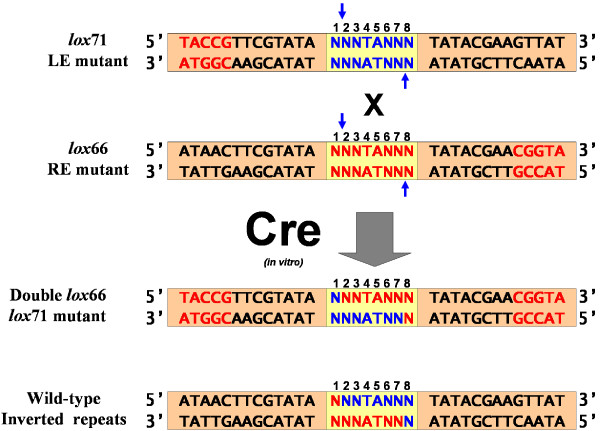
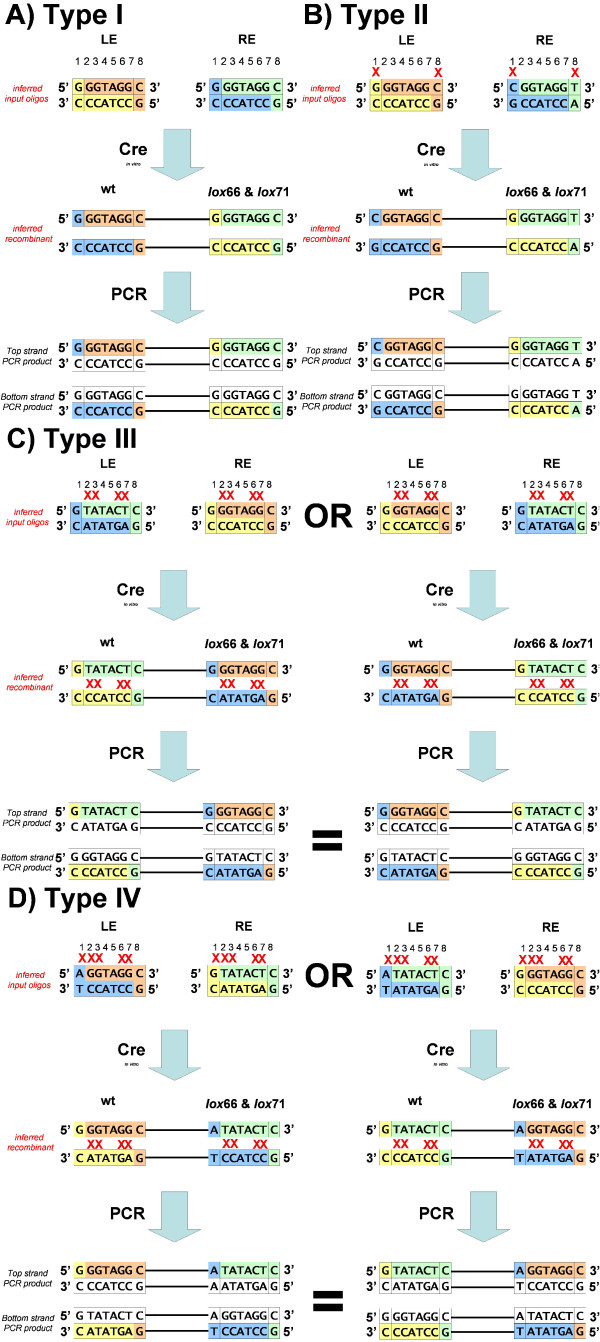
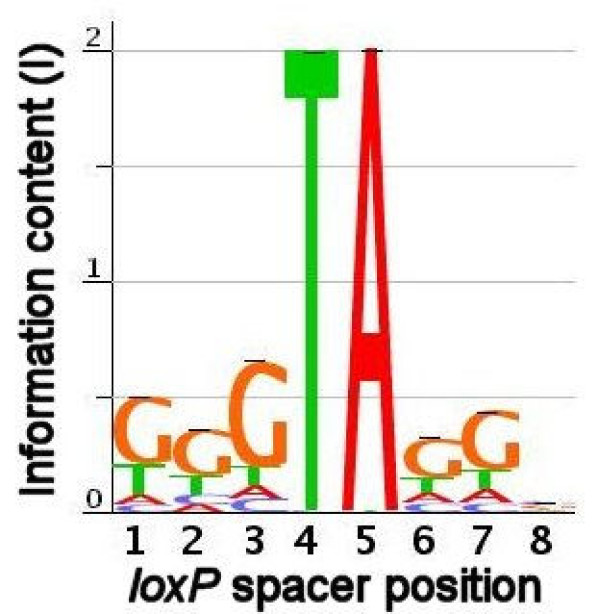
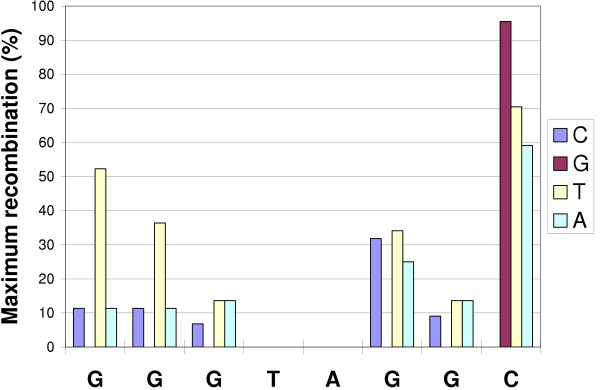
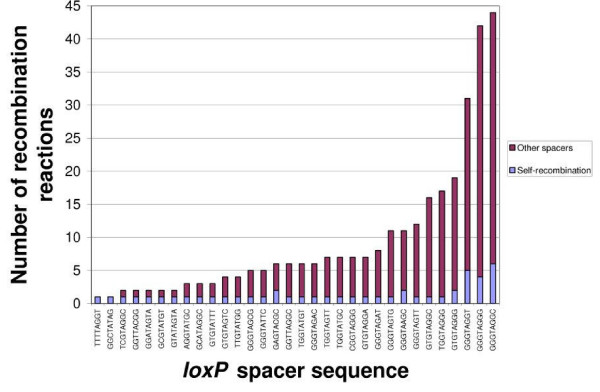
We created synthetic loxP oligonucleotides that contained a combination of inverted repeat mutations (the lox66 and lox71 mutations) and mutant spacer sequences, degenerate at 6 of the 8 positions. After in vitro Cre recombination, 3,124 recombinant clones were identified by sequencing. Included in this set were 31 unique, novel, self-recombining sequences. Using network visualization tools, we recognized 12 spacer sets with restricted promiscuity. We observed that increased guanine content at all spacer positions save for position 8 resulted in increased recombination. Interestingly, recombination between identical spacers was not preferred over non-identical spacers. We also identified a set of 16 pairs of loxP spacers that reacted at least twice with another spacer, but not themselves. Further, neither the wild-type P1 phage loxP sequence nor any of the known loxP spacer mutants appeared to be kinetically favoured by Cre recombinase.
This study approached loxP spacer mutant screening in an unbiased manner, assuming nothing about candidate loxP sites save for the conserved 4 and 5 spacer positions. Candidate sites were free to recombine with any other sequence in the pool of all possible sites. The subset of loxP sites identified here are candidates for in vivo serial recombination as they have already demonstrated limited promiscuity with other loxP spacer and stability in the presence of Cre.
Cre-loxP重组是指由两个loxP序列和Cre重组酶蛋白介导的位点特异性重组过程。转基因实验利用整合重组,即携带loxP位点和目的DNA的供体质粒整合到目标基因组中的受体loxP位点。不幸的是,整合重组效率极低,因为插入片段两侧是两个loxP位点,它们自身会成为Cre的作用靶点,导致插入片段随后被切除。在loxP序列的部分区域,特别是间隔区和反向重复序列段,发现了一些可提高整合重组效率的突变。在本研究中,我们引入了一种高通量体外检测方法,以快速检测新型loxP间隔区突变体,并描述成功重组体的序列特征。
我们创建了合成的loxP寡核苷酸,其包含反向重复突变(lox66和lox71突变)和突变间隔区序列的组合,在8个位置中的6个位置是简并的。体外Cre重组后,通过测序鉴定出3124个重组克隆。其中包括31个独特的、新型的、自我重组序列。使用网络可视化工具,我们识别出12个具有有限混杂性的间隔区组。我们观察到,除第8位外,所有间隔区位置鸟嘌呤含量的增加都会导致重组增加。有趣的是,相同间隔区之间的重组并不比不同间隔区之间的重组更受青睐。我们还鉴定出一组16对loxP间隔区,它们与另一个间隔区至少反应两次,但自身不反应。此外,野生型P1噬菌体loxP序列和任何已知的loxP间隔区突变体似乎都没有受到Cre重组酶的动力学偏好。
本研究以无偏倚的方式进行loxP间隔区突变体筛选,除保留保守的间隔区4和5位置外,对候选loxP位点不做任何假设。候选位点可与所有可能位点库中的任何其他序列自由重组。此处鉴定出的loxP位点子集是体内连续重组的候选者,因为它们已证明与其他loxP间隔区的混杂性有限,且在Cre存在下具有稳定性。