Kaivo-oja Noora, Jeffery Luke A, Ritvos Olli, Mottershead David G
Programme for Developmental and Reproductive Biology, Biomedicum Helsinki, University of Helsinki, Helsinki, Finland.
Reprod Biol Endocrinol. 2006 Apr 12;4:21. doi: 10.1186/1477-7827-4-21.
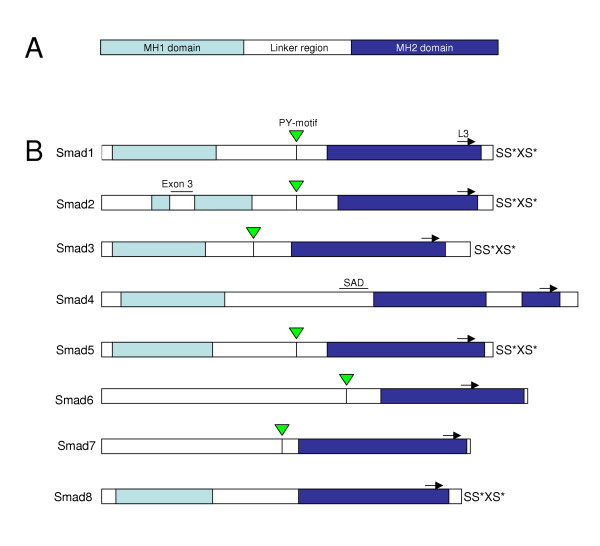
It has now been a decade since the first discovery of the intracellular Smad proteins, the downstream signalling molecules of one of the most important growth factor families in the animal kingdom, the transforming growth factor beta (TGF-beta) superfamily. In the ovary, several TGF-beta superfamily members are expressed by the oocyte, granulosa and thecal cells at different stages of folliculogenesis, and they signal mainly through two different Smad pathways in an autocrine/paracrine manner. Defects in the upstream signalling cascade molecules, the ligands and receptors, are known to have adverse effects on ovarian organogenesis and folliculogenesis, but the role of the individual Smad proteins in the proper function of the ovary is just beginning to be understood for example through the use of Smad knockout models. Although most of the different Smad knockouts are embryonic lethal, it is known, however, that in Smad1 and Smad5 knockout mice primordial germ cell development is impaired and that Smad3 deficient mice harbouring a deletion in exon 8 exhibit impaired folliculogenesis and reduced fertility. In this minireview we discuss the role of Smad structure and function in the ovarian context.
自首次发现细胞内Smad蛋白以来,已经过去了十年。Smad蛋白是动物界最重要的生长因子家族之一——转化生长因子β(TGF-β)超家族的下游信号分子。在卵巢中,几种TGF-β超家族成员在卵泡发生的不同阶段由卵母细胞、颗粒细胞和卵泡膜细胞表达,它们主要通过两种不同的Smad途径以自分泌/旁分泌方式发出信号。已知上游信号级联分子、配体和受体的缺陷会对卵巢器官发生和卵泡发生产生不利影响,但例如通过使用Smad基因敲除模型,人们才刚刚开始了解单个Smad蛋白在卵巢正常功能中的作用。尽管大多数不同的Smad基因敲除会导致胚胎致死,但已知在Smad1和Smad5基因敲除小鼠中,原始生殖细胞发育受损,而在第8外显子缺失的Smad3缺陷小鼠中,卵泡发生受损且生育力降低。在这篇小型综述中,我们讨论了Smad结构和功能在卵巢中的作用。