Hu Zonglin, Zhang Aixia, Storz Gisela, Gottesman Susan, Leppla Stephen H
Bacterial Toxins and Therapeutics Section, National Institute of Allergy and Infectious Diseases, National Institutes of Health, Bethesda, MD 20892, USA.
Nucleic Acids Res. 2006 Apr 13;34(7):e52. doi: 10.1093/nar/gkl142.
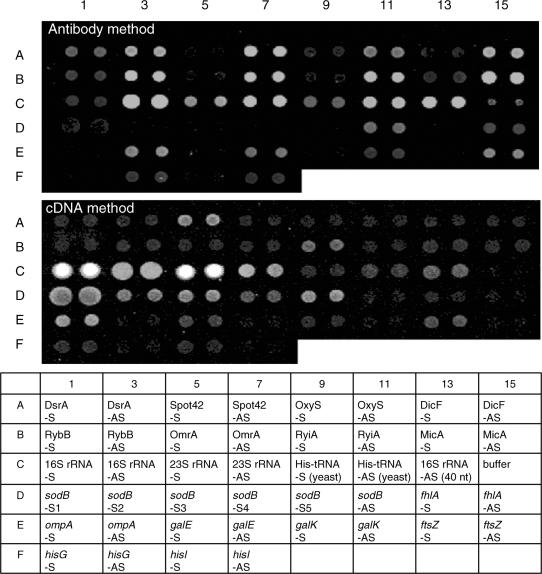
Detection of RNAs on microarrays is rapidly becoming a standard approach for molecular biologists. However, current methods frequently discriminate against structured and/or small RNA species. Here we present an approach that bypasses these problems. Unmodified RNA is hybridized directly to DNA microarrays and detected with the high-affinity, nucleotide sequence-independent, DNA/RNA hybrid-specific mouse monoclonal antibody S9.6. Subsequent reactions with a fluorescently-labeled anti-mouse IgG antibody or biotin-labeled anti-mouse IgG together with fluorescently labeled streptavidin produces a signal that can be measured in a standard microarray scanner. The antibody-based method was able to detect low abundance small RNAs of Escherichia coli much more efficiently than the commonly-used cDNA-based method. A specific small RNA was detected in amounts of 0.25 fmol (i.e. concentration of 10 pM in a 25 microl reaction). The method is an efficient, robust and inexpensive technique that allows quantitative analysis of gene expression and does not discriminate against short or structured RNAs.
在微阵列上检测RNA正迅速成为分子生物学家的标准方法。然而,目前的方法常常对结构化和/或小RNA种类存在歧视。在此,我们提出一种绕过这些问题的方法。未修饰的RNA直接与DNA微阵列杂交,并用高亲和力、不依赖核苷酸序列、针对DNA/RNA杂交体的小鼠单克隆抗体S9.6进行检测。随后与荧光标记的抗小鼠IgG抗体或生物素标记的抗小鼠IgG以及荧光标记的链霉亲和素反应,产生一个可在标准微阵列扫描仪中测量的信号。基于抗体的方法比常用的基于cDNA的方法能更有效地检测大肠杆菌中低丰度的小RNA。一种特定的小RNA能以0.25飞摩尔的量被检测到(即在25微升反应中的浓度为10皮摩尔)。该方法是一种高效、稳健且廉价的技术,可对基因表达进行定量分析,且不歧视短RNA或结构化RNA。