Han Tae Hee, Chey Myoung Jae, Han Kyou Sup
Department of Laboratory Medicine and Pediatrics, Inje University Sanggye Paik Hospital, Seoul, Korea.
J Korean Med Sci. 2006 Apr;21(2):351-4. doi: 10.3346/jkms.2006.21.2.351.
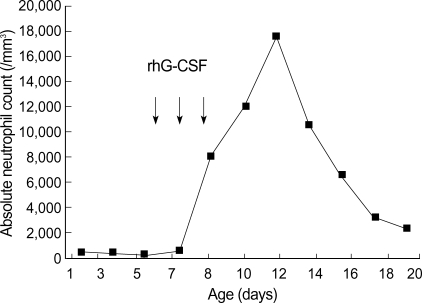
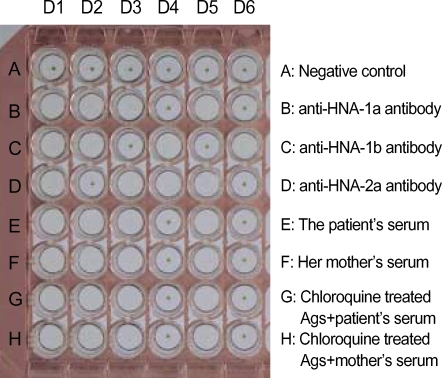
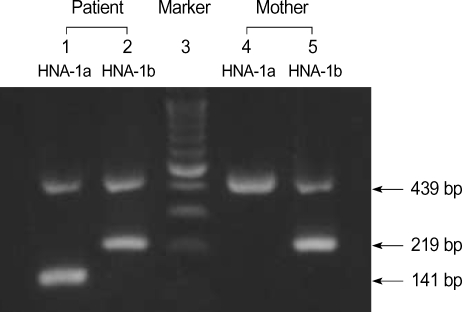
Neonatal alloimmune neutropenia (NAN) is an uncommon disease of the newborn provoked by the maternal production of neutrophil-specific alloantibodies, whereby neutrophil IgG antibodies cross the placenta and induce the destruction of fetal neutrophils. Affected newborns are usually identified by the occurrence of bacterial infections. The most frequent antigens involved in NAN are the human neutrophil antigen-1a (HNA-1a), HNA-1b, and HNA-2a. We report a neonate who was delivered at 36 weeks and had a severe neutropenia but who responded well to recombinant human granulocyte colony-stimulating factor (rhG-CSF). Anti-HNA-1a antibody was identified by mixed passive hemagglutination assay in both the sera of the baby and the mother. The baby had HNA-1a and HNA-1b but the mother had only HNA-1b on granulocytes. This is the first Korean report of NAN in which the specificity of the causative antibody was identified.
新生儿同种免疫性中性粒细胞减少症(NAN)是一种由母体产生中性粒细胞特异性同种抗体引发的新生儿罕见疾病,在此过程中,中性粒细胞IgG抗体穿过胎盘并导致胎儿中性粒细胞被破坏。受影响的新生儿通常因细菌感染而被发现。NAN中最常见的相关抗原是人类中性粒细胞抗原-1a(HNA-1a)、HNA-1b和HNA-2a。我们报告了一名36周出生的新生儿,其患有严重的中性粒细胞减少症,但对重组人粒细胞集落刺激因子(rhG-CSF)反应良好。通过混合被动血凝试验在婴儿和母亲的血清中均鉴定出了抗HNA-1a抗体。婴儿粒细胞上有HNA-1a和HNA-1b,而母亲粒细胞上仅有HNA-1b。这是韩国首例确定了致病抗体特异性的NAN报告。