Miyasaka Nobuyuki, Takeuchi Tsutomu, Eguchi Katsumi
Department of Medicine and Rheumatology, Graduate School, Tokyo Medical and Dental University, 1-5-45 Yushima, Bunkyo-ku, Tokyo, 113-8519, Japan.
Mod Rheumatol. 2006;16(2):63-7. doi: 10.1007/s10165-006-0457-7.
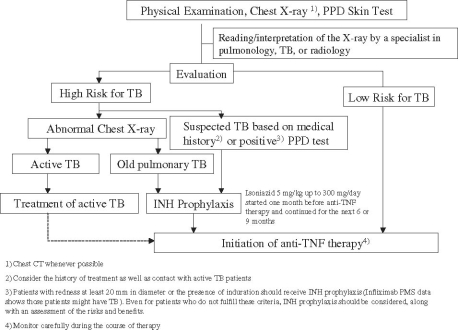
Application of biological agents targeting inflammatory cytokines such as tumor necrosis factor-alpha (TNF-alpha) dramatically caused a paradigm shift in the treatment of rheumatoid arthritis (RA). Infliximab, a chimeric anti-TNF-alpha monoclonal antibody, has initially been introduced to Japan in 2003 and shown to be dramatically effective in alleviating arthritis refractory to conventional treatment. However, serious adverse events such as bacterial pneumonia, tuberculosis, and Pneumocystis jiroveci pneumonia were reported to be in relatively high incidence; i.e., 2%, 0.3%, and 0.4%, respectively, in a strict postmarketing surveillance of an initial 4000 cases in Japan. Etancercept, a recombinant chimeric protein consisting of p75 TNF-alpha receptor and human IgG, was subsequently introduced to Japan in March of 2005. We therefore drew up treatment guidelines for the use of etanercept to avoid potential serous adverse events, since only approximately 150 cases have been included in the clinical study of etanercept in Japan. The guidelines were initially designed by the principal investigators (N.M, T.T., K.E.) of rheumatoid arthritis study groups of the Ministry of Health, Labor and Welfare (MHLW), Japan, and finally approved by the board of directors of the Japan College of Rheumatology. The MHLW assigned a duty to the pharmaceutical companies to perform a complete postmarketing surveillance of an initial 3000 cases to explore any adverse events, and this was performed according to the treatment guidelines shown in this article.
针对炎性细胞因子(如肿瘤坏死因子-α(TNF-α))的生物制剂的应用极大地改变了类风湿关节炎(RA)的治疗模式。英夫利昔单抗是一种嵌合抗TNF-α单克隆抗体,于2003年首次引入日本,已证明对缓解常规治疗无效的关节炎极为有效。然而,据报道,严重不良事件如细菌性肺炎、肺结核和耶氏肺孢子菌肺炎的发生率相对较高;即在日本对最初4000例病例进行的严格上市后监测中,分别为2%、0.3%和0.4%。依那西普是一种由p75 TNF-α受体和人IgG组成的重组嵌合蛋白,随后于2005年3月引入日本。由于在日本依那西普的临床研究中仅纳入了约150例病例,因此我们制定了依那西普使用的治疗指南,以避免潜在的严重不良事件。该指南最初由日本厚生劳动省(MHLW)类风湿关节炎研究组的主要研究者(N.M、T.T.、K.E.)制定,最终由日本风湿病学会董事会批准。厚生劳动省责成制药公司对最初3000例病例进行完整的上市后监测,以探索任何不良事件,这是根据本文所示的治疗指南进行的。