Sukocheva Olga, Wadham Carol, Holmes Andrew, Albanese Nathaniel, Verrier Emily, Feng Feng, Bernal Alex, Derian Claudia K, Ullrich Axel, Vadas Mathew A, Xia Pu
Signal Transduction Laboratory, Division of Human Immunology, Hanson Institute, Institute of Medical and Veterinary Science, Adelaide SA 5000, Australia.
J Cell Biol. 2006 Apr 24;173(2):301-10. doi: 10.1083/jcb.200506033.
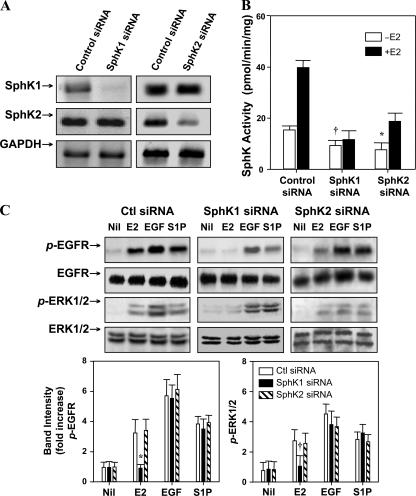
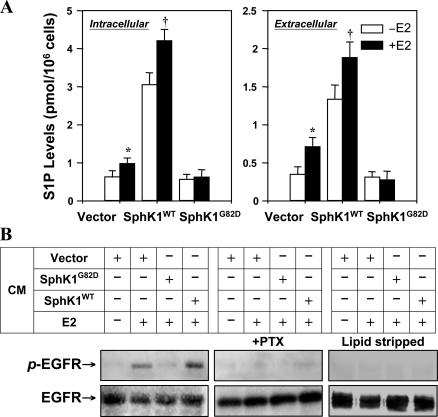
The transactivation of enhanced growth factor receptor (EGFR) by G protein-coupled receptor (GPCR) ligands is recognized as an important signaling mechanism in the regulation of complex biological processes, such as cancer development. Estrogen (E2), which is a steroid hormone that is intimately implicated in breast cancer, has also been suggested to function via EGFR transactivation. In this study, we demonstrate that E2-induced EGFR transactivation in human breast cancer cells is driven via a novel signaling system controlled by the lipid kinase sphingosine kinase-1 (SphK1). We show that E2 stimulates SphK1 activation and the release of sphingosine 1-phosphate (S1P), by which E2 is capable of activating the S1P receptor Edg-3, resulting in the EGFR transactivation in a matrix metalloprotease-dependent manner. Thus, these findings reveal a key role for SphK1 in the coupling of the signals between three membrane-spanning events induced by E2, S1P, and EGF. They also suggest a new signal transduction model across three individual ligand-receptor systems, i.e., "criss-cross" transactivation.
G蛋白偶联受体(GPCR)配体对增强型生长因子受体(EGFR)的反式激活被认为是调节复杂生物学过程(如癌症发展)中的一种重要信号传导机制。雌激素(E2)作为一种与乳腺癌密切相关的甾体激素,也被认为可通过EGFR反式激活发挥作用。在本研究中,我们证明了人乳腺癌细胞中E2诱导的EGFR反式激活是由脂质激酶鞘氨醇激酶-1(SphK1)控制的新型信号系统驱动的。我们发现E2刺激SphK1激活和鞘氨醇-1-磷酸(S1P)的释放,通过这种方式E2能够激活S1P受体Edg-3,从而以基质金属蛋白酶依赖性方式导致EGFR反式激活。因此,这些发现揭示了SphK1在E2、S1P和EGF诱导的三个跨膜事件之间的信号偶联中的关键作用。它们还提出了一个跨越三个独立配体-受体系统的新信号转导模型,即“交叉”反式激活。