Ariey Frédéric, Fandeur Thierry, Durand Remy, Randrianarivelojosia Milijaona, Jambou Ronan, Legrand Eric, Ekala Marie Thérèse, Bouchier Christiane, Cojean Sandrine, Duchemin Jean Bernard, Robert Vincent, Le Bras Jacques, Mercereau-Puijalon Odile
Institut Pasteur du Cambodge, Phnom-Penh, Cambodia.
Malar J. 2006 Apr 26;5:34. doi: 10.1186/1475-2875-5-34.
Because of its dramatic public health impact, Plasmodium falciparum resistance to chloroquine (CQ) has been documented early on. Chloroquine-resistance (CQR) emerged in the late 1950's independently in South East Asia and South America and progressively spread over all malaria areas. CQR was reported in East Africa in the 1970's, and has since invaded the African continent. Many questions remain about the actual selection and spreading process of CQR parasites, and about the evolution of the ancestral mutant gene(s) during spreading.
Eleven clinical isolates of P. falciparum from Cambodia and 238 from Africa (Senegal, Ivory Coast, Bukina Faso, Mali, Guinea, Togo, Benin, Niger, Congo, Madagascar, Comoros Islands, Tanzania, Kenya, Mozambique, Cameroun, Gabon) were collected during active case detection surveys carried out between 1996 and 2001. Parasite DNA was extracted from frozen blood aliquots and amplification of the gene pfcrt exon 2 (codon 72-76), exon 4 and intron 4 (codon 220 and microsatellite marker) were performed. All fragments were sequenced.
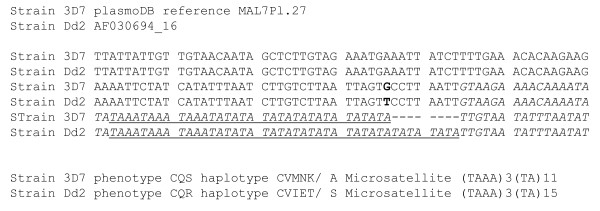
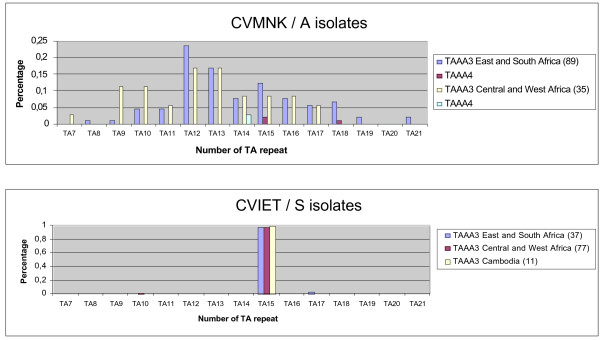
124 isolates with a sensitive (c76/c220:CVMNK/A) haplotype and 125 isolates with a resistant c76/c220:CVIET/S haplotype were found. The microsatellite showed 17 different types in the isolates carrying the c76/c220:CVMNK/A haplotype while all 125 isolates with a CVIET/S haplotype but two had a single microsatellite type, namely (TAAA)3(TA)15, whatever the location or time of collection.
Those results are consistent with the migration of a single ancestral pfcrt CQR allele from Asia to Africa. This is related to the importance of PFCRT in the fitness of P. falciparum point out this protein as a potential target for developments of new antimalarial drugs.
由于其对公共卫生产生巨大影响,恶性疟原虫对氯喹(CQ)的耐药性很早就有记载。氯喹耐药性(CQR)于20世纪50年代末在东南亚和南美洲独立出现,并逐渐蔓延至所有疟疾流行地区。20世纪70年代在东非报告了CQR,此后已侵入非洲大陆。关于CQR寄生虫的实际选择和传播过程,以及传播过程中祖先突变基因的进化,仍有许多问题。
在1996年至2001年期间进行的主动病例检测调查中,收集了11株来自柬埔寨的恶性疟原虫临床分离株和238株来自非洲(塞内加尔、象牙海岸、布基纳法索、马里、几内亚、多哥、贝宁、尼日尔、刚果、马达加斯加、科摩罗群岛、坦桑尼亚、肯尼亚、莫桑比克、喀麦隆、加蓬)的分离株。从冷冻血液样本中提取寄生虫DNA,并对基因pfcrt外显子2(密码子72 - 76)、外显子4和内含子4(密码子220和微卫星标记)进行扩增。对所有片段进行测序。
发现124株具有敏感(c76/c220:CVMNK/A)单倍型的分离株和125株具有耐药c76/c220:CVIET/S单倍型的分离株。微卫星在携带c76/c220:CVMNK/A单倍型的分离株中显示出17种不同类型,而所有125株具有CVIET/S单倍型的分离株(除两株外)具有单一微卫星类型,即(TAAA)3(TA)15,无论收集地点或时间如何。
这些结果与单个祖先pfcrt CQR等位基因从亚洲迁移到非洲一致。这与PFCRT在恶性疟原虫适应性中的重要性相关,指出该蛋白是开发新型抗疟药物的潜在靶点。