Yahya-Malima Khadija I, Olsen Bjørg E, Matee Mecky I, Fylkesnes Knut
Centre for International Health, University of Bergen, Bergen, Norway.
BMC Public Health. 2006 Apr 27;6:109. doi: 10.1186/1471-2458-6-109.
Many national antenatal clinics (ANC) based HIV surveillance systems in sub-Saharan Africa have limited coverage of remote rural sites, a weakness that compromises adequate estimation, monitoring and development of effective preventive and care programmes. To address this void in rural Manyara and Singida within Northern Tanzania, we conducted antenatal clinic-based sentinel surveillance.
We consecutively enrolled 1377 counselled and consenting pregnant women attending ANC clinics for the first time during the current pregnancy. The study was conducted in six antenatal clinics, within three divisions of rural Manyara and Singida regions in 2003/2004. Interviews were conducted and blood samples for routine purposes were collected and tested for anti-HIV IgG antibody anonymously, using Bionor HIV-1 & 2 assay.
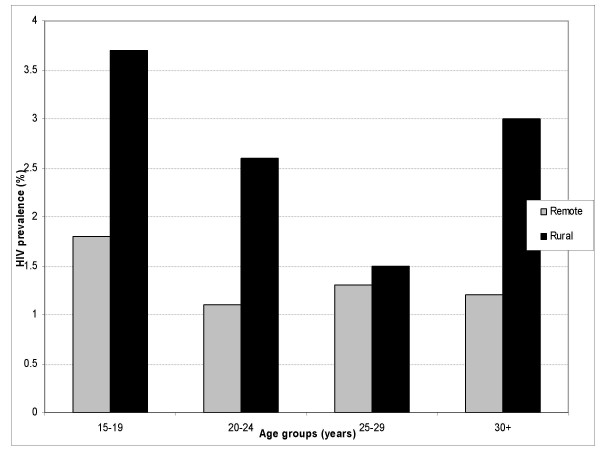
Among enrollees, 94% (1296/1377) participated fully. The overall prevalence of HIV was 2.0% (95%CI: 1.34-2.97). The highest HIV prevalence was among women aged between 15-19 years in both rural and remote rural populations. The odds of HIV infection was 4.3 (95%CI: 1.42-12.77) times among women reporting more than one lifetime sexual partners compared with those with one partner. HIV infection was associated with history of genital sores or foul smelling discharge, OR 6.8 (95%CI: 2.78-16.66) and age at first pregnancy (2.5 times higher likelihood of infection if before the age of 18 years versus at a later age).
Including rural remote sites, as part of the national ANC routine surveillance, is crucial in order to discover imminent silent epidemics such as the one described in this paper. Scaling up HIV prevention efforts is mandatory to prevent the imminent escalation of the HIV epidemic highly associated with a history of sexually transmitted infections (STIs), multiple sexual partners and pregnancies at a younger age. Ignorance of relevant knowledge and low utilisation of condoms underscores the urgency for large-scale preventive efforts. Research to capture a wider representation of the risk factors in the general population should be a priority to enable further customised HIV prevention efforts.
撒哈拉以南非洲许多基于国家产前诊所(ANC)的艾滋病毒监测系统对偏远农村地区的覆盖有限,这一弱点影响了对有效预防和护理项目的充分评估、监测及开展。为填补坦桑尼亚北部曼亚拉和辛吉达农村地区的这一空白,我们开展了基于产前诊所的哨点监测。
我们连续招募了1377名在本次孕期首次前往ANC诊所咨询并同意参与的孕妇。该研究于2003/2004年在曼亚拉和辛吉达农村地区三个分区的六家产前诊所进行。进行了访谈,并采集了用于常规目的的血样,使用Bionor HIV-1 & 2检测法对其进行匿名的抗HIV IgG抗体检测。
在登记参与者中,94%(1296/1377)完全参与。艾滋病毒总体流行率为2.0%(95%置信区间:1.34 - 2.97)。在农村和偏远农村人口中,艾滋病毒流行率最高的是年龄在15 - 19岁之间的女性。报告有多个性伴侣的女性感染艾滋病毒的几率是只有一个性伴侣女性的4.3倍(95%置信区间:1.42 - 12.77)。艾滋病毒感染与生殖器溃疡或有异味分泌物病史相关,比值比为6.8(95%置信区间:2.78 - 16.66),以及首次怀孕年龄(18岁之前怀孕相比之后怀孕感染可能性高2.5倍)。
将农村偏远地区纳入国家ANC常规监测的一部分,对于发现本文所述的此类潜在隐匿性流行至关重要。扩大艾滋病毒预防工作势在必行,以防止与性传播感染(STIs)病史、多个性伴侣及年轻时怀孕高度相关的艾滋病毒流行迅速升级。对相关知识的无知和避孕套的低使用率凸显了大规模预防工作的紧迫性。开展研究以更广泛地反映一般人群中的风险因素应成为优先事项,以便进一步定制艾滋病毒预防工作。