Davies Jeannette E, Huang Carol, Proschel Christoph, Noble Mark, Mayer-Proschel Margot, Davies Stephen J A
Department of Neurosurgery, Baylor College of Medicine, 1709 Dryden Street, Suite 750, Houston, Texas 77030, USA.
J Biol. 2006;5(3):7. doi: 10.1186/jbiol35. Epub 2006 Apr 27.
Transplantation of embryonic stem or neural progenitor cells is an attractive strategy for repair of the injured central nervous system. Transplantation of these cells alone to acute spinal cord injuries has not, however, resulted in robust axon regeneration beyond the sites of injury. This may be due to progenitors differentiating to cell types that support axon growth poorly and/or their inability to modify the inhibitory environment of adult central nervous system (CNS) injuries. We reasoned therefore that pre-differentiation of embryonic neural precursors to astrocytes, which are thought to support axon growth in the injured immature CNS, would be more beneficial for CNS repair.
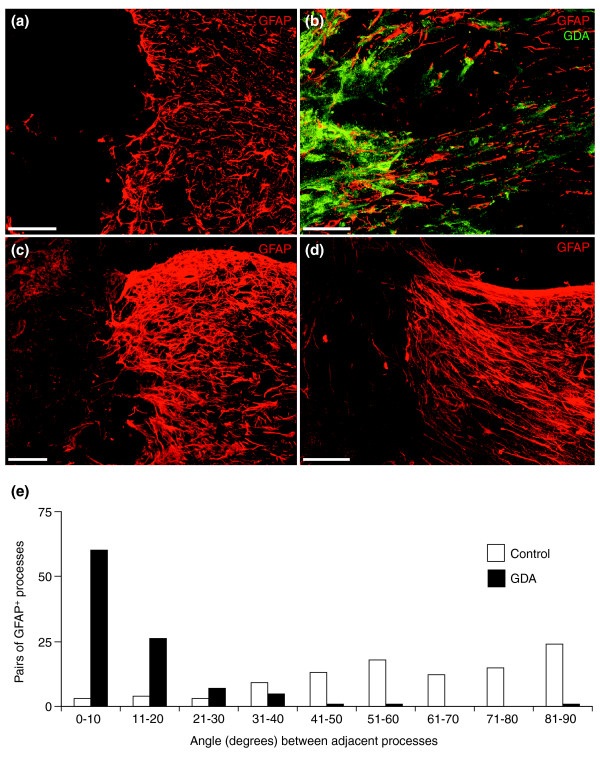
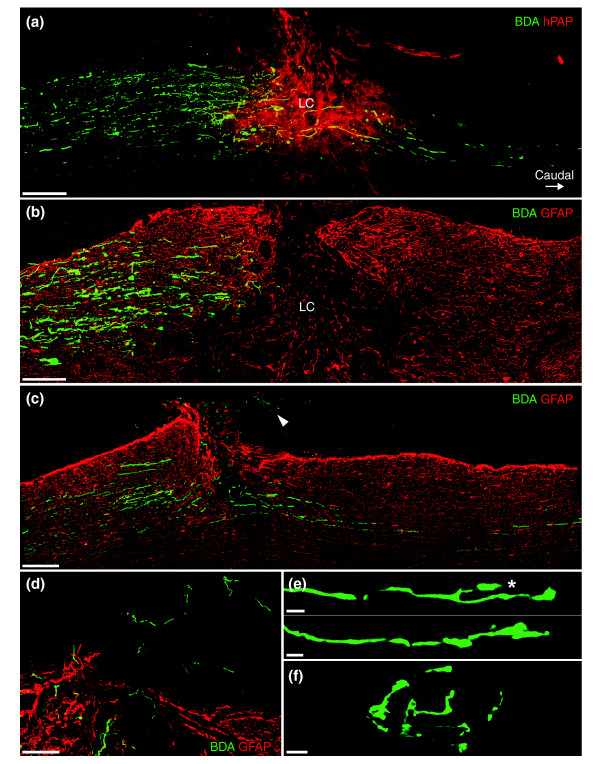
Transplantation of astrocytes derived from embryonic glial-restricted precursors (GRPs) promoted robust axon growth and restoration of locomotor function after acute transection injuries of the adult rat spinal cord. Transplantation of GRP-derived astrocytes (GDAs) into dorsal column injuries promoted growth of over 60% of ascending dorsal column axons into the centers of the lesions, with 66% of these axons extending beyond the injury sites. Grid-walk analysis of GDA-transplanted rats with rubrospinal tract injuries revealed significant improvements in locomotor function. GDA transplantation also induced a striking realignment of injured tissue, suppressed initial scarring and rescued axotomized CNS neurons with cut axons from atrophy. In sharp contrast, undifferentiated GRPs failed to suppress scar formation or support axon growth and locomotor recovery.
Pre-differentiation of glial precursors into GDAs before transplantation into spinal cord injuries leads to significantly improved outcomes over precursor cell transplantation, providing both a novel strategy and a highly effective new cell type for repairing CNS injuries.
胚胎干细胞或神经祖细胞移植是修复受损中枢神经系统的一种有吸引力的策略。然而,将这些细胞单独移植到急性脊髓损伤处并未导致损伤部位以外的强劲轴突再生。这可能是由于祖细胞分化为对轴突生长支持不佳的细胞类型,和/或它们无法改变成体中枢神经系统(CNS)损伤的抑制环境。因此,我们推断将胚胎神经前体细胞预分化为星形胶质细胞,这种细胞被认为在未成熟的受损CNS中支持轴突生长,对CNS修复可能更有益。
源自胚胎神经胶质限制前体细胞(GRPs)的星形胶质细胞移植促进了成年大鼠脊髓急性横断损伤后强劲的轴突生长和运动功能恢复。将GRP衍生的星形胶质细胞(GDAs)移植到背柱损伤处,促进了超过60%的上升背柱轴突向损伤中心生长,其中66%的轴突延伸到损伤部位之外。对接受GDA移植的红核脊髓束损伤大鼠进行网格行走分析,结果显示其运动功能有显著改善。GDA移植还引起了损伤组织的显著重新排列,抑制了初期瘢痕形成,并挽救了轴突被切断的CNS神经元,使其免于萎缩。与之形成鲜明对比的是,未分化的GRPs未能抑制瘢痕形成,也无法支持轴突生长和运动功能恢复。
在移植到脊髓损伤部位之前,将神经胶质前体细胞预分化为GDAs,与祖细胞移植相比,能显著改善治疗效果,为修复CNS损伤提供了一种新策略和一种高效的新型细胞类型。