Beck Julia, Bornemann-Kolatzki Kirsten, Knorr Christoph, Taeubert Helge, Brenig Bertram
Institute of Veterinary Medicine, Georg-August-University Goettingen, Burckhardtweg 2, 37077 Goettingen, Germany.
BMC Vet Res. 2006 Apr 28;2:14. doi: 10.1186/1746-6148-2-14.
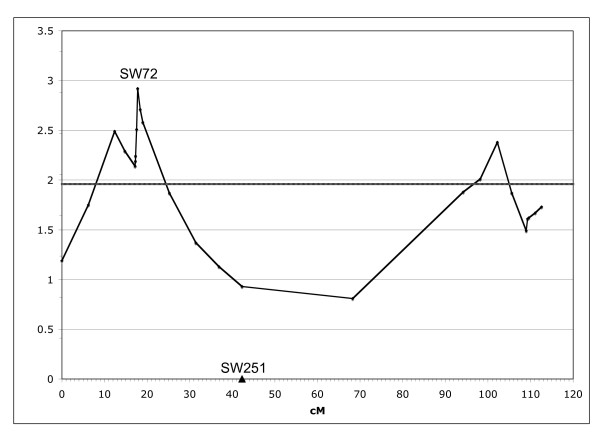
Inguinal hernias are usually caused by a congenital defect, which occurs as a weakness of the inguinal canal. Porcine beta-glucuronidase gene (GUSB) was chosen as functional candidate gene because of its involvement in degradation of hyaluronan within gubernacular tissue during descent of testes. Since a genome-wide linkage analysis approach has shown evidence that two regions on porcine chromosome 3 (SSC 3) are involved in the inheritance of hernia inguinalis/scrotalis in German pig breeds, GUSB also attained status as a positional candidate gene by its localization within a hernia-associated chromosomal region.
A contig spanning 17,157 bp, which contains the entire GUSB, was assembled. Comparative sequence analyses were conducted for the GUSB gene locus. Single nucleotide polymorphisms (SNPs) located within the coding region of GUSB were genotyped in 512 animals. Results of transmission disequilibrium test (TDT) for two out of a total of five detected SNPs gave no significant association with the outcome of hernia in pigs.
On the basis of our studies we are able to exclude the two analyzed SNPs within the porcine GUSB gene as causative for the transmission of inguinal hernia.
腹股沟疝通常由先天性缺陷引起,这种缺陷表现为腹股沟管的薄弱。猪β-葡萄糖醛酸酶基因(GUSB)因其在睾丸下降过程中参与鞘膜组织内透明质酸的降解而被选为功能候选基因。由于全基因组连锁分析方法已表明猪3号染色体(SSC 3)上的两个区域参与德国猪种腹股沟/阴囊疝的遗传,GUSB因其定位于与疝相关的染色体区域也成为一个位置候选基因。
组装了一个跨越17157 bp的重叠群,其中包含整个GUSB。对GUSB基因座进行了比较序列分析。在512只动物中对位于GUSB编码区内的单核苷酸多态性(SNP)进行了基因分型。在总共检测到的5个SNP中,有2个的传递不平衡测试(TDT)结果与猪疝的发生无显著关联。
根据我们的研究,我们能够排除猪GUSB基因内分析的两个SNP作为腹股沟疝传递的病因。