Station de Génétique Végétale, Institut National de la Recherche Agronomique-Centre National de la Recherche Scientifique-Université Paris Sud, La Ferme du Moulon, 91190 Gif-sur-Yvette, France.
Plant Physiol. 1992 Nov;100(3):1486-93. doi: 10.1104/pp.100.3.1486.
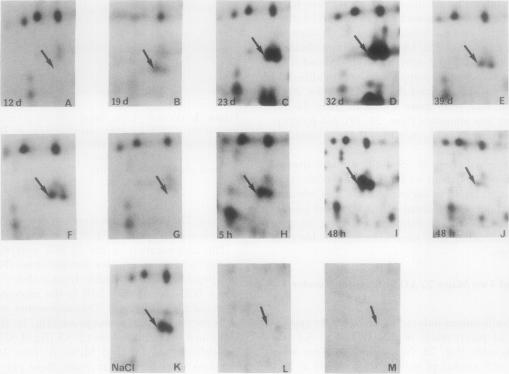
Under progressive drought stress, Brassica napus displays differential leaf modifications. The oldest leaves, developed before the onset of water deficit, wilt gradually, whereas the youngest leaves harden. Hardening was distinguished by leaf turgor and bluish wax bloom when the shoot water potential was below -3 MPa and the leaf water saturation deficit was about 60%. This adaptive change was accompanied by modifications in two-dimensional protein profiles. Ten percent of the polypeptides had altered abundance or were unique to drought-stressed plants. Two-dimensional analysis of in vitro translation products did not reveal a general decrease in mRNA population. A 22-kD double polypeptide was increased by progressive or rapid water stress and salinity and disappeared upon rehydration. These polypeptides have a common N-terminal sequence, which does not reveal homology with any known water-stress protein but which contains the signature motif of soybean Künitz trypsin inhibitors. Immunoprecipitation allowed these polypeptides to be identified on two-dimensional gels of in vitro translation products. They appeared to be synthesized as a 24-kD precursor, and their transcript was present in the control well-watered leaves, where the polypeptides were never detected, indicating a possible translational regulation. A putative function of this protein, named BnD22, in the retardation of drought-induced leaf senescence is discussed.
在渐进性干旱胁迫下,油菜表现出不同的叶片修饰。在水分亏缺发生之前发育的最老叶片逐渐萎蔫,而最年轻的叶片变硬。当茎水势低于-3 MPa 且叶片水饱和亏缺约 60%时,硬化表现为叶片膨压和略带蓝色的蜡状光泽。这种适应性变化伴随着二维蛋白质图谱的改变。10%的多肽丰度发生改变或仅存在于受干旱胁迫的植物中。体外翻译产物的二维分析并未显示 mRNA 群体普遍减少。22-kD 双多肽被渐进性或快速水分胁迫和盐胁迫增加,并在复水时消失。这些多肽具有共同的 N 端序列,与任何已知的水分胁迫蛋白没有同源性,但含有大豆 Kunitz 胰蛋白酶抑制剂的特征模体。免疫沉淀允许在体外翻译产物的二维凝胶上鉴定这些多肽。它们似乎作为 24-kD 前体被合成,并且它们的转录本存在于对照的充分浇水的叶片中,在那里从未检测到这些多肽,这表明可能存在翻译调控。讨论了这种名为 BnD22 的蛋白质在延缓干旱诱导的叶片衰老中的潜在功能。