Mozafar A, Goodin J R
Department of Agronomy, University of California, Riverside, California 92502.
Plant Physiol. 1970 Jan;45(1):62-5. doi: 10.1104/pp.45.1.62.
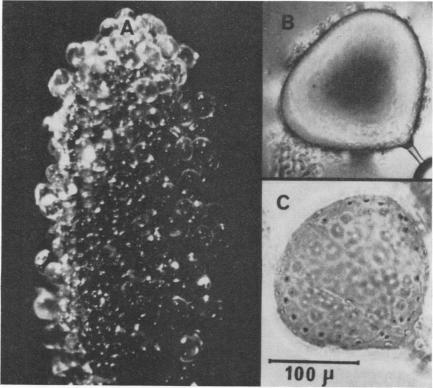
The concentration of salts in the vesiculated hairs of Atriplex halimus L. was measured and was remarkably higher than that of the leaf sap and xylem exudate. In spite of their unusually high salt content, these hairs when immersed seemed unable to absorb water, in apparent contradiction to the previously held hypothesis that vesiculated hairs make it possible for such plants to absorb water from the atmosphere. Although growing the plants under saline conditions increased the salt content of the hairs from 2.3 m Na+K to 11.6 m, salt content of the expressed leaf sap from young leaves did not change significantly. This observation indicates that in A. halimus the vesiculated hairs play a significant role in removing salt from the remainder of the leaf and preventing the accumulation of toxic salts in the parenchyma and vascular tissues. Thus, a nearly constant salt content is maintained in leaf cells other than the hairs.
对滨藜叶滨藜泡状毛中的盐分浓度进行了测量,其浓度显著高于叶汁和木质部渗出液。尽管这些毛的含盐量异常高,但浸泡时它们似乎无法吸收水分,这显然与之前认为泡状毛使这类植物能够从大气中吸收水分的假设相矛盾。虽然在盐胁迫条件下种植植物会使毛中的盐分含量从2.3 m Na⁺+K增加到11.6 m,但幼叶中挤出的叶汁盐分含量并未显著变化。这一观察结果表明,在滨藜叶滨藜中,泡状毛在从叶片其他部分去除盐分以及防止薄壁组织和维管组织中有毒盐分积累方面发挥着重要作用。因此,除了毛之外的叶细胞中盐分含量几乎保持恒定。