Shayk M, Kolattukudy P E
Department of Agricultural Chemistry and Program in Biochemistry and Biophysics, Washington State University, Pullman, Washington 99164.
Plant Physiol. 1977 Dec;60(6):907-15. doi: 10.1104/pp.60.6.907.
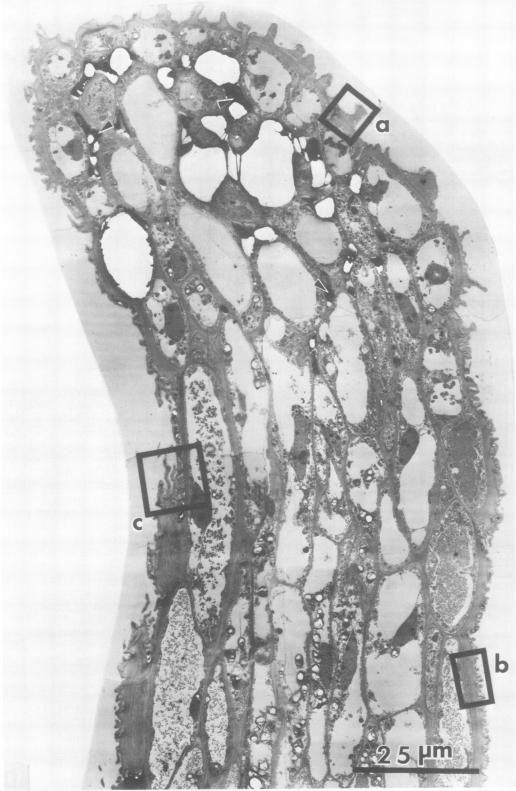
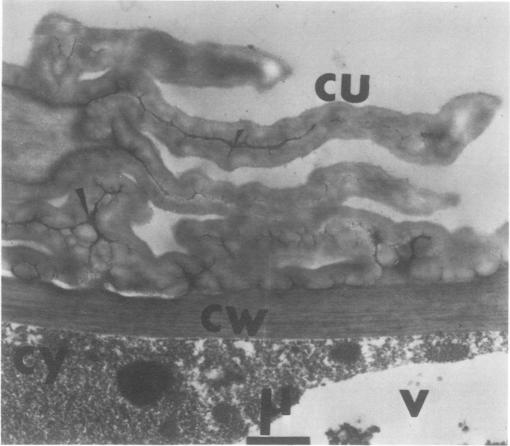
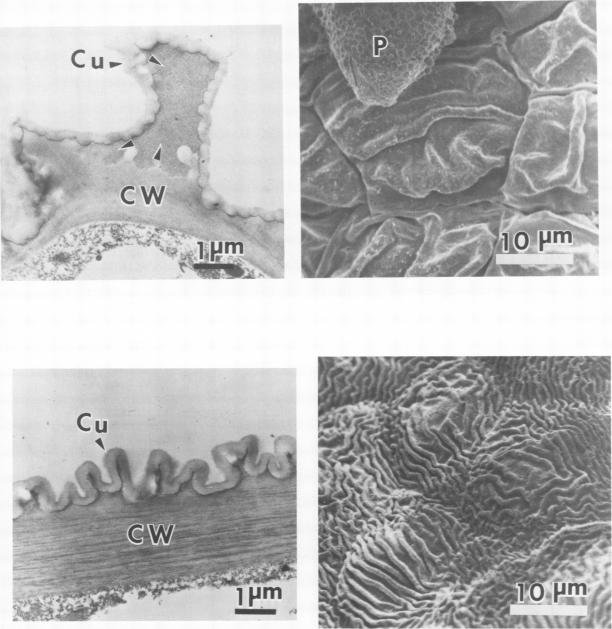
Germinating nasturtium pollen (Tropaeolum majus) is shown to excrete an enzyme(s) which hydrolyzes all types of monomers from biosynthetically labeled cutin and p-nitrophenyl esters, which are model substrates for fungal cutinases. The pollen cutinase showed an optimum pH near 6.5 and was inhibited by thiol-directed reagents such as p-hydroxymercuribenzoate and N-ethyl maleimide but not by diisopropyl-fluorophosphate, an "active serine"-directed reagent indicating that the pollen enzyme is an "-SH cutinase" unlike the fungal enzyme which is a serine cutinase. Excretion of the pollen cutinase into the extracellular fluid was complete within 4 to 6 hours at 30 C. Since actinomycin D and cycloheximide showed little effect on the level of cutinase excreted, it appears that cutinase is an enzyme synthesized prior to germination. Release of cutinase into the medium did not require germination. Electron microscopy revealed the presence of a continuous cutin layer on mature stigma with extensive folds, which are proposed to play a role similar to that played by the cellular papillae found in the stigma of other plants. Chemical analysis of stigma cutin by depolymerization and combined gas-liquid chromatography and mass spectrometry showed that this cutin consists of mainly the C(16) family of acids. The major (70%) components were dihydroxy C(16) acids which consisted of 10,16- (64%), 9,16- (16%), 8,16- (12%), and 7,16- (8%) dihydroxy plamitic acid. Deuterium-labeling studies showed the presence of 16-oxo-9-hydroxy C(16) acid and 16-oxo-10-hydroxy C(16) acid in this cutin. The biochemical and ultrastructural studies indicate that the pollen tube may gain entry into stigma using cutinase excreted by the pollen.
研究表明,发芽的旱金莲花粉(旱金莲)能分泌一种酶,该酶可水解生物合成标记的角质和对硝基苯酯中的所有类型单体,对硝基苯酯是真菌角质酶的模型底物。花粉角质酶的最适pH接近6.5,受到对羟基汞苯甲酸和N - 乙基马来酰亚胺等巯基导向试剂的抑制,但不受二异丙基氟磷酸酯(一种“活性丝氨酸”导向试剂)的抑制,这表明花粉酶是一种“-SH角质酶”,与真菌的丝氨酸角质酶不同。在30℃下,花粉角质酶在4至6小时内完全分泌到细胞外液中。由于放线菌素D和环己酰亚胺对分泌的角质酶水平影响很小,因此角质酶似乎是发芽前合成的一种酶。角质酶释放到培养基中不需要发芽。电子显微镜显示成熟柱头上存在连续的角质层,有广泛的褶皱,推测其作用类似于其他植物柱头中发现的细胞乳头。通过解聚以及气相色谱 - 质谱联用对柱头角质进行化学分析表明,这种角质主要由C(16)酸家族组成。主要(70%)成分是二羟基C(16)酸,其中包括10,16 - (64%)、9,16 - (16%)、8,16 - (12%)和7,16 - (8%)二羟基棕榈酸。氘标记研究表明该角质中存在16 - 氧代 - 9 - 羟基C(16)酸和16 - 氧代 - 10 - 羟基C(16)酸。生化和超微结构研究表明,花粉管可能利用花粉分泌的角质酶进入柱头。