Kochian L V, Lucas W J
Department of Botany, University of California, Davis, California 95616.
Plant Physiol. 1983 Oct;73(2):208-15. doi: 10.1104/pp.73.2.208.
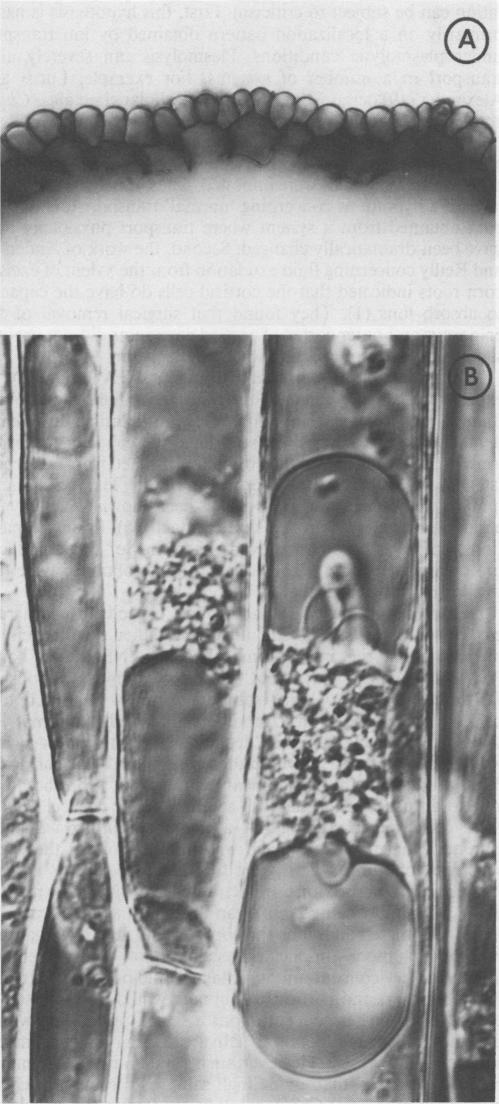
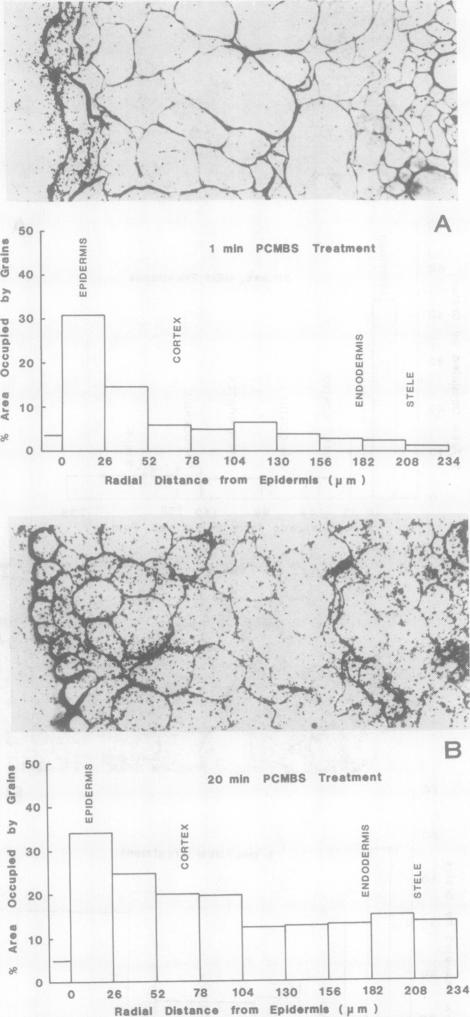
The relative transport capabilities of the cells of the root periphery and cortex were investigated using a variety of experimental techniques. Brief (30 seconds to 1 minute) exposures with the penetrating sulfhydryl reagent, N-ethyl maleimide (NEM), and the impermeant reagent, p-chloromercuribenzene sulfonic acid (PCMBS), dramatically reduced (86)Rb(+) (0.2 millimolar RbCl) uptake into 2 centimeter corn (Zea mays [A632 x (C3640 x Oh43)]) root segments. Autoradiographic localization studies with [(3)H]NEM and [(203)Hg]PCMBS demonstrated that, during short term exposures with either reagent, sulfhydryl binding occurred almost exclusively in the cells of the root periphery.Corn root cortical protoplasts were isolated, and exhibited significant K(+)((86)Rb(+)) influx. The kinetics for K(+) uptake were studied; the influx isotherms were smooth, nonsaturating curves that approached linearity at higher K(+)(Rb(+)) concentrations (above 1 millimolar K(+)). These kinetics were identical in shape to the complex kinetics previously observed for K(+) uptake in corn roots (Kochian, Lucas 1982 Plant Physiol 70: 1723-1731), and could be resolved into a saturable and a first order kinetic component.The existence of a hypodermal apoplastic barrier was investigated. The apoplastic, cell wall binding dye, Calcofluor White M2R, appeared to be excluded from the cortex by the hypodermis. However, experiments with damaged roots indicated that this result may be an artifact resulting from the binding of dye to the epidermal cell walls. Furthermore, [(203)Hg] PCMBS autoradiography demonstrated that the hypodermis was not a barrier to apoplastic movement of PCMBS.These results suggest that although cortical cells possess the capacity to absorb ions, K(+) influx at low concentrations is limited to the root periphery. Cortical cell uptake appears to be repressed under these conditions. At higher concentrations, cortical cells may function to absorb K(+). Such a model may involve regulation of cortical cell ion transport capacity.
利用多种实验技术研究了根外周细胞和皮层细胞的相对运输能力。用穿透性巯基试剂N - 乙基马来酰亚胺(NEM)和非渗透性试剂对氯汞苯磺酸(PCMBS)进行短暂(30秒至1分钟)处理,显著降低了2厘米长的玉米(Zea mays [A632 x (C3640 x Oh43)])根段对(86)Rb(+)(0.2毫摩尔RbCl)的吸收。用[(3)H]NEM和[(203)Hg]PCMBS进行的放射自显影定位研究表明,在用这两种试剂进行短期处理期间,巯基结合几乎只发生在根外周细胞中。分离出玉米根皮层原生质体,其表现出显著的K(+)((86)Rb(+))内流。研究了K(+)吸收的动力学;内流等温线是平滑的、非饱和曲线,在较高K(+)(Rb(+))浓度(高于1毫摩尔K(+))时接近线性。这些动力学在形状上与先前在玉米根中观察到的K(+)吸收的复杂动力学相同(Kochian,Lucas 1982 Plant Physiol 70: 1723 - 1731),并且可以分解为一个可饱和的和一个一级动力学成分。研究了内皮层质外体屏障的存在。质外体细胞壁结合染料荧光增白剂M2R似乎被内皮层排除在皮层之外。然而,对受损根的实验表明,这个结果可能是由于染料与表皮细胞壁结合而产生的假象。此外,[(203)Hg]PCMBS放射自显影表明,内皮层不是PCMBS质外体移动的屏障。这些结果表明,虽然皮层细胞具有吸收离子的能力,但低浓度下的K(+)内流仅限于根外周。在这些条件下,皮层细胞的吸收似乎受到抑制。在较高浓度下,皮层细胞可能起到吸收K(+)的作用。这样一个模型可能涉及皮层细胞离子运输能力的调节。