Beers E P, Duke S H
Department of Agronomy, University of Wisconsin, Madison, Wisconsin 53706-1597.
Plant Physiol. 1990 Apr;92(4):1154-63. doi: 10.1104/pp.92.4.1154.
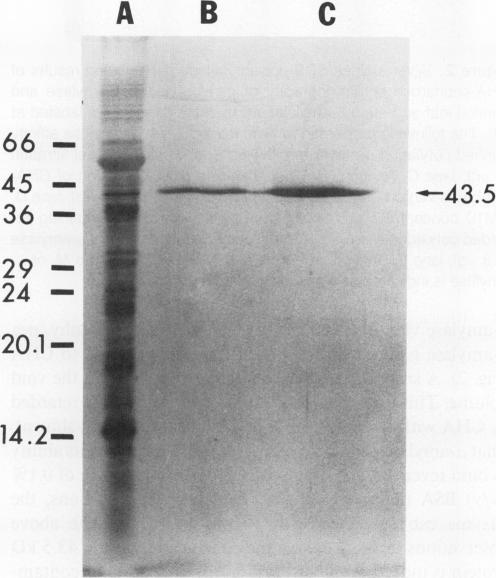
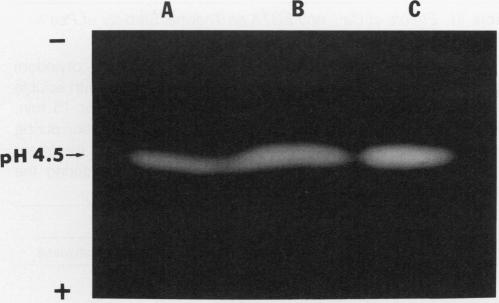
The most abundant alpha-amylase (EC 3.2.1.1) in shoots and cotyledons from pea (Pisum sativum L.) seedlings was purified 6700-and 850-fold, respectively, utilizing affinity (amylose and cycloheptaamylose) and gel filtration chromatography and ultrafiltration. This alpha-amylase contributed at least 79 and 15% of the total amylolytic activity in seedling cotyledons and shoots, respectively. The enzyme was identified as an alpha-amylase by polarimetry, substrate specificity, and end product analyses. The purified alpha-amylases from shoots and cotyledons appear identical. Both are 43.5 kilodalton monomers with pls of 4.5, broad pH activity optima from 5.5 to 6.5, and nearly identical substrate specificities. They produce identical one-dimensional peptide fingerprints following partial proteolysis in the presence of SDS. Calcium is required for activity and thermal stability of this amylase. The enzyme cannot attack maltodextrins with degrees of polymerization below that of maltotetraose, and hydrolysis of intact starch granules was detected only after prolonged incubation. It best utilizes soluble starch as substrate. Glucose and maltose are the major end products of the enzyme with amylose as substrate. This alpha-amylase appears to be secreted, in that it is at least partially localized in the apoplast of shoots. The native enzyme exhibits a high degree of resistance to degradation by proteinase K, trypsin/chymostrypsin, thermolysin, and Staphylococcus aureus V8 protease. It does not appear to be a high-mannose-type glycoprotein. Common cell wall constituents (e.g. beta-glucan) are not substrates of the enzyme. A very low amount of this alpha-amylase appears to be associated with chloroplasts; however, it is unclear whether this activity is contamination or alpha-amylase which is integrally associated with the chloroplast.
利用亲和(直链淀粉和环庚糖)、凝胶过滤色谱法和超滤,分别将豌豆(Pisum sativum L.)幼苗茎和子叶中含量最丰富的α-淀粉酶(EC 3.2.1.1)纯化了6700倍和850倍。这种α-淀粉酶分别至少占幼苗子叶和茎中总淀粉分解活性的79%和15%。通过旋光测定法、底物特异性和终产物分析,该酶被鉴定为α-淀粉酶。从茎和子叶中纯化得到的α-淀粉酶似乎是相同的。二者均为43.5千道尔顿的单体,等电点为4.5,最适pH活性范围较宽,为5.5至6.5,底物特异性几乎相同。在SDS存在下进行部分蛋白酶解后,它们产生相同的一维肽指纹图谱。钙是该淀粉酶活性和热稳定性所必需的。该酶不能作用于聚合度低于麦芽四糖的麦芽糊精,只有经过长时间孵育才能检测到完整淀粉颗粒的水解。它最适合将可溶性淀粉作为底物。以直链淀粉为底物时,葡萄糖和麦芽糖是该酶的主要终产物。这种α-淀粉酶似乎是分泌型的,因为它至少部分定位于茎的质外体中。天然酶对蛋白酶K、胰蛋白酶/胰凝乳蛋白酶、嗜热菌蛋白酶和金黄色葡萄球菌V8蛋白酶的降解具有高度抗性。它似乎不是高甘露糖型糖蛋白。常见的细胞壁成分(如β-葡聚糖)不是该酶的底物。这种α-淀粉酶只有非常少量与叶绿体相关;然而,尚不清楚这种活性是污染还是与叶绿体整体相关的α-淀粉酶。