Laboratory of Biochemistry, School of Agriculture, Nagoya University, Chikusa-ku, Nagoya 464-01, Japan.
Plant Physiol. 1991 Jul;96(3):902-9. doi: 10.1104/pp.96.3.902.
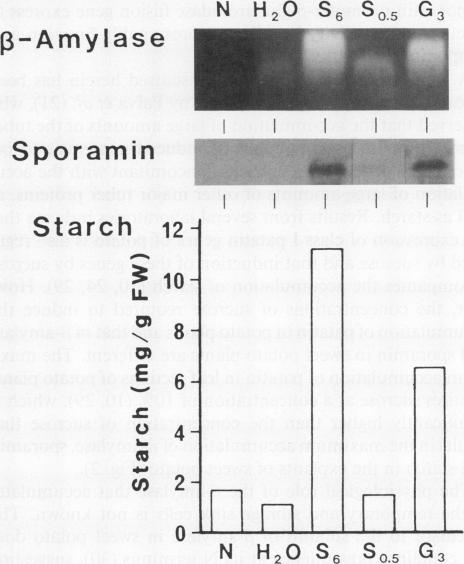
beta-Amylase of sweet potato (Ipomoea batatas L.), which constitutes about 5% of the total soluble protein of the tuberous root, is absent or is present in only small amounts in organs other than the tuberous roots of the normal, field-grown plants. However, when leaf-petiole cuttings from such plants were supplied with a solution that contained sucrose, the accumulation of beta-amylase was induced in both leaf and petiole portions of the explants. The sucrose-induced accumulation of beta-amylase in leaf-petiole cuttings occurred concomitant with the accumulation of starch and of sporamin, the most abundant storage protein of the tuberous root. The accumulation of beta-amylase, of sporamin and of starch in the petioles showed similar dependence on the concentration of sucrose, and a 6% solution of sucrose gave the highest levels of induction when assayed after 7 days of treatment. The induction of mRNAs for beta-amylase and sporamin in the petiole could be detected after 6 hours of treatment with sucrose, and the accumulation of beta-amylase and sporamin polypeptides, as well as that of starch, continued for a further 3 weeks. In addition to sucrose, glucose or fructose, but not mannitol or sorbitol, also induced the accumulation of beta-amylase and sporamin, suggesting that metabolic effects of sucrose are important in the mechanism of this induction. Treatment of leaf-petiole cuttings with water under continuous light, but not in darkness, also caused the accumulation of small amounts of these components in the petioles, probably as a result of the endogenous supply of sucrose by photosynthesis. These results suggest that the expression of the gene for beta-amylase is under metabolic control which is coupled with the expression of sink function of cells in the sweet potato.
甘薯(Ipomoea batatas L.)的β-淀粉酶约占块根总可溶性蛋白的 5%,在正常田间生长植株的除块根以外的器官中不存在或含量很少。然而,当将这些植物的叶柄叶片切段用含有蔗糖的溶液处理时,在愈伤组织的叶片和叶柄部分都诱导了β-淀粉酶的积累。蔗糖诱导的叶柄叶片切段中β-淀粉酶的积累伴随着淀粉和甘薯球蛋白(甘薯块根中最丰富的贮藏蛋白)的积累。β-淀粉酶、甘薯球蛋白和淀粉在叶柄中的积累对蔗糖浓度表现出相似的依赖性,当在处理 7 天后测定时,6%的蔗糖溶液给出了最高的诱导水平。在叶柄中可以检测到β-淀粉酶和甘薯球蛋白的 mRNA 在蔗糖处理 6 小时后的诱导,β-淀粉酶和甘薯球蛋白多肽以及淀粉的积累持续了另外 3 周。除了蔗糖外,葡萄糖或果糖,但不是甘露醇或山梨醇,也诱导了β-淀粉酶和甘薯球蛋白的积累,这表明蔗糖的代谢效应在这种诱导机制中很重要。在持续光照下而不是在黑暗中用水处理叶柄叶片切段也会导致这些成分在叶柄中少量积累,这可能是光合作用为叶柄提供了内源蔗糖的结果。这些结果表明,β-淀粉酶基因的表达受到与细胞代谢相关的表达调控,这与甘薯中细胞的汇功能表达有关。