Foyer C, Champigny M L
Photosynthèse et Métabolisme (U.R.A. 1128), Bâtiment 430, Université Paris-Sud, F-91405 Orsay cedex, France.
Plant Physiol. 1991 Dec;97(4):1476-82. doi: 10.1104/pp.97.4.1476.
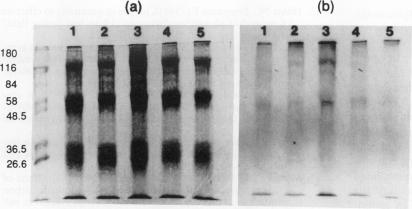
Phosphoenolpyruvate carboxylase (PEPcase) activity was studied in excised leaves of wheat (Triticum aestivum L.) in the dark and in the light, in presence of either N-free (low-NO(3) (-) leaves) or 40 millimolar KNO(3) (high-NO(3) (-) leaves) nutrient solutions. PEPcase activity increased to 2.7-fold higher than that measured in dark-adapted tissue (control) during the first 60 minutes and continued to increase more slowly to 3.8-fold that of the control. This level was reached after 200 minutes exposure of the leaves to light and high NO(3) (-). In contrast, the lower rate of increase recorded for low-NO(3) (-) leaves ceased after 60 minutes of exposure to light at 2.3-fold the control level. The short-term NO(3) (-) effect increased linearly with the level of NO(3) (-) uptake. In immunoprecipitation experiments, the antibody concentration for PEPcase precipitation increased with the protein extracts from the different treatments in the order: control, illuminated low-NO(3) (-) leaves, illuminated high-NO(3) (-) leaves. This order also applied with regard to a decreasing sensitivity to malate and an increasing stimulation by okadaic acid (an inhibitor of P-protein phosphatases). Following these studies, (32)P labeling experiments were carried out in vivo. These showed that the light-induced change in the properties of the PEPcase was due to an alteration in the phosphorylation state of the protein and that this effect was enhanced in high-NO(3) (-) conditions. Based on the responses of PEPcase and sucrose phosphate synthase in wheat leaves to light and NO(3) (-), an interpretation of the role of NO(3) (-) as either an inhibitor of P-protein phosphatase(s) or activator of protein kinase(s) is inferred. In the presence of NO(3) (-), the phosphorylation state of both PEPcase and sucrose phosphate synthase is increased. This causes activation of the former enzyme and inhibition of the latter. We suggest that NO(3) (-) modulates the relative protein kinase/protein phosphatase ratio to favor increased phosphorylation of both enzymes in order to redirect carbon flow away from sucrose synthesis and toward amino acid synthesis.
在无氮(低硝酸盐叶)或40毫摩尔硝酸钾(高硝酸盐叶)营养液存在的情况下,研究了黑暗和光照条件下小麦(Triticum aestivum L.)离体叶片中磷酸烯醇式丙酮酸羧化酶(PEPcase)的活性。在最初的60分钟内,PEPcase活性增加到比暗适应组织(对照)中测得的活性高2.7倍,并继续缓慢增加至对照的3.8倍。叶片在光照和高硝酸盐条件下暴露200分钟后达到该水平。相比之下,低硝酸盐叶记录到的较低增加速率在光照60分钟后停止,达到对照水平的2.3倍。短期硝酸盐效应随硝酸盐吸收水平线性增加。在免疫沉淀实验中,用于沉淀PEPcase的抗体浓度随不同处理的蛋白质提取物增加,顺序为:对照、光照低硝酸盐叶、光照高硝酸盐叶。这个顺序在对苹果酸敏感性降低和冈田酸(一种P蛋白磷酸酶抑制剂)刺激增加方面也适用。在这些研究之后,进行了体内32P标记实验。这些实验表明,光照引起的PEPcase性质变化是由于蛋白质磷酸化状态的改变,并且这种效应在高硝酸盐条件下增强。基于小麦叶片中PEPcase和蔗糖磷酸合酶对光照和硝酸盐的反应,推断出硝酸盐作为P蛋白磷酸酶抑制剂或蛋白激酶激活剂的作用解释。在硝酸盐存在的情况下,PEPcase和蔗糖磷酸合酶两者的磷酸化状态均增加。这导致前者酶的激活和后者的抑制。我们认为,硝酸盐调节相对蛋白激酶/蛋白磷酸酶比率,以利于两种酶的磷酸化增加,从而将碳流从蔗糖合成转向氨基酸合成。