Khan Rishi L, Gonye Gregory E, Gao Guang, Schwaber James S
Daniel Baugh Institute for Functional Genomics/Computational Biology, Department of Pathology, Anatomy and Cell Biology, Thomas Jefferson University, Philadelphia, Pennsylvania 19107, USA.
BMC Genomics. 2006 May 5;7:109. doi: 10.1186/1471-2164-7-109.
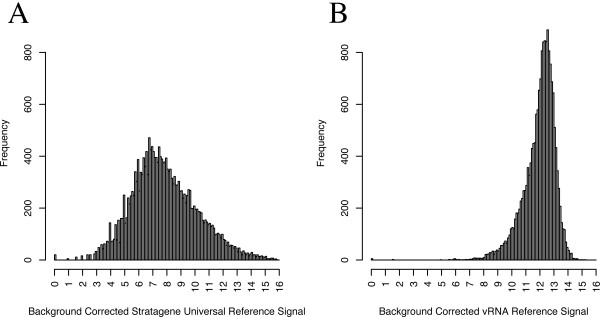
Using microarrays by co-hybridizing two samples labeled with different dyes enables differential gene expression measurements and comparisons across slides while controlling for within-slide variability. Typically one dye produces weaker signal intensities than the other often causing signals to be undetectable. In addition, undetectable spots represent a large problem for two-color microarray designs and most arrays contain at least 40% undetectable spots even when labeled with reference samples such as Stratagene's Universal Reference RNAs.
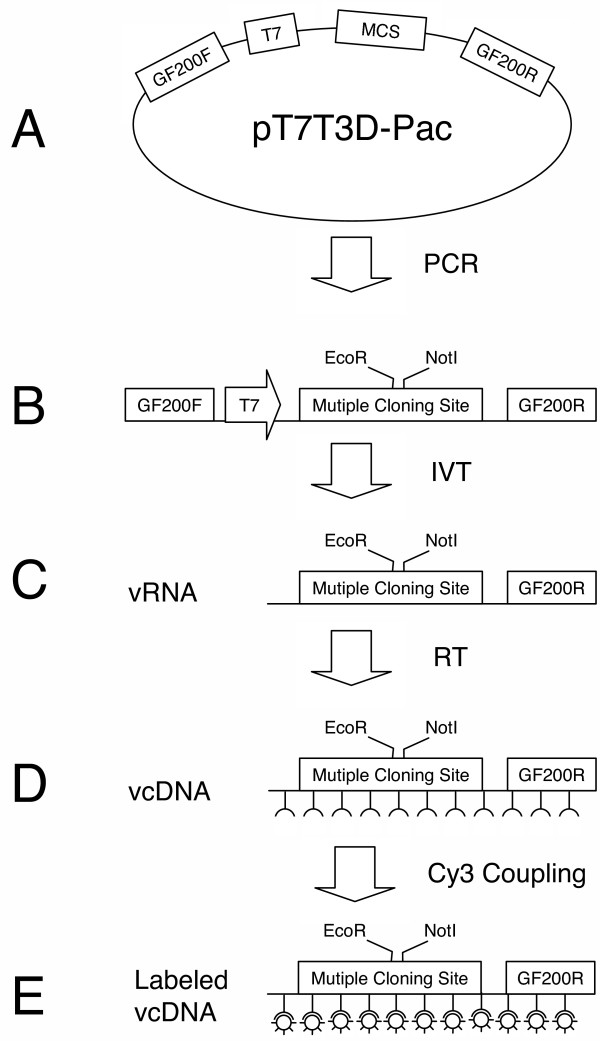
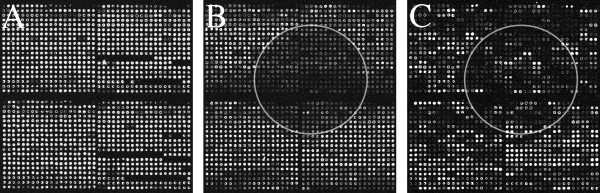
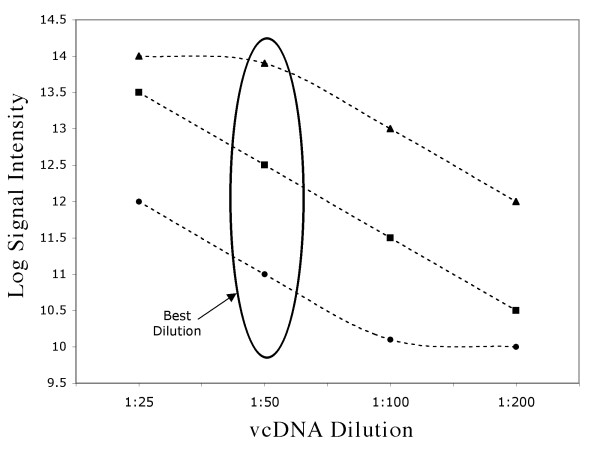
We introduce a novel universal reference sample that produces strong signal for all spots on the array, increasing the average fraction of detectable spots to 97%. Maximizing detectable spots on the reference image channel also decreases the variability of microarray data allowing for reliable detection of smaller differential gene expression changes. The reference sample is derived from sequence contained in the parental EST clone vector pT7T3D-Pac and is called vector RNA (vRNA). We show that vRNA can also be used for quality control of microarray printing and PCR product quality, detection of hybridization anomalies, and simplification of spot finding and segmentation tasks. This reference sample can be made inexpensively in large quantities as a renewable resource that is consistent across experiments.
Results of this study show that vRNA provides a useful universal reference that yields high signal for almost all spots on a microarray, reduces variation and allows for comparisons between experiments and laboratories. Further, it can be used for quality control of microarray printing and PCR product quality, detection of hybridization anomalies, and simplification of spot finding and segmentation tasks. This type of reference allows for detection of small changes in differential expression while reference designs in general allow for large-scale multivariate experimental designs. vRNA in combination with reference designs enable systems biology microarray experiments of small physiologically relevant changes.
通过将用不同染料标记的两个样品共同杂交来使用微阵列,能够在控制芯片内变异性的同时进行差异基因表达测量以及跨芯片比较。通常一种染料产生的信号强度比另一种弱,这常常导致信号无法检测到。此外,对于双色微阵列设计而言,无法检测到的斑点是一个大问题,并且即使使用诸如Stratagene公司的通用参考RNA等参考样品进行标记,大多数阵列仍包含至少40%无法检测到的斑点。
我们引入了一种新型通用参考样品,它能为阵列上的所有斑点产生强信号,将可检测斑点的平均比例提高到97%。使参考图像通道上的可检测斑点最大化还能降低微阵列数据的变异性,从而可靠地检测到较小的差异基因表达变化。该参考样品源自亲本EST克隆载体pT7T3D - Pac中包含的序列,被称为载体RNA(vRNA)。我们表明vRNA还可用于微阵列打印的质量控制、PCR产物质量检测、杂交异常检测以及简化斑点查找和分割任务。这种参考样品可以作为一种在不同实验中保持一致的可再生资源大量廉价制备。
本研究结果表明,vRNA提供了一种有用的通用参考,它能为微阵列上几乎所有斑点产生高信号,减少变异性,并允许在不同实验和实验室之间进行比较。此外,它可用于微阵列打印的质量控制、PCR产物质量检测、杂交异常检测以及简化斑点查找和分割任务。这种类型的参考允许检测差异表达中的微小变化,而一般的参考设计允许进行大规模多变量实验设计。vRNA与参考设计相结合能够实现对生理相关微小变化的系统生物学微阵列实验。