Shiojiri Kaori, Ozawa Rika, Takabayashi Junji
Center for Ecological Research, Kyoto University, Kamitanakami, Otsu, Japan.
PLoS Biol. 2006 Jun;4(6):e164. doi: 10.1371/journal.pbio.0040164. Epub 2006 May 16.
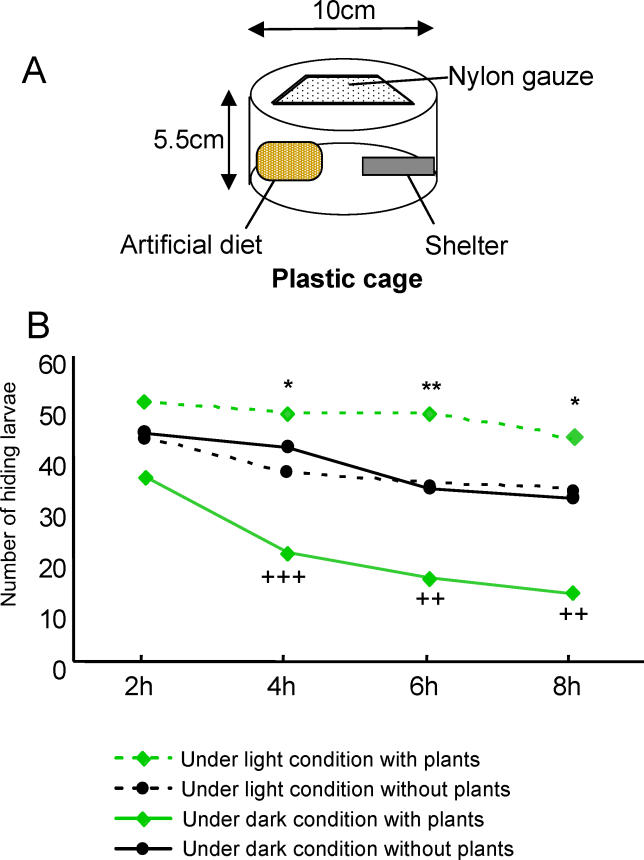
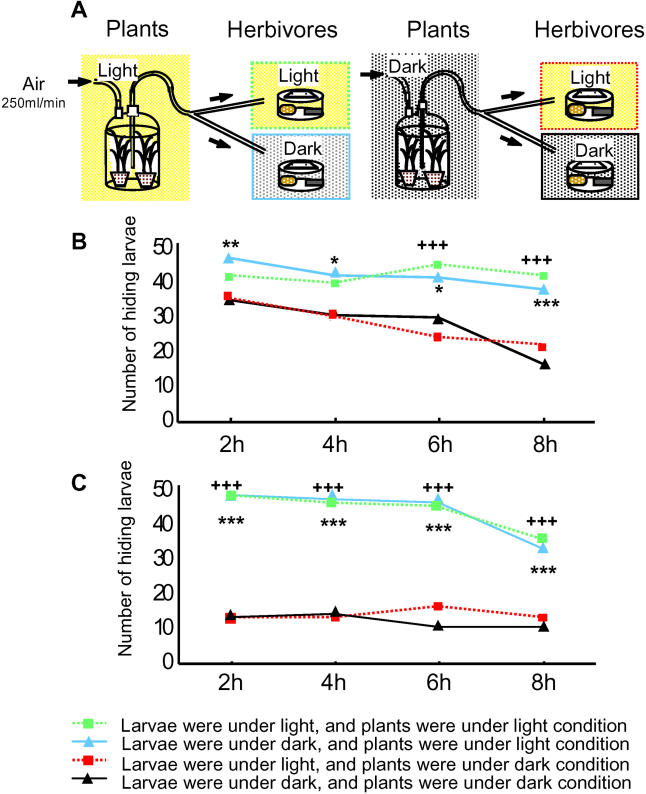
Although many organisms show daily rhythms in their activity patterns, the mechanistic causes of these patterns are poorly understood. Here we show that host plant volatiles affect the nocturnal behavior of the caterpillar Mythimna separata. Irrespective of light status, the caterpillars behaved as if they were in the dark when exposed to volatiles emitted from host plants (either uninfested or infested by conspecific larvae) in the dark. Likewise, irrespective of light status, the caterpillars behaved as if they were in the light when exposed to volatiles emitted from plants in the light. Caterpillars apparently utilize plant volatile information to sense their environment and modulate their daily activity patterns, thereby potentially avoiding the threat of parasitism.
尽管许多生物体在其活动模式中表现出每日节律,但这些模式的机制原因却知之甚少。在这里,我们表明寄主植物挥发物会影响粘虫Mythimna separata幼虫的夜间行为。无论光照状态如何,当在黑暗中暴露于寄主植物(未受侵染或被同种幼虫侵染)释放的挥发物时,幼虫的行为就好像它们处于黑暗中一样。同样,无论光照状态如何,当暴露于光照下植物释放的挥发物时,幼虫的行为就好像它们处于光照中一样。幼虫显然利用植物挥发物信息来感知它们的环境并调节它们的日常活动模式,从而有可能避免寄生的威胁。