He Yue-Qiu, Feng Bo, Guo Qian-Shuang, Du Yongjun
Ningbo City College of Vocational Technology, Xuefu Road, Yinzhou High Educational Park, NingBo, 315100, ZheJiang, China.
Institute of Health and Environmental Ecology, Wenzhou Medical University, University Town, Wenzhou, 325035, China.
BMC Genomics. 2017 Jan 5;18(1):32. doi: 10.1186/s12864-016-3427-2.
The oriental armyworm Mythimna separata (Walk) is a serious migratory pest; however, studies on its olfactory response and its underlying molecular mechanism are limited. To gain insights to the olfactory mechanism of migration, olfactory genes were identified using antennal transcriptome analysis. The olfactory response and the expression of olfactory genes for 1-day and 5-day-old moths were respectively investigated by EAG and RT-qPCR analyses.
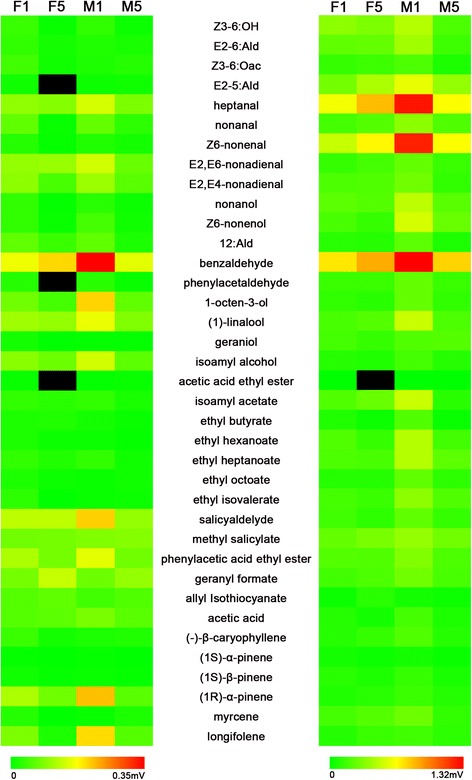
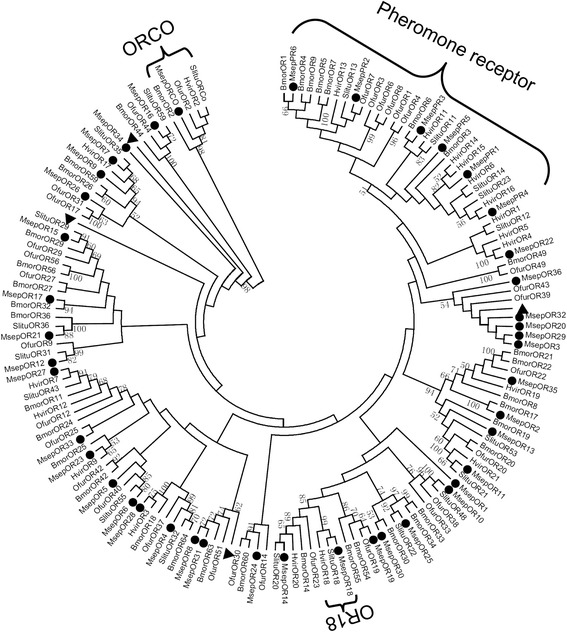
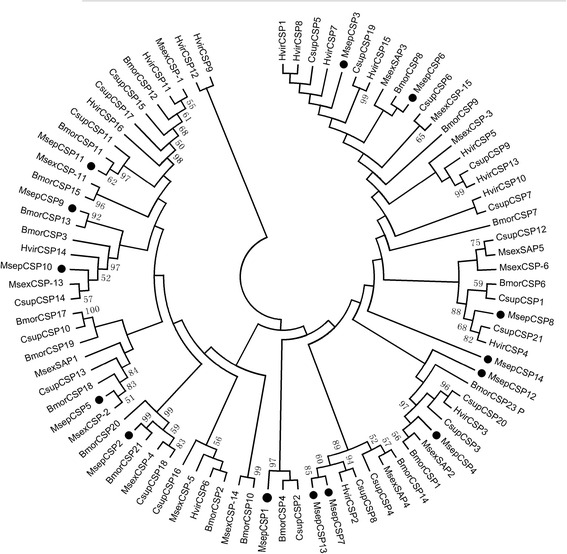
Putative 126 olfactory genes were identified in M. separata, which included 43 ORs, 13 GRs, 16 IRs, 37 OBPs, 14 CSPs, and 3 SNMPs. RPKM values of IR75d and 10 ORs were larger than co-receptors IR25a and ORco, and the RPKM value of PR2 was larger than that of other ORs. Expression of GR1 (sweet receptor) was higher than that of other GRs. Several sex pheromones activated evident EAG responses where the responses of 5-day-old male moths to the sex pheromones were significantly greater than those of female and 1-day old male moths. In accordance with the EAG response, 11 pheromone genes, including 6 PRs and 5 PBPs were identified in M. separate, and the expression levels of 7 pheromone genes in 5-day-old moths were significantly higher than those of females and 1-day-old moths. PR2 and PBP2 might be used in identifying Z11-16: Ald, which is the main sex pheromone component of M. separata. EAG responses to 16 plant volatiles and the expression levels of 43 olfactory genes in 1-day-old moths were significantly greater than that observed in the 5-day-old moths. Heptanal, Z6-nonenal, and benzaldehyde might be very important floral volatiles for host searching and recognized by several olfactory genes with high expression. Some plant volatiles might be important to male moths because the EAG response to 16 plant volatiles and the expression of 43 olfactory genes were significantly larger in males than in females.
The findings of the present study show the effect of adult age on olfactory responses and expression profile of olfactory genes in the migratory pest M. separate.
东方粘虫Mythimna separata(沃克)是一种严重的迁飞性害虫;然而,关于其嗅觉反应及其潜在分子机制的研究有限。为深入了解迁飞的嗅觉机制,通过触角转录组分析鉴定嗅觉基因。分别采用触角电位(EAG)和实时定量聚合酶链反应(RT-qPCR)分析,研究1日龄和5日龄蛾的嗅觉反应及嗅觉基因表达。
在东方粘虫中鉴定出126个假定的嗅觉基因,包括43个气味受体(ORs)、13个味觉受体(GRs)、16个离子型受体(IRs)、37个气味结合蛋白(OBPs)、14个化学感受蛋白(CSPs)和3个感觉神经元膜蛋白(SNMPs)。IR75d和10个ORs的每百万映射读取中每千碱基的读取数(RPKM)值大于共受体IR25a和ORco,PR2的RPKM值大于其他ORs。GR1(甜味受体)的表达高于其他GRs。几种性信息素激活明显的EAG反应,其中5日龄雄蛾对性信息素的反应显著大于雌蛾和1日龄雄蛾。根据EAG反应,在东方粘虫中鉴定出11个信息素基因,包括6个信息素受体(PRs)和5个信息素结合蛋白(PBPs),5日龄蛾中7个信息素基因的表达水平显著高于雌蛾和1日龄蛾。PR2和PBP2可能用于识别Z11-16:醛,它是东方粘虫的主要性信息素成分。1日龄蛾对16种植物挥发物的EAG反应和43个嗅觉基因的表达水平显著高于5日龄蛾。庚醛、Z6-壬烯醛和苯甲醛可能是寄主搜索中非常重要的花香挥发物,并被几个高表达的嗅觉基因识别。一些植物挥发物对雄蛾可能很重要,因为雄蛾对16种植物挥发物的EAG反应和43个嗅觉基因的表达显著大于雌蛾。
本研究结果显示了成虫年龄对迁飞害虫东方粘虫嗅觉反应和嗅觉基因表达谱的影响。