Tsunenari Takashi, Nathans Jeremy, Yau King-Wai
Department of Neuroscience, Johns Hopkins University School of Medicine, Baltimore, MD 21205, USA.
J Gen Physiol. 2006 Jun;127(6):749-54. doi: 10.1085/jgp.200609527. Epub 2006 May 15.
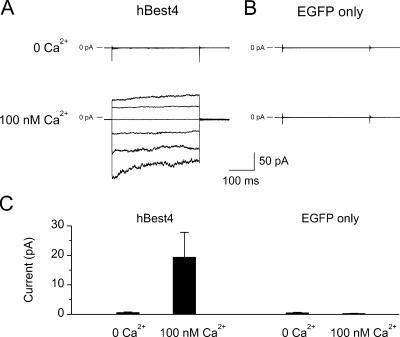
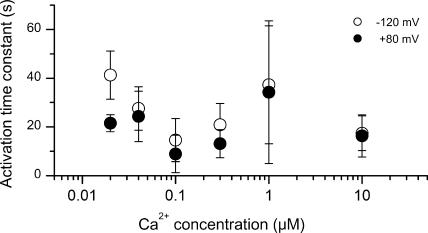
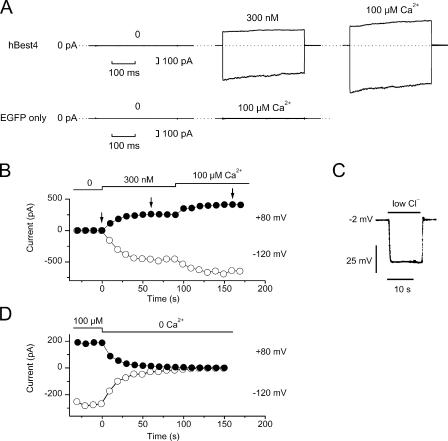
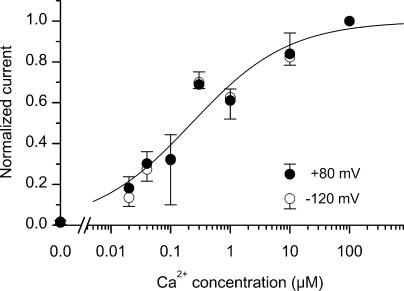
Bestrophins are a newly discovered family of Cl(-) channels, some members of which are activated by intracellular Ca(2+). So far, all studies were carried out with whole-cell recordings from plasmid-transfected cultured cells, so it is unclear whether Ca(2+) activates bestrophin through a metabolic mechanism or in a more direct way. We report here experiments that addressed this question with excised, inside-out membrane patches. We chose human bestrophin-4 (hBest4) for heterologous expression because it gave particularly large Cl(-) currents when expressed, thus allowing detection even in excised membrane patches. hBest4 gave a negligible Cl(-) current in a Ca(2+)-free solution on the cytoplasmic (bath) side, but produced a Cl(-) current that was activated by Ca(2+) in a dose-dependent manner, with a K(1/2) of 230 nM. Thus, Ca(2+) appears to activate the bestrophin Cl(-) channel without going through a freely diffusible messenger or through protein phosphorylation. Because the activation and deactivation kinetics were very slow, however, we cannot exclude the involvement of a membrane-associated messenger.
贝斯特罗蛋白是新发现的一类氯离子通道,其中一些成员可被细胞内钙离子激活。到目前为止,所有研究都是在质粒转染的培养细胞上进行全细胞记录,因此尚不清楚钙离子是通过代谢机制还是更直接的方式激活贝斯特罗蛋白。我们在此报告了用内面向外的膜片进行实验以解决这个问题。我们选择人类贝斯特罗蛋白4(hBest4)进行异源表达,因为它在表达时会产生特别大的氯离子电流,因此即使在切除的膜片中也能检测到。在细胞质(浴)侧的无钙溶液中,hBest4产生的氯离子电流可忽略不计,但在有钙的情况下会产生氯离子电流,且该电流被钙离子以剂量依赖方式激活,半数激活浓度(K1/2)为230 nM。因此,钙离子似乎无需通过可自由扩散的信使或蛋白质磷酸化就能激活贝斯特罗蛋白氯离子通道。然而,由于激活和失活动力学非常缓慢,我们不能排除膜相关信使的参与。