Keravala Annahita, Lechman Eric R, Nash Joan, Mi Zhibao, Robbins Paul D
Department of Molecular Genetics and Biochemistry, University of Pittsburgh, School of Medicine, Pittsburgh, PA 15261, USA.
Arthritis Res Ther. 2006;8(4):R91. doi: 10.1186/ar1960.
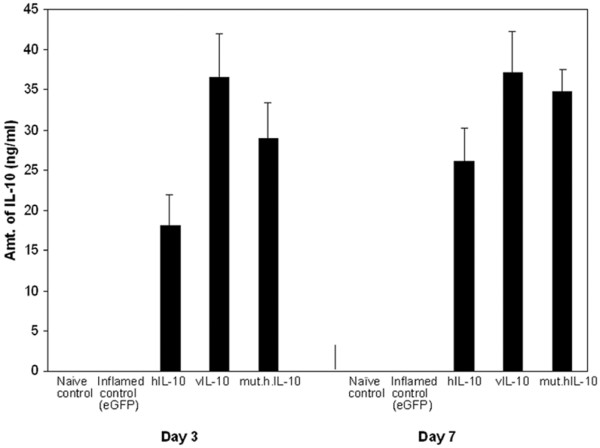
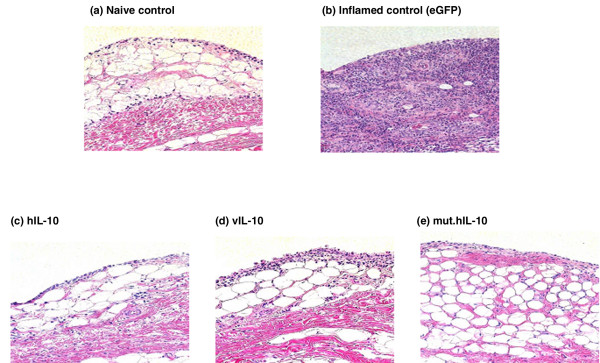
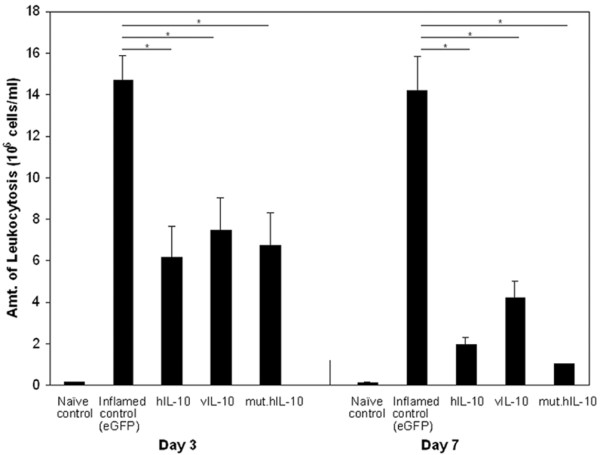
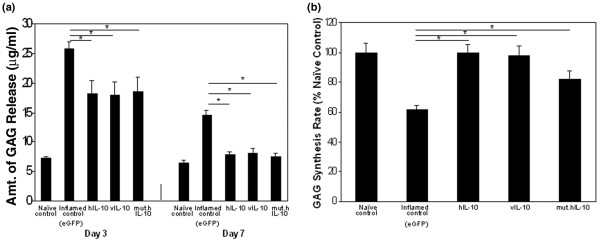
IL-10 is a Th2 cytokine important for inhibiting cell-mediated immunity while promoting humoral responses. Human IL-10 (hIL-10) has anti-inflammatory, immunosuppressive as well as immunostimulatory characteristics, whereas viral IL-10 (vIL-10), a homologue of hIL-10 encoded by Epstein Barr virus (EBV), lacks several immunostimulatory functions. The immunostimulatory characteristic of hIL-10 has been attributed to a single amino acid, isoleucine at position 87, which in vIL-10 is alanine. A mutant hIL-10 in which isoleucine has been substituted (mut.hIL-10) is biologically active with only immunosuppressive, but not immunostimulatory, functions, making it a potentially superior therapeutic for inflammatory diseases. To compare the efficacy of mut.hIL-10 with hIL-10 and vIL-10 in blocking the progression of rheumatoid arthritis, we used replication defective adenoviral vectors to deliver intra-articularly the gene encoding hIL-10, vIL-10 or mut.hIL-10 to antigen-induced arthritic (AIA) knee joints in rabbits. Intra-articular expression of hIL-10, vIL-10, and mut.hIL-10 resulted in significant improvement of the pathology in the treated joints to similar levels. These observed changes included a significant reduction in intra-articular leukocytosis and the degree of synovitis, as well as normalization of cartilage matrix metabolism. Our results suggest that hIL-10, vIL-10, and mut.hIL-10 are all equally therapeutic in the rabbit AIA model for treating disease pathology.
白细胞介素-10是一种Th2细胞因子,对抑制细胞介导的免疫反应同时促进体液免疫反应很重要。人白细胞介素-10(hIL-10)具有抗炎、免疫抑制以及免疫刺激特性,而病毒白细胞介素-10(vIL-10)是由爱泼斯坦-巴尔病毒(EBV)编码的hIL-10的同源物,缺乏多种免疫刺激功能。hIL-10的免疫刺激特性归因于一个单一氨基酸,即第87位的异亮氨酸,而在vIL-10中该位置是丙氨酸。异亮氨酸被取代的突变型hIL-10(mut.hIL-10)具有生物活性,仅具有免疫抑制功能,而无免疫刺激功能,这使其成为治疗炎症性疾病的潜在更优疗法。为比较mut.hIL-10与hIL-10和vIL-10在阻断类风湿性关节炎进展方面的疗效,我们使用复制缺陷型腺病毒载体将编码hIL-10、vIL-10或mut.hIL-10的基因关节内注射到兔抗原诱导性关节炎(AIA)膝关节中。hIL-10、vIL-10和mut.hIL-10的关节内表达导致治疗关节的病理学显著改善至相似水平。这些观察到的变化包括关节内白细胞增多症和滑膜炎程度的显著降低,以及软骨基质代谢的正常化。我们的结果表明,hIL-10、vIL-10和mut.hIL-10在兔AIA模型中治疗疾病病理学方面的疗效相同。