• 文献检索
  • 文档翻译
  • 深度研究
  • 学术资讯
  • Suppr Zotero 插件Zotero 插件
  • 邀请有礼
  • 套餐&价格
  • 历史记录
应用&插件
Suppr Zotero 插件Zotero 插件浏览器插件Mac 客户端Windows 客户端微信小程序
定价
高级版会员购买积分包购买API积分包
服务
文献检索文档翻译深度研究API 文档MCP 服务
关于我们
关于 Suppr公司介绍联系我们用户协议隐私条款
关注我们

Suppr 超能文献

核心技术专利:CN118964589B侵权必究
粤ICP备2023148730 号-1Suppr @ 2026

文献检索

告别复杂PubMed语法,用中文像聊天一样搜索,搜遍4000万医学文献。AI智能推荐,让科研检索更轻松。

立即免费搜索

文件翻译

保留排版,准确专业,支持PDF/Word/PPT等文件格式,支持 12+语言互译。

免费翻译文档

深度研究

AI帮你快速写综述,25分钟生成高质量综述,智能提取关键信息,辅助科研写作。

立即免费体验

基于同意的临床数据登记处各站点招募情况的差异:来自加拿大卒中网络的经验教训。

Variation in recruitment across sites in a consent-based clinical data registry: lessons from the Canadian Stroke Network.

作者信息

Willison Donald J, Kapral Moira K, Peladeau Pierrot, Richards Janice A, Fang Jiming, Silver Frank L

机构信息

Centre for Evaluation of Medicines, St, Joseph's Healthcare, Department of Clinical Epidemiology & Biostatistics, McMaster University Hamilton, Ontario, Canada.

出版信息

BMC Med Ethics. 2006 May 23;7:E6. doi: 10.1186/1472-6939-7-6.

DOI:10.1186/1472-6939-7-6
PMID:16716233
原文链接:https://pmc.ncbi.nlm.nih.gov/articles/PMC1513239/
Abstract

BACKGROUND

In earlier work, we found important selection biases when we tried to obtain consent for participation in a national stroke registry. Recognizing that not all registries will be exempt from requiring consent for participation, we examine here in greater depth the reasons for the poor accrual of patients from a systems perspective with a view to obtaining as representative sample as possible.

METHODS

We determined the percent of eligible patients who were approached to participate and, among those approached, the percent who actually consented to participate. In addition we examined the reasons why people were not approached or did not consent and the variation across sites in the percent of patients approached and consented. We also considered site variation in restrictions on the accrual and data collection process imposed by either the local research ethics board or the hospital.

RESULTS

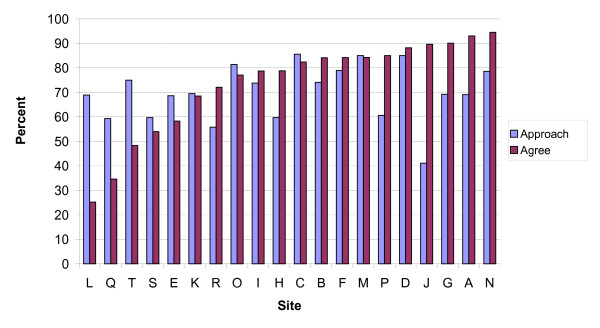
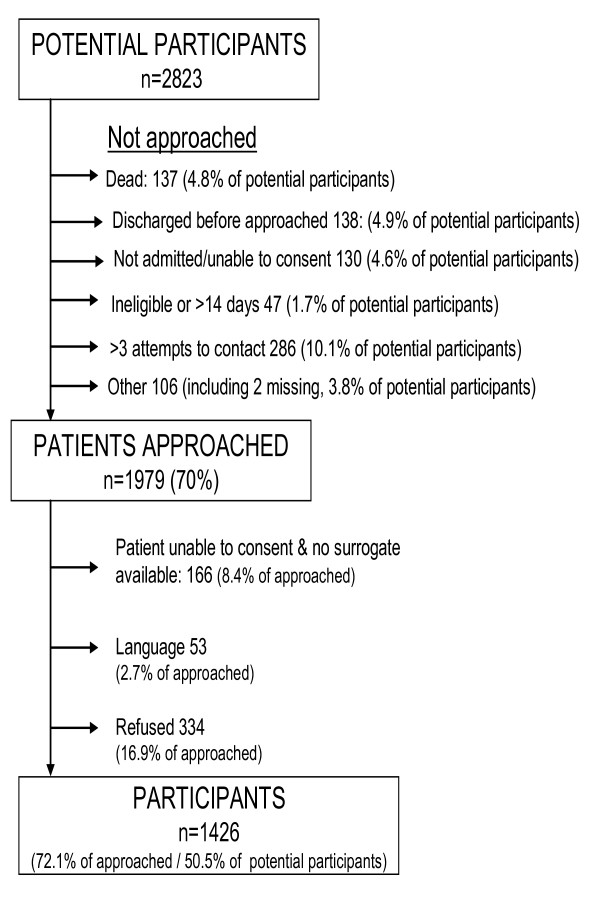
Seventy percent of stroke patients were approached, with wide variations in approach rates across sites (from: 41% to 86%), and considerable inter-site variation in hospital policies governing patient accrual. Chief reasons for not approaching were discharge or death before being approached for consent. Seventeen percent of those approached refused to participate (range: 5% to 75%). Finally, 11% of those approached did not participate due to language or communication difficulties.

CONCLUSION

We found wide variation in approach and agree rates across sites that were accounted for, in part, by different approaches to accrual and idiosyncratic policies of the hospitals. This wide variation in approach and agree rates raises important challenges for research ethics boards and data protection authorities in determining when to waive consent requirements, when to press for increased quality control, when to permit local adaptation of the consent process, and when to permit alternatives to individual express consent. We offer several suggestions for those registries that require consent for participation.

摘要

背景

在早期的研究中,我们发现,在试图获取参与一项全国性卒中登记研究的同意书时,存在重大的选择偏倚。鉴于并非所有登记研究都可免于要求参与者提供同意书,我们从系统角度更深入地研究了患者纳入率低的原因,以期获得尽可能具有代表性的样本。

方法

我们确定了被邀请参与的符合条件患者的百分比,以及在被邀请者中实际同意参与的百分比。此外,我们研究了人们未被邀请或未同意参与的原因,以及各研究点在被邀请和同意参与的患者百分比方面的差异。我们还考虑了当地研究伦理委员会或医院对纳入和数据收集过程所施加限制方面的研究点差异。

结果

70%的卒中患者被邀请参与,各研究点的邀请率差异很大(范围为41%至86%),且各医院在患者纳入政策方面存在显著的研究点间差异。未被邀请的主要原因是在被邀请同意参与之前已出院或死亡。17%的被邀请者拒绝参与(范围为5%至75%)。最后,11%的被邀请者因语言或沟通困难而未参与。

结论

我们发现各研究点在邀请率和同意率方面存在很大差异,部分原因在于不同的纳入方法和医院的特殊政策。这种邀请率和同意率的广泛差异给研究伦理委员会和数据保护机构带来了重大挑战,涉及确定何时可免除同意要求、何时应加强质量控制、何时允许对同意过程进行局部调整,以及何时允许替代个人明确同意的方式。我们为那些需要参与者提供同意书的登记研究提出了若干建议。
https://cdn.ncbi.nlm.nih.gov/pmc/blobs/8d38/1513239/3841474457bf/1472-6939-7-6-2.jpg
https://cdn.ncbi.nlm.nih.gov/pmc/blobs/8d38/1513239/1d85923f1d93/1472-6939-7-6-1.jpg
https://cdn.ncbi.nlm.nih.gov/pmc/blobs/8d38/1513239/3841474457bf/1472-6939-7-6-2.jpg
https://cdn.ncbi.nlm.nih.gov/pmc/blobs/8d38/1513239/1d85923f1d93/1472-6939-7-6-1.jpg
https://cdn.ncbi.nlm.nih.gov/pmc/blobs/8d38/1513239/3841474457bf/1472-6939-7-6-2.jpg

相似文献

1
Variation in recruitment across sites in a consent-based clinical data registry: lessons from the Canadian Stroke Network.基于同意的临床数据登记处各站点招募情况的差异:来自加拿大卒中网络的经验教训。
BMC Med Ethics. 2006 May 23;7:E6. doi: 10.1186/1472-6939-7-6.
2
Impracticability of informed consent in the Registry of the Canadian Stroke Network.加拿大卒中网络登记处中知情同意的不可行性。
N Engl J Med. 2004 Apr 1;350(14):1414-21. doi: 10.1056/NEJMsa031697.
3
Who refuses enrollment in cardiac clinical trials?谁会拒绝参与心脏临床试验?
Clin Trials. 2007;4(3):258-63. doi: 10.1177/1740774507079434.
4
Record linkage research and informed consent: who consents?记录链接研究与知情同意:谁来同意?
BMC Health Serv Res. 2007 Feb 12;7:18. doi: 10.1186/1472-6963-7-18.
5
Demographic and AIDS-related characteristics of consenters to a population-based HIV-survey: results from a pilot study in Arusha, Tanzania.基于人群的艾滋病毒调查同意参与者的人口统计学特征及与艾滋病相关的特征:坦桑尼亚阿鲁沙一项试点研究的结果
East Afr Med J. 1994 Aug;71(8):483-9.
6
Access to medical records for research purposes: varying perceptions across research ethics boards.用于研究目的的病历获取:各研究伦理委员会的不同看法
J Med Ethics. 2008 Apr;34(4):308-14. doi: 10.1136/jme.2006.020032.
7
Informed consent for genetic research.基因研究的知情同意书。
Arch Pediatr Adolesc Med. 2004 Jun;158(6):551-5. doi: 10.1001/archpedi.158.6.551.
8
Informed consent--practical considerations.知情同意——实际考量
Bull NYU Hosp Jt Dis. 2010;68(2):127-9.
9
A patient registry for cognitive rehabilitation research: a strategy for balancing patients' privacy rights with researchers' need for access.
Arch Phys Med Rehabil. 2005 Sep;86(9):1807-14. doi: 10.1016/j.apmr.2005.03.009.
10
Ethical issues in social research: difficulties encountered gaining access to children in hospital for research.社会研究中的伦理问题:在医院接触儿童进行研究时遇到的困难。
Child Care Health Dev. 2004 Jul;30(4):377-83. doi: 10.1111/j.1365-2214.2004.00426.x.

引用本文的文献

1
Joint replacement recipients' views about health information privacy.关节置换手术患者对健康信息隐私的看法。
Health Expect. 2015 Oct;18(5):1519-29. doi: 10.1111/hex.12142. Epub 2013 Oct 1.
2
Written informed consent and selection bias in observational studies using medical records: systematic review.使用医疗记录的观察性研究中的书面知情同意和选择偏倚:系统评价
BMJ. 2009 Mar 12;338:b866. doi: 10.1136/bmj.b866.
3
Alternatives to project-specific consent for access to personal information for health research: what is the opinion of the Canadian public?

本文引用的文献

1
Cross sectional survey of multicentre clinical databases in the United Kingdom.英国多中心临床数据库的横断面调查。
BMJ. 2004 Jun 19;328(7454):1478. doi: 10.1136/bmj.328.7454.1478.
2
The future of institutional review boards.机构审查委员会的未来。
Lancet Oncol. 2004 May;5(5):325-9. doi: 10.1016/S1470-2045(04)01473-1.
3
Impracticability of informed consent in the Registry of the Canadian Stroke Network.加拿大卒中网络登记处中知情同意的不可行性。
健康研究获取个人信息时特定项目同意之外的其他方式:加拿大公众持何看法?
J Am Med Inform Assoc. 2007 Nov-Dec;14(6):706-12. doi: 10.1197/jamia.M2457. Epub 2007 Aug 21.
N Engl J Med. 2004 Apr 1;350(14):1414-21. doi: 10.1056/NEJMsa031697.
4
Comparison of requirements of research ethics committees in 11 European countries for a non-invasive interventional study.11个欧洲国家研究伦理委员会对一项非侵入性介入性研究的要求比较。
BMJ. 2004 Jan 17;328(7432):140-1. doi: 10.1136/bmj.328.7432.140.
5
Ethics review roulette: what can we learn?伦理审查轮盘赌:我们能学到什么?
BMJ. 2004 Jan 17;328(7432):121-2. doi: 10.1136/bmj.328.7432.121.
6
Privacy and the secondary use of data for health research: experience in Canada and suggested directions forward.隐私与健康研究中数据的二次使用:加拿大的经验及未来建议方向
J Health Serv Res Policy. 2003 Jul;8 Suppl 1:S1:17-23. doi: 10.1258/135581903766468837.
7
Reporting the recruitment process in clinical trials: who are these patients and how did they get there?报告临床试验中的招募过程:这些患者都是谁,他们是如何参与进来的?
Ann Intern Med. 2002 Jul 2;137(1):10-6. doi: 10.7326/0003-4819-137-1-200207020-00007.
8
The effect of the new federal medical-privacy rule on research.新的联邦医疗隐私规则对研究的影响。
N Engl J Med. 2002 Jan 17;346(3):201-4. doi: 10.1056/NEJM200201173460312.
9
Rights involve responsibilities for patients.权利意味着患者要承担责任。
BMJ. 2001 Mar 24;322(7288):730.
10
Multicentre research ethics committees: has the cure been worse than the disease? No, but idiosyncracies and obstructions to good research must be removed.多中心研究伦理委员会:是否治丝益棼?不,但必须消除怪癖和对良好研究的阻碍。
BMJ. 2000 Apr 29;320(7243):1157-8. doi: 10.1136/bmj.320.7243.1157.