Campbell-Yeo Marsha L, Allen Alexander C, Joseph K S, Ledwidge Joyce M, Allen Victoria M, Dooley Kent C
Neonatal Intensive Care Unit, IWK Health Centre and Dalhousie University, Halifax, Nova Scotia, Canada.
BMC Pregnancy Childbirth. 2006 May 23;6:17. doi: 10.1186/1471-2393-6-17.
Domperidone, a drug that enhances upper gastric motility, is an anti-dopaminergic medication that also elevates prolactin levels. It has been shown to safely increase the milk supply of lactating women. To date, researchers have analyzed the effects of domperidone on lactating woman with respect to the quantity of their milk production, adverse effects, and drug levels in the breast milk. However, the effect of domperidone on the macronutrient composition of breast milk has not been studied and current guidelines for fortification of human milk for premature infants do not distinguish between those women using or those not using domperidone. The purpose of this study is to evaluate the effect of domperidone (given to lactating mothers of very preterm infants) on the macronutrient composition of breast milk.
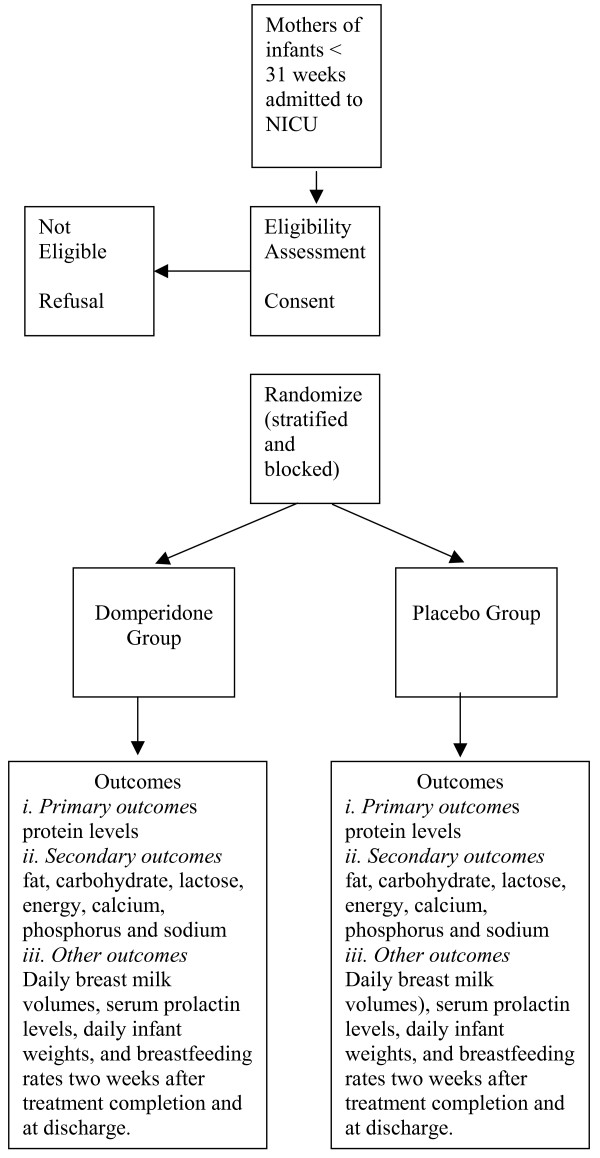
METHODS/DESIGN: Mothers of infants delivered at less than 31 weeks gestation, who are at least 3 weeks postpartum, and experiencing lactational failure despite non-pharmacological interventions, will be randomized to receive domperidone (10 mg three times daily) or placebo for a 14-day period. Breast milk samples will be obtained the day prior to beginning treatment and on days 4, 7 and 14. The macronutrient (protein, fat, carbohydrate and energy) and macromineral content (calcium, phosphorus and sodium) will be analyzed and compared between the two groups. Additional outcome measures will include milk volumes, serum prolactin levels (measured on days 0, 4, and 10), daily infant weights and breastfeeding rates at 2 weeks post study completion and at discharge. Forty-four participants will be recruited into the study. Analysis will be carried out using the intention to treat approach.
If domperidone causes significant changes to the nutrient content of breast milk, an alteration in feeding practices for preterm infants may need to be made in order to optimize growth, nutrition and neurodevelopment outcomes.
多潘立酮是一种增强上消化道动力的药物,属于抗多巴胺能药物,也会升高催乳素水平。已证明它能安全增加哺乳期妇女的乳汁分泌量。迄今为止,研究人员已分析了多潘立酮对哺乳期妇女乳汁分泌量、不良反应及母乳中药物水平的影响。然而,多潘立酮对母乳中宏量营养素组成的影响尚未得到研究,目前关于早产儿母乳强化的指南并未区分使用或未使用多潘立酮的妇女。本研究的目的是评估多潘立酮(给予极早产儿的哺乳期母亲)对母乳中宏量营养素组成的影响。
方法/设计:孕周小于31周且产后至少3周、尽管进行了非药物干预但仍存在泌乳不足的婴儿母亲,将被随机分为两组,一组接受多潘立酮(每日3次,每次10毫克),另一组接受安慰剂,为期14天。在开始治疗前一天以及第4、7和14天采集母乳样本。分析并比较两组母乳中宏量营养素(蛋白质、脂肪、碳水化合物和能量)及常量矿物质含量(钙、磷和钠)。其他结局指标将包括乳汁量、血清催乳素水平(在第0、4和10天测量)、每日婴儿体重以及研究结束后2周和出院时的母乳喂养率。本研究将招募44名参与者。分析将采用意向性分析方法。
如果多潘立酮导致母乳营养成分发生显著变化,可能需要改变早产儿的喂养方式,以优化其生长、营养和神经发育结局。