Hedden Sarra L, Woolson Robert F, Malcolm Robert J
Department of Biostatistics, Bioinformatics and Epidemiology (DB2E), Medical University of South Carolina, Cannon Place, Cannon Street, Charleston, SC 29425, USA.
Subst Abuse Treat Prev Policy. 2006 Feb 6;1:6. doi: 10.1186/1747-597X-1-6.
A well designed randomized clinical trial rates as the highest level of evidence for a particular intervention's efficacy. Randomization, a fundamental feature of clinical trials design, is a process invoking the use of probability to assign treatment interventions to patients. In general, randomization techniques pursue the goal of providing objectivity to the assignment of treatments, while at the same time balancing for treatment assignment totals and covariate distributions. Numerous randomization techniques, each with varying properties of randomness and balance, are suggested in the statistical literature. This paper reviews common randomization techniques often used in substance abuse research and an application from a National Institute on Drug Abuse (NIDA)-funded clinical trial in substance abuse is used to illustrate several choices an investigator faces when designing a clinical trial.
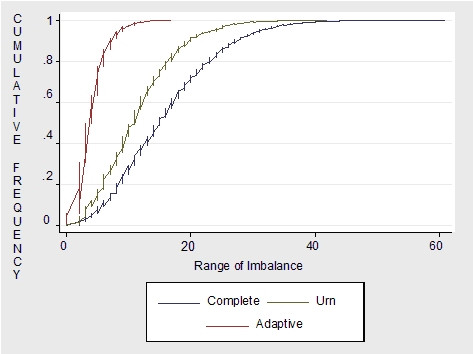
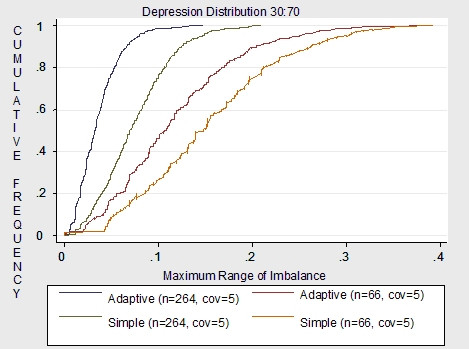
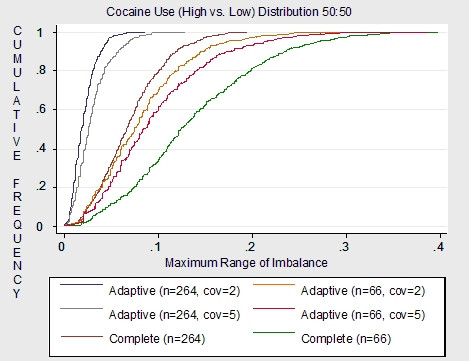
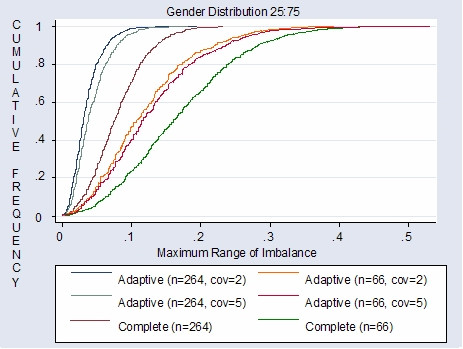
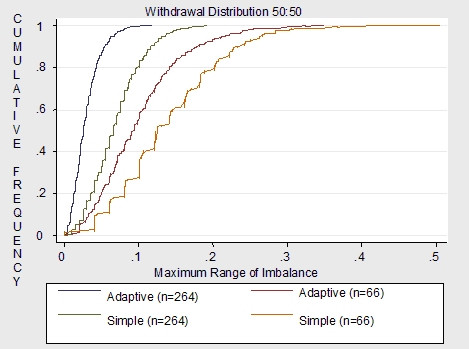
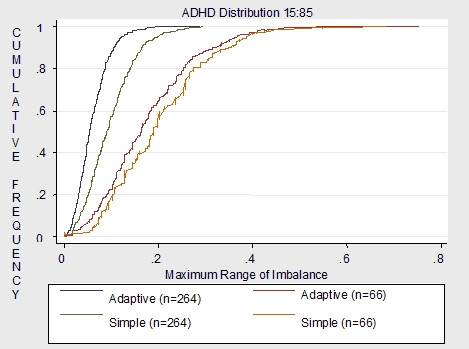
Comparisons and contrasts of randomization schemes are provided with respect to deterministic and balancing properties. Specifically, Monte Carlo simulation is used to explore the balancing nature of randomization techniques for moderately sized clinical trials. Results demonstrate large treatment imbalance for complete randomization with less imbalance for the urn or adaptive scheme. The urn and adaptive randomization methods display smaller treatment imbalance as demonstrated by the low variability of treatment allocation imbalance. For all randomization schemes, covariate imbalance between treatment arms was small with little variation between adaptive schemes, stratified schemes and unstratified schemes given that sample sizes were moderate to large.
We develop this paper with the goal of reminding substance abuse researchers of the broad array of randomization options available for clinical trial designs. There may be too quick a tendency for substance abuse researchers to implement the fashionable urn randomization schemes and other highly adaptive designs. In many instances, simple or blocked randomization with stratification on a major covariate or two will accomplish the same objectives as an urn or adaptive design, and it can do so with more simply implemented schedules and without the dangers of overmatching. Furthermore, the proper analysis, fully accounting for the stratified design, can be conducted.
精心设计的随机临床试验被视为特定干预措施疗效的最高证据水平。随机化是临床试验设计的一个基本特征,是一个运用概率将治疗干预措施分配给患者的过程。一般来说,随机化技术旨在为治疗分配提供客观性,同时平衡治疗分配总数和协变量分布。统计文献中提出了许多随机化技术,每种技术的随机性和平衡性各不相同。本文回顾了药物滥用研究中常用的随机化技术,并通过美国国立药物滥用研究所(NIDA)资助的一项药物滥用临床试验的应用,来说明研究者在设计临床试验时面临的几种选择。
就确定性和平衡性而言,对随机化方案进行了比较和对比。具体而言,使用蒙特卡罗模拟来探索中等规模临床试验中随机化技术的平衡特性。结果表明,完全随机化存在较大的治疗不平衡,而瓮随机化或自适应方案的不平衡较小。瓮随机化和自适应随机化方法显示出较小的治疗不平衡,这一点通过治疗分配不平衡的低变异性得到了证明。对于所有随机化方案,鉴于样本量为中等至较大,治疗组之间的协变量不平衡较小,自适应方案、分层方案和非分层方案之间的差异不大。
我们撰写本文的目的是提醒药物滥用研究人员,在临床试验设计中有多种随机化选择。药物滥用研究人员可能过于倾向于采用流行的瓮随机化方案和其他高度自适应设计。在许多情况下,基于一两个主要协变量进行分层的简单随机化或区组随机化将实现与瓮随机化或自适应设计相同的目标,并且可以通过更简单的实施计划来实现,同时不存在过度匹配的风险。此外,可以进行充分考虑分层设计的适当分析。