Salerno Grazia, Di Vizio Dolores, Staibano Stefania, Mottola Giampiero, Quaremba Giuseppe, Mascolo Massimo, Galli Vieri, De Rosa Gaetano, Insabato Luigi
Department of Otolaryngology, University Federico II, Naples, Italy.
BMC Cancer. 2006 Jun 1;6:146. doi: 10.1186/1471-2407-6-146.
Very few reports have investigated the role of cell cycle regulators as biomarkers in Basaloid Squamous Cell Carcinoma (BSCC) of the larynx, a definite morphologic, uncommon, very aggressive variant of squamous cell carcinoma. Lower expression of Ki67/Mib-1, a proliferation marker highly expressed in the majority of tumours, and p53, a tumour suppressor protein that can induce an arrest of the G1-S transition, was related to a better prognosis in laryngeal BSCC. In the head and neck, p27kip1, a member of the Cip1/Kip1 family of cyclin-dependent kinase inhibitors, has emerged as an independent prognostic factor, able to identify low-expressing tumours with unfavourable course. Up to date the role of this protein was never studied in BSCC. Aim of our study was to investigate the potential prognostic value of p27kip1 levels and their correlation with Ki67/Mib-1 and p53 expression in BSCC of the larynx.
The retrospective study group consisted of 15 male and 1 female patients, affected by laryngeal BSCC, ranging in age from 44 to 69 years (mean 58). The tumour originated from the supraglottis in thirtheen cases and from the glottis in the remaining three. Ten patients had metastatic cervical lymph nodes at presentation and were classified as N+. Post surgical stage was IV in four patients, III in nine, II in two cases and I in the remaining one. Follow-up ranged from a minimum of 5 months up to 9 years. Paraffin-embedded tissue sections of each laryngeal tumour were analyzed for p27kip, Ki67/Mib-1 and p53 expression by immunohistochemistry.
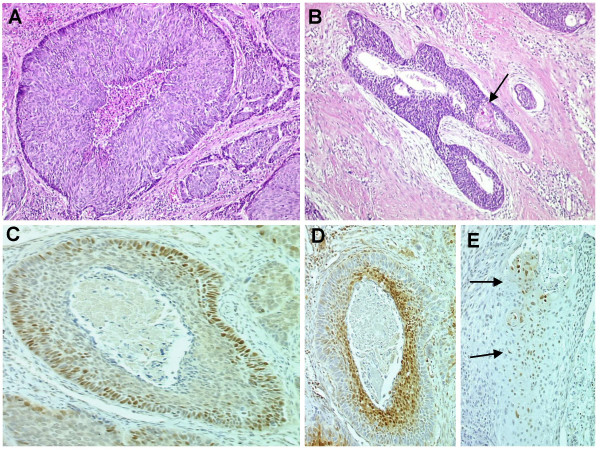
The immunohistochemical study showed p27kip1 expression in 40% of the patients with no evidence of disease (NED) and in none (0%) of the patients dead of disease (DOD), whilst p53 was expressed in 60% of patients in NED status and in 90% of patients in DOD status. Ki67/Mib-1 was positive in 80% of NED patients and in 100% of DOD patients. At multivariate analysis, performed by means of Discriminant analysis, low levels of p27kip1 expression significantly correlated with poor prognosis (P < 0.05).
p27kip1 protein has been shown to be a significant independent prognostic factor in laryngeal SCC. In our series of laryngeal BSCC the resulting data seem to confirm the clinical prognostic relevance of p27kip1 low expression, which directly correlated with biological aggressiveness and consequent shortened survival.
喉基底样鳞状细胞癌(BSCC)是一种形态明确、少见且侵袭性很强的鳞状细胞癌变体,关于细胞周期调节因子作为其生物标志物作用的研究报道极少。Ki67/Mib-1是一种在大多数肿瘤中高表达的增殖标志物,p53是一种可诱导G1-S期转换停滞的肿瘤抑制蛋白,它们在喉BSCC中的低表达与较好的预后相关。在头颈部,细胞周期蛋白依赖性激酶抑制剂Cip1/Kip1家族成员p27kip1已成为一个独立的预后因素,能够识别病程不良的低表达肿瘤。迄今为止,该蛋白在BSCC中的作用从未被研究过。我们研究的目的是探讨p27kip1水平在喉BSCC中的潜在预后价值及其与Ki67/Mib-1和p53表达的相关性。
回顾性研究组由15例男性和1例女性喉BSCC患者组成,年龄在44至69岁之间(平均58岁)。肿瘤起源于声门上区13例,声门区3例。10例患者初诊时伴有颈部淋巴结转移,被分类为N+。术后分期为IV期4例,III期9例,II期2例,I期1例。随访时间最短5个月,最长9年。通过免疫组织化学分析各喉肿瘤石蜡包埋组织切片中p27kip、Ki67/Mib-1和p53的表达。
免疫组织化学研究显示,40%无疾病证据(NED)的患者中有p27kip1表达,而死于疾病(DOD)的患者中无一例(0%)有该表达;p53在NED状态的患者中60%有表达,在DOD状态的患者中90%有表达。Ki67/Mib-1在80%的NED患者中呈阳性,在100%的DOD患者中呈阳性。通过判别分析进行多变量分析,p27kip1低表达水平与预后不良显著相关(P<0.05)。
p27kip1蛋白已被证明是喉鳞状细胞癌的一个重要独立预后因素。在我们的一系列喉BSCC病例中,所得数据似乎证实了p27kip1低表达的临床预后相关性,其与生物学侵袭性直接相关,进而导致生存期缩短。