Taylor Erica D, Theim Kelly R, Mirch Margaret C, Ghorbani Samareh, Tanofsky-Kraff Marian, Adler-Wailes Diane C, Brady Sheila, Reynolds James C, Calis Karim A, Yanovski Jack A
Unit on Growth and Obesity, Developmental Endocrinology Branch, National Institute of Child Health and Human Development, Bethesda, Maryland, USA.
Pediatrics. 2006 Jun;117(6):2167-74. doi: 10.1542/peds.2005-1832.
Few studies have quantified the prevalence of weight-related orthopedic conditions in otherwise healthy overweight children. The goal of the present investigation was to describe the musculoskeletal consequences of pediatric overweight in a large pediatric cohort of children that included severely overweight children.
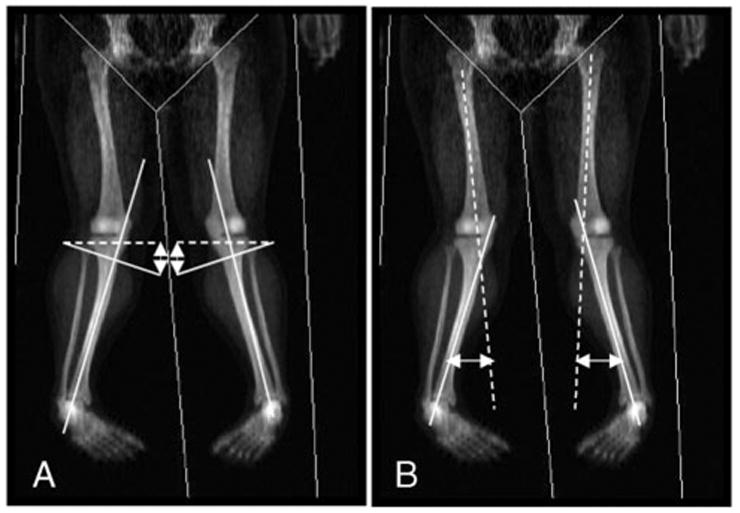
Medical charts from 227 overweight and 128 nonoverweight children and adolescents who were enrolled in pediatric clinical studies at the National Institutes of Health from 1996 to 2004 were reviewed to record pertinent orthopedic medical history and musculoskeletal complaints. Questionnaire data from 183 enrollees (146 overweight) documented difficulties with mobility. In 250, lower extremity alignment was determined by bilateral metaphyseal-diaphyseal and anatomic tibiofemoral angle measurements made from whole-body dual-energy x-ray absorptiometry scans.
Compared with nonoverweight children, overweight children reported a greater prevalence of fractures and musculoskeletal discomfort. The most common self-reported joint complaint among those who were questioned directly was knee pain (21.4% overweight vs 16.7% nonoverweight). Overweight children reported greater impairment in mobility than did nonoverweight children (mobility score: 17.0 +/- 6.8 vs 11.6 +/- 2.8). Both metaphyseal-diaphyseal and anatomic tibiofemoral angle measurements showed greater malalignment in overweight compared with nonoverweight children.
Reported fractures, musculoskeletal discomfort, impaired mobility, and lower extremity malalignment are more prevalent in overweight than nonoverweight children and adolescents. Because they affect the likelihood that children will engage in physical activity, orthopedic difficulties may be part of the cycle that perpetuates the accumulation of excess weight in children.
很少有研究对健康超重儿童中与体重相关的骨科疾病患病率进行量化。本研究的目的是描述一个包含重度超重儿童的大型儿科队列中儿童超重的肌肉骨骼后果。
回顾了1996年至2004年在美国国立卫生研究院儿科临床研究中登记的227名超重儿童和128名非超重儿童及青少年的病历,以记录相关的骨科病史和肌肉骨骼主诉。183名登记者(146名超重)的问卷数据记录了行动困难情况。对250名儿童,通过全身双能X线吸收法扫描测量双侧干骺端-骨干和解剖学胫股角来确定下肢对线情况。
与非超重儿童相比,超重儿童报告的骨折和肌肉骨骼不适患病率更高。在直接接受询问的儿童中,最常见的自我报告关节主诉是膝关节疼痛(超重儿童为21.4%,非超重儿童为16.7%)。超重儿童报告的行动障碍比非超重儿童更严重(行动评分:17.0±6.8对11.6±2.8)。干骺端-骨干和解剖学胫股角测量均显示,与非超重儿童相比,超重儿童的对线不良情况更严重。
超重儿童和青少年中报告的骨折、肌肉骨骼不适、行动障碍和下肢对线不良比非超重者更普遍。由于这些情况会影响儿童进行体育活动的可能性,骨科问题可能是导致儿童超重持续累积的循环的一部分。