Launikonis Bradley S, Zhou Jingsong, Santiago Demetrio, Brum Gustavo, Ríos Eduardo
Section of Cellular Signaling, Department of Molecular Biophysics and Physiology, Rush University, Chicago, IL 60612, USA.
J Gen Physiol. 2006 Jul;128(1):45-54. doi: 10.1085/jgp.200609545. Epub 2006 Jun 12.
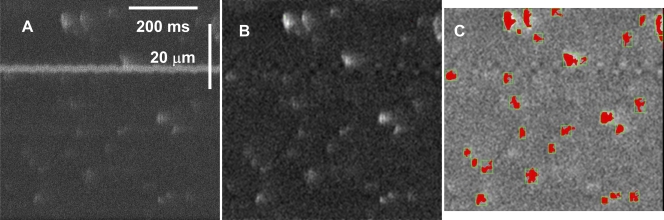
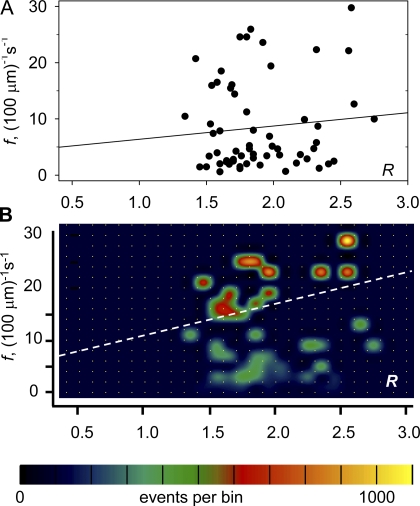
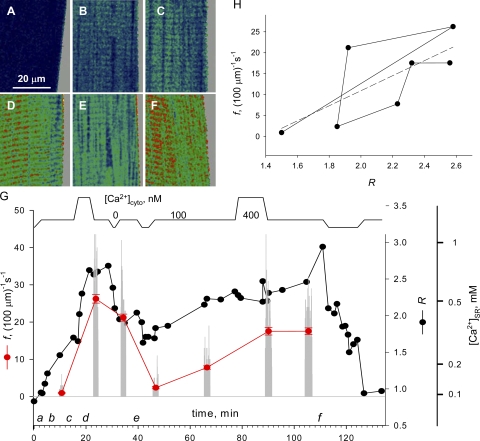
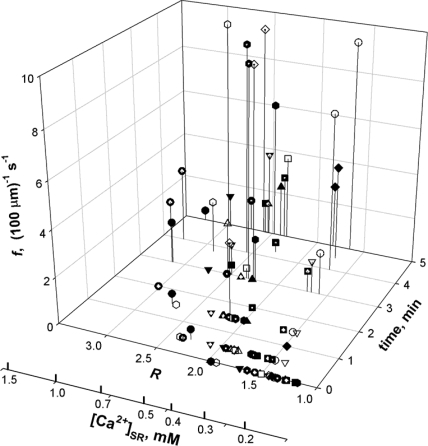
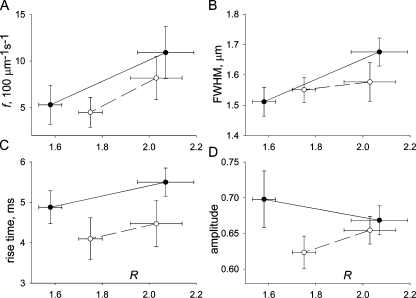
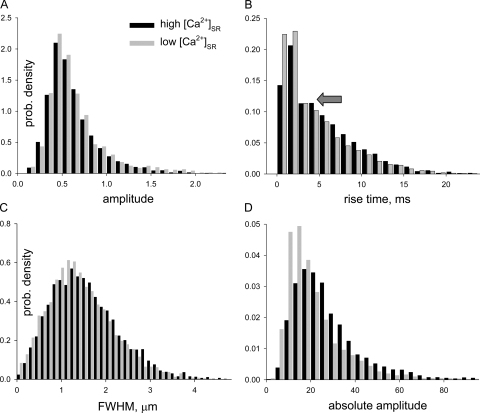
In cardiac muscle and amphibian skeletal muscle, the intracellular Ca2+ release that signals contractile activation proceeds by discrete local packets, which result in Ca2+ sparks. The remarkably stereotyped duration of these release events requires a robustly timed termination mechanism. In cardiac muscle the mechanism of spark termination appears to crucially involve depletion of Ca2+ in the lumen of the sarcoplasmic reticulum (SR), but in skeletal muscle, the mechanism is unknown. We used SEER (shifted excitation and emission ratioing of fluorescence) of SR-trapped mag-indo-1 and confocal imaging of fluorescence of cytosolic rhod-2 to image Ca2+ sparks while reversibly changing and measuring [Ca2+] in the SR ([Ca2+]SR) of membrane-permeabilized frog skeletal muscle cells. Sparks were collected in cells immersed in a solution promoting production of events at moderate frequency. Just after permeabilization, event frequency was zero, and in 10 minutes it reached close to a steady value. Controlled interventions modified [Ca2+]SR reversibly between a low value (299 microM on average in 10 experiments) and a high value (433 microM, a 45% average increase). This change increased sparks frequency by 93%, spatial width by 7%, rise time by 10%, and peak amplitude by 38% (provided that it was calculated in absolute terms, rather than normalized by resting fluorescence). The changes in event frequency and amplitude were statistically significant. The "strength" of the effect of [Ca2+]SR on frequency, quantified by decomposition of variance, was <6%. While the average change in [Ca2+]SR was limited, it reached up to 200% in individual fibers, without causing massive Ca2+ release or an increase of >3.5-fold in event frequency. Taken together with existing evidence that depletion is modest during Ca2+ sparks or release elicited by an action potential, the mild effects of [Ca2+]SR reported here do not support a major role of depletion in either the termination of sparks or the strong inactivation that terminates Ca2+ release at the global level in frog skeletal muscle.
在心肌和两栖类骨骼肌中,引发收缩激活的细胞内钙离子释放通过离散的局部包进行,这些包会产生钙火花。这些释放事件显著固定的持续时间需要一个严格定时的终止机制。在心肌中,火花终止机制似乎关键涉及肌浆网(SR)腔内钙离子的耗尽,但在骨骼肌中,该机制尚不清楚。我们使用SR捕获的mag-indo-1的SEER(荧光的激发和发射比值移位)以及胞质rhod-2荧光的共聚焦成像来对钙火花进行成像,同时可逆地改变并测量膜通透的青蛙骨骼肌细胞SR中的钙离子浓度([Ca2+]SR)。火花是在浸入促进中等频率事件产生的溶液中的细胞中收集的。刚通透后,事件频率为零,10分钟后达到接近稳定值。控制性干预使[Ca2+]SR在低值(10次实验中平均为299微摩尔)和高值(433微摩尔,平均增加45%)之间可逆地变化。这种变化使火花频率增加了93%,空间宽度增加了7%,上升时间增加了10%,峰值幅度增加了38%(前提是按绝对值计算,而不是通过静息荧光归一化)。事件频率和幅度的变化具有统计学意义。通过方差分解量化的[Ca2+]SR对频率的“影响强度”<6%。虽然[Ca2+]SR的平均变化有限,但在个别纤维中可达200%,而不会引起大量钙离子释放或事件频率增加超过3.5倍。结合现有证据表明在动作电位引发的钙火花或释放过程中耗尽程度适中,此处报道的[Ca2+]SR的温和影响不支持耗尽在青蛙骨骼肌中火花终止或在全局水平终止钙离子释放的强失活中起主要作用。