Phillips Kathryn A, Van Bebber Stephanie, Marshall Deborah, Walsh Judith, Thabane Lehana
University of California, San Francisco, San Francisco, CA 94143-0613, USA.
Prev Chronic Dis. 2006 Jul;3(3):A75. Epub 2006 Jun 15.
Stated preference studies for cancer screening programs are used to understand how the programs can be improved to maximize usage. Our objectives were to conduct a systematic review of stated preference studies for cancer screening, identify gaps in the literature, and determine which types of research should be conducted in the future.
We considered all studies in the PubMed database through May 2005 that measured utility-based stated preferences for cancer screening using contingent valuation or conjoint analysis. We abstracted data on 1) study characteristics and 2) study results and policy implications.
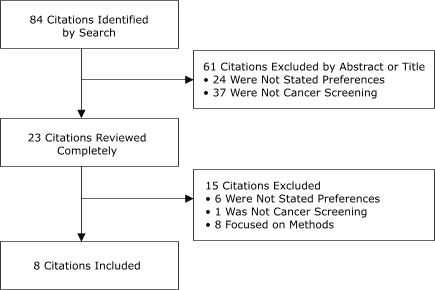
We found eight (of 84 identified) preference studies for cancer screening. The most commonly studied cancer was breast cancer, and the most commonly used method was contingent valuation. We found no studies for prostate cancer or physician preferences. Studies demonstrated that although individuals are able to state their preferences for cancer screening, they do not weigh test benefits and harms, and a significant percentage would choose to have no screening at all. Several studies found that test accuracy and reduction in mortality risk were important for determining preferences.
Few studies of cancer screening preferences exist. The available studies examine only a few types of cancer and do not explore practice and policy implications in depth. The results of this review will be useful in identifying the focus of future research, identifying which screening methods may be more preferred to increase use of the programs, and developing interventions and policies that could facilitate informed and shared decision making for screening.
针对癌症筛查项目的陈述性偏好研究用于了解如何改进这些项目以实现最大程度的利用。我们的目标是对癌症筛查的陈述性偏好研究进行系统综述,找出文献中的空白,并确定未来应开展哪些类型的研究。
我们纳入了截至2005年5月在PubMed数据库中所有使用条件价值评估法或联合分析法来衡量基于效用的癌症筛查陈述性偏好的研究。我们提取了关于1)研究特征以及2)研究结果和政策含义的数据。
我们在84项已识别的研究中发现了8项癌症筛查偏好研究。研究最多的癌症是乳腺癌,最常用的方法是条件价值评估法。我们未发现关于前列腺癌或医生偏好的研究。研究表明,尽管个体能够陈述他们对癌症筛查的偏好,但他们并未权衡检测的益处和危害,且有相当比例的人会选择完全不进行筛查。几项研究发现检测准确性和死亡风险降低对于确定偏好很重要。
关于癌症筛查偏好的研究很少。现有研究仅考察了少数几种癌症类型,且未深入探讨实践和政策含义。本综述的结果将有助于确定未来研究的重点,确定哪些筛查方法可能更受青睐以增加项目的使用,并制定能够促进筛查的明智和共同决策的干预措施及政策。