Izadpanah Reza, Trygg Cynthia, Patel Bindiya, Kriedt Christopher, Dufour Jason, Gimble Jeffery M, Bunnell Bruce A
Division of Gene Therapy, Tulane National Primate Center, Tulane University Health Sciences Center, Covington, Louisiana 70433, USA.
J Cell Biochem. 2006 Dec 1;99(5):1285-97. doi: 10.1002/jcb.20904.
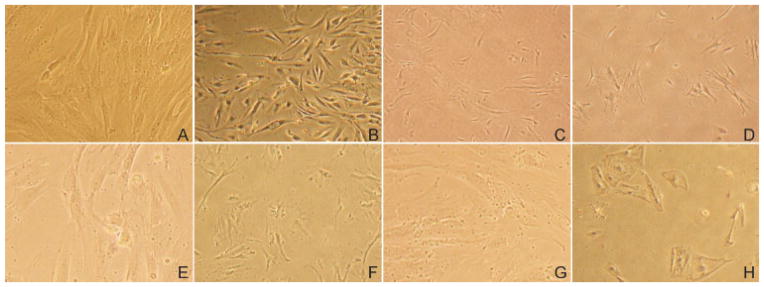
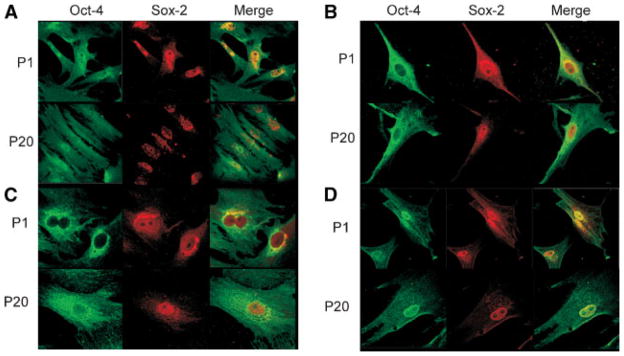
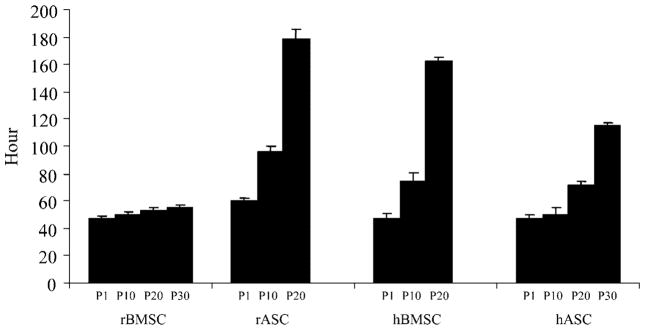
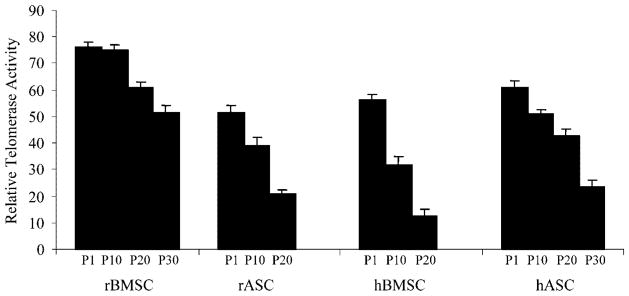
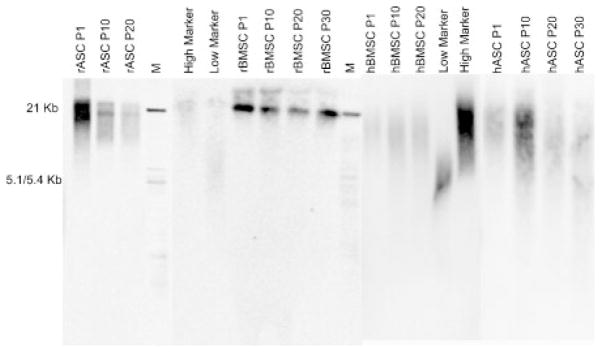
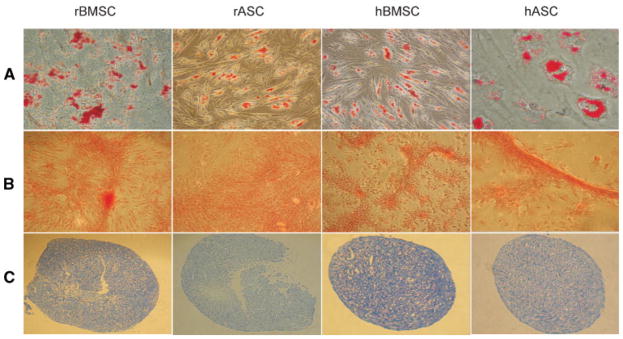
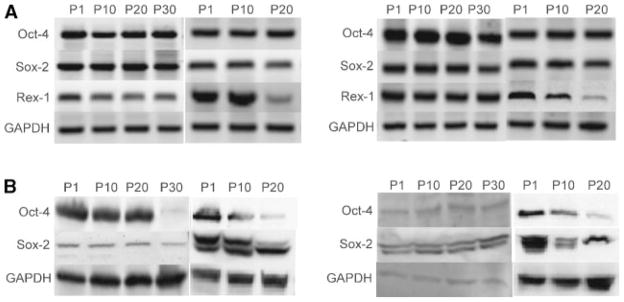
The biologic characteristics of mesenchymal stem cells (MSCs) isolated from two distinct tissues, bone marrow and adipose tissue were evaluated in these studies. MSCs derived from human and non-human primate (rhesus monkey) tissue sources were compared. The data indicate that MSCs isolated from rhesus bone marrow (rBMSCs) and human adipose tissue (hASCs) had more similar biologic properties than MSCs of rhesus adipose tissue (rASCs) and human bone marrow MSCs (hBMSCs). Analyses of in vitro growth kinetics revealed shorter doubling time for rBMSCs and hASCs. rBMSCs and hASCs underwent significantly more population doublings than the other MSCs. MSCs from all sources showed a marked decrease in telomerase activity over extended culture; however, they maintained their mean telomere length. All of the MSCs expressed embryonic stem cell markers, Oct-4, Rex-1, and Sox-2 for at least 10 passages. Early populations of MSCs types showed similar multilineage differentiation capability. However, only the rBMSCs and hASCs retain greater differentiation efficiency at higher passages. Overall in vitro characterization of MSCs from these two species and tissue sources revealed a high level of common biologic properties. However, the results demonstrate clear biologic distinctions, as well.
在这些研究中,对从两种不同组织(骨髓和脂肪组织)分离出的间充质干细胞(MSC)的生物学特性进行了评估。比较了源自人类和非人类灵长类动物(恒河猴)组织来源的MSC。数据表明,与恒河猴脂肪组织来源的MSC(rASC)和人类骨髓来源的MSC(hBMSC)相比,从恒河猴骨髓(rBMSC)和人类脂肪组织(hASC)分离出的MSC具有更相似的生物学特性。体外生长动力学分析显示,rBMSC和hASC的倍增时间更短。rBMSC和hASC经历的群体倍增次数明显多于其他MSC。所有来源的MSC在长时间培养后端粒酶活性均显著下降;然而,它们保持了平均端粒长度。所有MSC至少在传代10次时均表达胚胎干细胞标志物Oct-4、Rex-1和Sox-2。早期的MSC类型群体显示出相似的多向分化能力。然而,只有rBMSC和hASC在较高传代时仍保持更高的分化效率。对来自这两个物种和组织来源的MSC的整体体外特性分析显示出高度的共同生物学特性。然而,结果也表明了明显的生物学差异。