Tamosiunas Abdonas, Reklaitiene Regina, Virviciute Dalia, Sopagiene Diana
Department of Population Studies, Institute of Cardiology, Kaunas University of Medicine, Kaunas, Lithuania.
BMC Public Health. 2006 Jul 13;6:184. doi: 10.1186/1471-2458-6-184.
Throughout the last decade of the twentieth century, Lithuania had the highest suicide rates in Europe among both men and women aged 25-64 years. The rates increased from 1986 until 1995, but later there was a slight decrease. This paper describes the trends in suicide deaths in urban population in Lithuania by gender, dates and suicide method over the period 1984-2003.
Data from the regional mortality register were used to analyze suicide deaths among all men and women aged 25-64 years in Kaunas city, Lithuania over the period 1984-2003. Age-standardized death rates per 100,000 persons (using European standard population) were calculated by gender, suicide method and dates. A joinpoint regression method was used to estimate annual percentage changes (EPACs) and to detect points where the trends changed significantly.
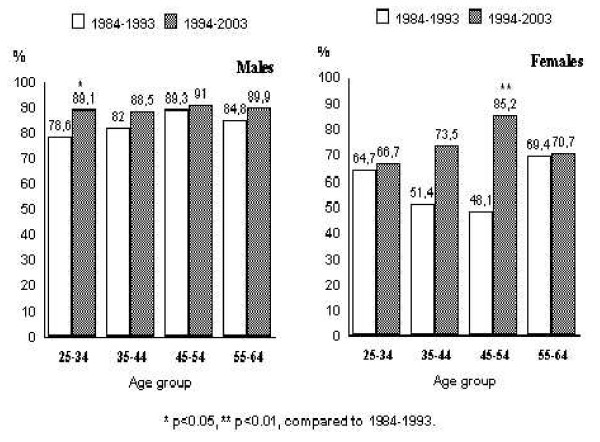
The frequency of death by suicide among males was 48% higher in 1994-2003 than in 1984-1993. The corresponding increase among females was 28%. The most common methods of suicide among men were hanging, strangulation and suffocation (87.4% among all suicide deaths). The proportions of hanging, strangulation and suffocation in males increased by 6.9% - from 83.9% to 89.7% - compared to a 24.2% increase in deaths from handgun, rifle and shotgun firearm discharges and a 216.7% increase in deaths from poisoning with solvents, gases, pesticides and vapors. Among females, the most common methods of suicide were hanging, strangulation and suffocation (68.3% of all suicide deaths). The proportion of hanging deaths among females increased during the time period examined, whereas the proportion of poisonings with solid or liquid substances decreased.
Suicide rates increased significantly among urban men aged 25-64 years in Lithuania throughout the period 1984-2003, whereas among women an increasing but statistically insignificant trend was observed. There were changes in the suicide methods used by both men and women. Changes in the choice of method may have contributed to the changes in suicide rates.
在20世纪的最后十年间,立陶宛25至64岁的男性和女性自杀率在欧洲各国中均为最高。自杀率从1986年至1995年呈上升趋势,但随后略有下降。本文描述了1984年至2003年期间立陶宛城市人口中按性别、日期和自杀方式划分的自杀死亡趋势。
利用地区死亡率登记数据,分析了1984年至2003年期间立陶宛考纳斯市所有25至64岁男性和女性的自杀死亡情况。按性别、自杀方式和日期计算了每10万人的年龄标准化死亡率(采用欧洲标准人口)。采用连接点回归方法估计年度百分比变化(EPACs),并检测趋势发生显著变化的点。
1994年至2003年男性自杀死亡频率比1984年至1993年高48%。女性相应的增幅为28%。男性最常见的自杀方式是上吊、勒颈和窒息(占所有自杀死亡人数的87.4%)。与手枪、步枪和猎枪射击造成的死亡人数增加24.2%以及溶剂、气体、农药和蒸汽中毒造成的死亡人数增加216.7%相比,男性上吊、勒颈和窒息的比例增加了6.9%,从83.9%增至89.7%。在女性中,最常见的自杀方式是上吊、勒颈和窒息(占所有自杀死亡人数的68.3%)。在所研究的时间段内,女性上吊死亡比例上升,而固体或液体物质中毒的比例下降。
1984年至2003年期间,立陶宛25至64岁城市男性的自杀率显著上升,而女性则呈现上升趋势,但从统计学角度来看并不显著。男性和女性使用的自杀方式均有变化。自杀方式选择的变化可能导致了自杀率的变化。