Blissmer Bryan, Riebe Deborah, Dye Gabriela, Ruggiero Laurie, Greene Geoffrey, Caldwell Marjorie
University of Rhode Island, Kingston RI 02881, USA.
Health Qual Life Outcomes. 2006 Jul 17;4:43. doi: 10.1186/1477-7525-4-43.
Despite a growing literature on the efficacy of behavioral weight loss interventions, we still know relatively little about the long terms effects they have on HRQL. Therefore, we conducted a study to investigate the immediate post-intervention (6 months) and long-term (12 and 24 months) effects of clinically based weight management programs on HRQL.
We conducted a randomized clinical trial in which all participants completed a 6 month clinical weight loss program and were randomized into two 6-month extended care groups. Participants then returned at 12 and 24 months for follow-up assessments. A total of 144 individuals (78% women, M age = 50.2 (9.2) yrs, M BMI = 32.5 (3.8) kg/m2) completed the 6 month intervention and 104 returned at 24 months. Primary outcomes of weight and HRQL using the SF-36 were analyzed using multivariate repeated measures analyses.
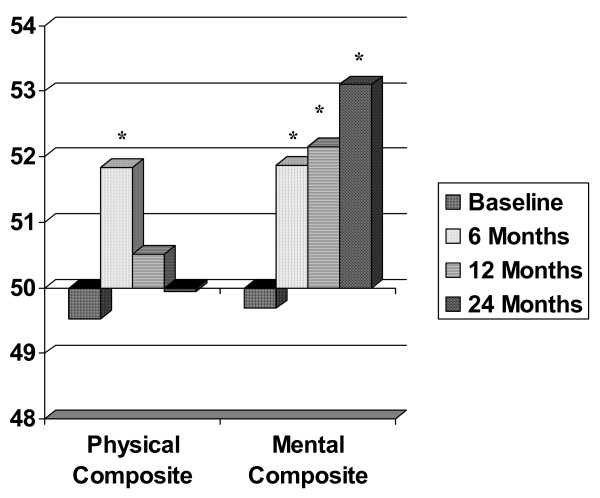
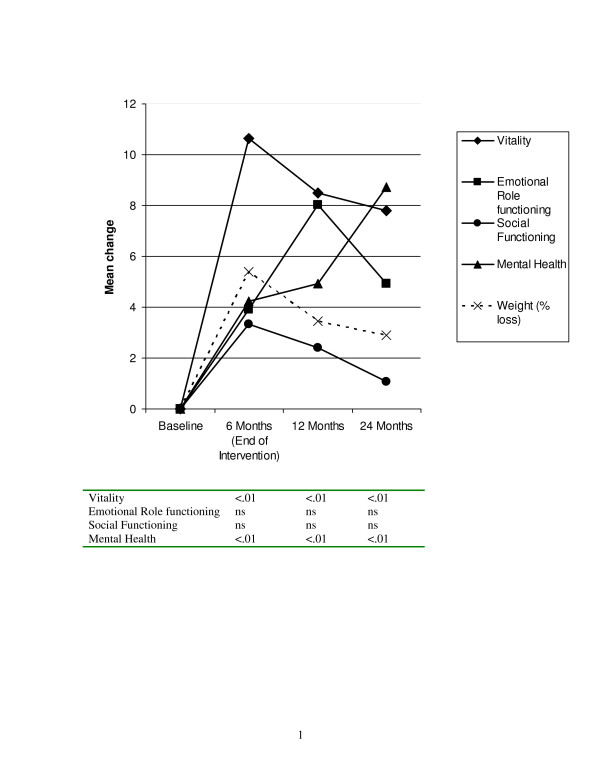
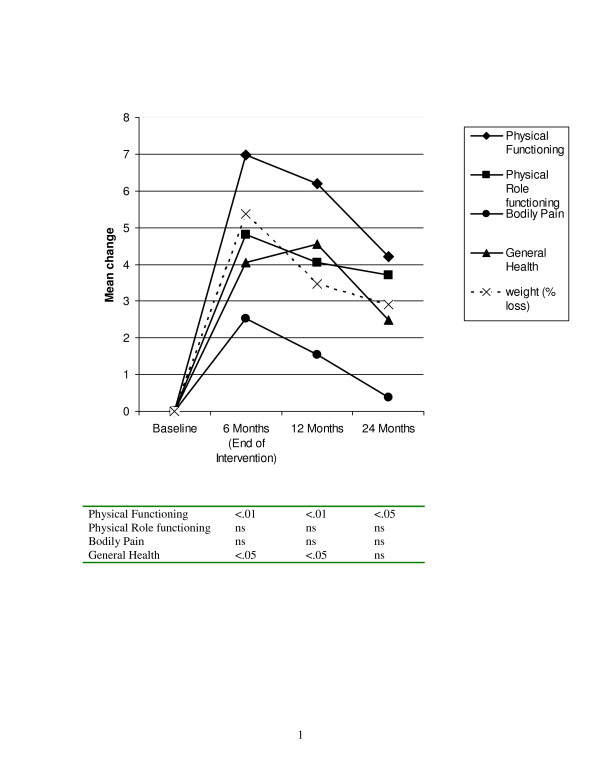
There was complete data on 91 participants through the 24 months of the study. At baseline the participants scored lower than U.S. age-specific population norms for bodily pain, vitality, and mental health. At the completion of the 6 month clinical intervention there were increases in the physical and mental composite measures as well as physical functioning, general health, vitality, and mental health subscales of the SF-36. Despite some weight regain, the improvements in the mental composite scale as well as the physical functioning, vitality, and mental health subscales were maintained at 24 months. There were no significant main effects or interactions by extended care treatment group or weight loss group (whether or not they maintained 5% loss at 24 months).
A clinical weight management program focused on behavior change was successful in improving several factors of HRQL at the completion of the program and many of those improvements were maintained at 24 months. Maintaining a significant weight loss (> 5%) was not necessary to have and maintain improvements in HRQL.
尽管关于行为减肥干预效果的文献越来越多,但我们对其对健康相关生活质量(HRQL)的长期影响仍知之甚少。因此,我们开展了一项研究,以调查基于临床的体重管理计划在干预后即刻(6个月)和长期(12个月和24个月)对HRQL的影响。
我们进行了一项随机临床试验,所有参与者都完成了一个为期6个月的临床减肥计划,并被随机分为两个为期6个月的延续护理组。参与者随后在12个月和24个月时返回进行随访评估。共有144人(78%为女性,平均年龄=50.2(9.2)岁,平均体重指数=32.5(3.8)kg/m²)完成了6个月的干预,104人在24个月时返回。使用SF-36对体重和HRQL的主要结局进行多变量重复测量分析。
在为期24个月的研究中,有91名参与者的完整数据。在基线时,参与者在身体疼痛、活力和心理健康方面的得分低于美国特定年龄人群的标准。在6个月的临床干预结束时,SF-36的身体和心理综合测量以及身体功能、总体健康、活力和心理健康子量表均有所增加。尽管体重有所反弹,但在24个月时,心理综合量表以及身体功能、活力和心理健康子量表的改善仍得以维持。延续护理治疗组或减肥组(无论他们在24个月时是否保持了5%的体重减轻)均无显著的主效应或交互作用。
一项专注于行为改变的临床体重管理计划在计划结束时成功改善了HRQL的几个因素,其中许多改善在24个月时得以维持。要实现并维持HRQL的改善,并不一定需要保持显著的体重减轻(>5%)。