
为稳定中性粒细胞极性,磷脂酰肌醇-3,4,5-三磷酸(PIP3)和Cdc42增强了细胞后部的RhoA活性以及前部的信号。
To stabilize neutrophil polarity, PIP3 and Cdc42 augment RhoA activity at the back as well as signals at the front.
作者信息
Van Keymeulen Alexandra, Wong Kit, Knight Zachary A, Govaerts Cedric, Hahn Klaus M, Shokat Kevan M, Bourne Henry R
机构信息
Department of Cellular and Molecular Pharmacology, and Cardiovascular Research Institute, University of California, San Francisco, San Francisco, CA 94143, USA.
出版信息
J Cell Biol. 2006 Jul 31;174(3):437-45. doi: 10.1083/jcb.200604113. Epub 2006 Jul 24.
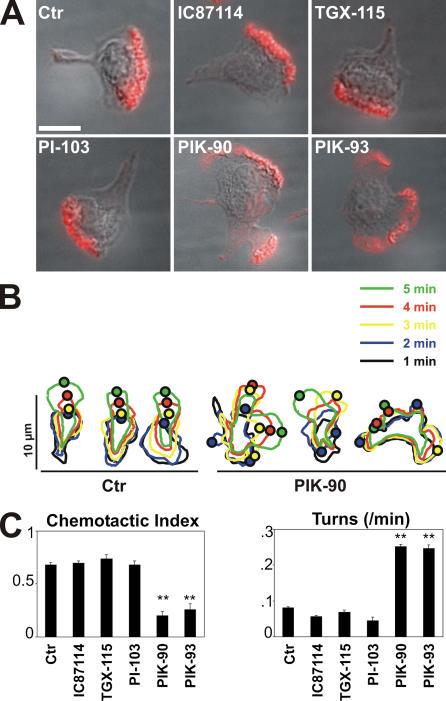
Chemoattractants like f-Met-Leu-Phe (fMLP) induce neutrophils to polarize by triggering divergent signals that promote the formation of protrusive filamentous actin (F-actin; frontness) and RhoA-dependent actomyosin contraction (backness). Frontness locally inhibits backness and vice versa. In neutrophil-like HL60 cells, blocking phosphatidylinositol-3,4,5-tris-phosphate (PIP3) accumulation with selective inhibitors of PIP3 synthesis completely prevents fMLP from activating a PIP3-dependent kinase and Cdc42 but not from stimulating F-actin accumulation. PIP3-deficient cells show reduced fMLP-dependent Rac activity and unstable pseudopods, which is consistent with the established role of PIP3 as a mediator of positive feedback pathways that augment Rac activation at the front. Surprisingly, such cells also show reduced RhoA activation and RhoA-dependent contraction at the trailing edge, leading to the formation of multiple lateral pseudopods. Cdc42 mediates PIP3's positive effect on RhoA activity. Thus, PIP3 and Cdc42 maintain stable polarity with a single front and a single back not only by strengthening pseudopods but also, at longer range, by promoting RhoA-dependent actomyosin contraction at the trailing edge.
像甲酰甲硫氨酸-亮氨酸-苯丙氨酸(fMLP)这样的趋化因子通过触发不同信号诱导中性粒细胞极化,这些信号促进突出的丝状肌动蛋白(F-肌动蛋白;前沿)的形成以及RhoA依赖的肌动球蛋白收缩(后端)。前沿局部抑制后端,反之亦然。在类中性粒细胞HL60细胞中,用PIP3合成的选择性抑制剂阻断磷脂酰肌醇-3,4,5-三磷酸(PIP3)的积累可完全阻止fMLP激活PIP3依赖的激酶和Cdc42,但不能阻止其刺激F-肌动蛋白积累。缺乏PIP3的细胞显示出fMLP依赖的Rac活性降低和伪足不稳定,这与PIP3作为增强前沿Rac激活的正反馈途径的介质的既定作用一致。令人惊讶的是,这类细胞在尾端也显示出RhoA激活和RhoA依赖的收缩减少,导致形成多个侧向伪足。Cdc42介导PIP3对RhoA活性的正向作用。因此,PIP3和Cdc42不仅通过加强伪足,而且在更远的范围内通过促进尾端RhoA依赖的肌动球蛋白收缩来维持具有单个前沿和单个后端的稳定极性。



 Zotero 插件