Eysenbach Gunther
Centre for Global eHealth Innovation, Toronto, Canada.
J Med Internet Res. 2006 May 15;8(2):e8. doi: 10.2196/jmir.8.2.e8.
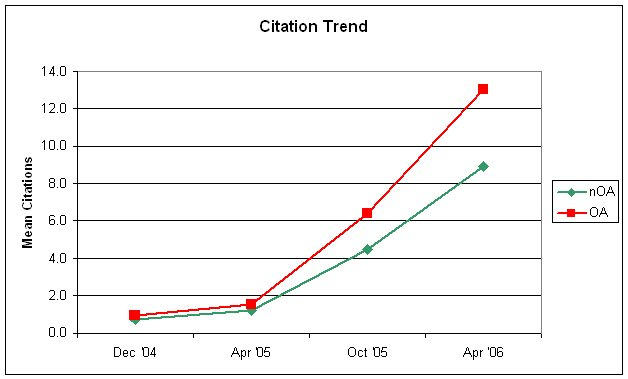
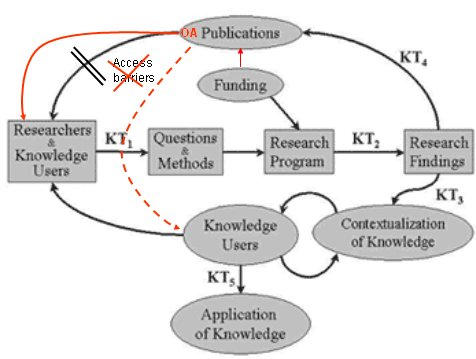
A study published today in PLoS Biology provides robust evidence that open-access articles are more immediately recognized and cited than non-OA articles. This editorial provides some additional follow up data from the most recent analysis of the same cohort in April 2006, 17 to 21 months after publication. These data suggest that the citation gap between open access and non-open access papers continues to widen. I conclude with the observation that the "open access advantage" has at least three components: (1) a citation count advantage (as a metric for knowledge uptake within the scientific community), (2) an end user uptake advantage, and (3) a cross-discipline fertilization advantage. More research is needed, and JMIR is inviting research on all aspects of open access. As the advantages for publishing open access from a researchers' point of view become increasingly clear, questions around the sustainability of open access journals remain. This journal is a living example that "lean publishing" models can create successful open access journals. Open source tools which have been developed by the Public Knowledge Project at the University of British Columbia with contributions from the Epublishing & Open Access group at the Centre for Global eHealth Innovation in Toronto are an alternative to hosting journals on commercial open access publisher sites.
今天发表于《公共科学图书馆·生物学》的一项研究提供了有力证据,表明开放获取文章比非开放获取文章更易被即时识别和引用。这篇社论提供了来自2006年4月对同一队列进行的最新分析的一些额外后续数据,该分析是在文章发表17至21个月后进行的。这些数据表明,开放获取论文与非开放获取论文之间的被引差距在持续扩大。我的结论是,“开放获取优势”至少有三个组成部分:(1)被引次数优势(作为科学界知识吸收的一个指标),(2)终端用户获取优势,以及(3)跨学科融合优势。还需要更多研究,《医学互联网研究杂志》(JMIR)正在邀请开展关于开放获取各方面的研究。从研究人员的角度来看,开放获取出版的优势日益明显,但围绕开放获取期刊可持续性的问题依然存在。本期刊就是一个生动的例子,表明“精益出版”模式能够创建成功的开放获取期刊。由英属哥伦比亚大学公共知识项目开发,并得到多伦多全球电子健康创新中心电子出版与开放获取小组贡献的开源工具,是在商业开放获取出版商网站上托管期刊的一种替代方案。