Helleman Jozien, van Staveren Iris L, Dinjens Winand N M, van Kuijk Patricia F, Ritstier Kirsten, Ewing Patricia C, van der Burg Maria E L, Stoter Gerrit, Berns Els M J J
Department of Medical Oncology, Erasmus MC/Daniel den Hoed Cancer Center, Rotterdam, The Netherlands.
BMC Cancer. 2006 Jul 31;6:201. doi: 10.1186/1471-2407-6-201.
The treatment of ovarian cancer is hindered by intrinsic or acquired resistance to platinum-based chemotherapy. The aim of this study is to determine the frequency of mismatch repair (MMR) inactivation in ovarian cancer and its association with resistance to platinum-based chemotherapy.
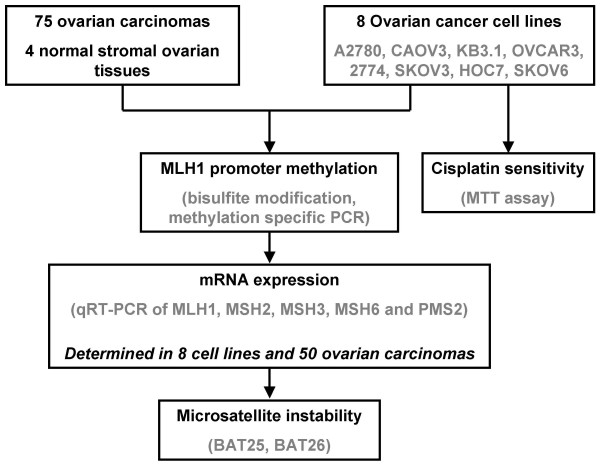
We determined, microsatellite instability (MSI) as a marker for MMR inactivation (analysis of BAT25 and BAT26), MLH1 promoter methylation status (methylation specific PCR on bisulfite treated DNA) and mRNA expression of MLH1, MSH2, MSH3, MSH6 and PMS2 (quantitative RT-PCR) in 75 ovarian carcinomas and eight ovarian cancer cell lines
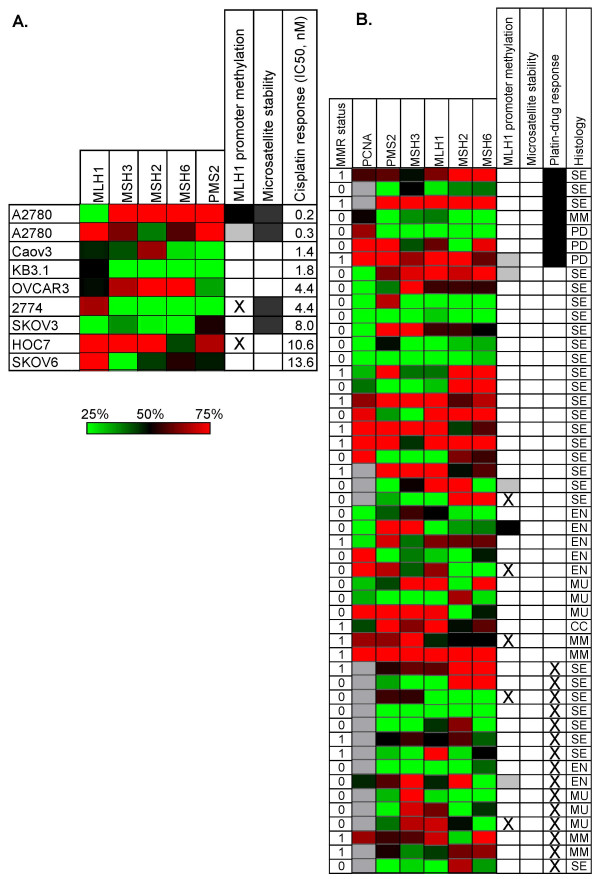
MSI was detected in three of the eight cell lines i.e. A2780 (no MLH1 mRNA expression due to promoter methylation), SKOV3 (no MLH1 mRNA expression) and 2774 (no altered expression of MMR genes). Overall, there was no association between cisplatin response and MMR status in these eight cell lines. Seven of the 75 ovarian carcinomas showed MLH1 promoter methylation, however, none of these showed MSI. Forty-six of these patients received platinum-based chemotherapy (11 non-responders, 34 responders, one unknown response). The resistance seen in the eleven non-responders was not related to MSI and therefore also not to MMR inactivation.
No MMR inactivation was detected in 75 ovarian carcinoma specimens and no association was seen between MMR inactivation and resistance in the ovarian cancer cell lines as well as the ovarian carcinomas. In the discussion, the results were compared to that of twenty similar studies in the literature including in total 1315 ovarian cancer patients. Although no association between response and MMR status was seen in the primary tumor the possible role of MMR inactivation in acquired resistance deserves further investigation.
卵巢癌的治疗受到对铂类化疗药物的内在或获得性耐药的阻碍。本研究的目的是确定卵巢癌中错配修复(MMR)失活的频率及其与铂类化疗耐药性的关系。
我们检测了75例卵巢癌组织和8种卵巢癌细胞系中的微卫星不稳定性(MSI)作为MMR失活的标志物(分析BAT25和BAT26)、MLH1启动子甲基化状态(对亚硫酸氢盐处理的DNA进行甲基化特异性PCR)以及MLH1、MSH2、MSH3、MSH6和PMS2的mRNA表达(定量RT-PCR)。
在8种细胞系中的3种检测到MSI,即A2780(由于启动子甲基化无MLH1 mRNA表达)、SKOV3(无MLH1 mRNA表达)和2774(MMR基因表达无改变)。总体而言,这8种细胞系中顺铂反应与MMR状态之间无关联。75例卵巢癌中有7例显示MLH1启动子甲基化,但均未显示MSI。这些患者中有46例接受了铂类化疗(11例无反应者,34例反应者,1例反应情况未知)。11例无反应者中观察到的耐药与MSI无关,因此也与MMR失活无关。
在75例卵巢癌标本中未检测到MMR失活,在卵巢癌细胞系和卵巢癌中MMR失活与耐药之间也未发现关联。在讨论中,将结果与文献中20项类似研究(共纳入1315例卵巢癌患者)的结果进行了比较。尽管在原发性肿瘤中未观察到反应与MMR状态之间的关联,但MMR失活在获得性耐药中的可能作用值得进一步研究。