Blüthgen Nico, Menzel Florian, Blüthgen Nils
Department of Animal Ecology and Tropical Biology, University of Würzburg, Biozentrum, Am Hubland, 97074 Würzburg, Germany.
BMC Ecol. 2006 Aug 14;6:9. doi: 10.1186/1472-6785-6-9.
Network analyses of plant-animal interactions hold valuable biological information. They are often used to quantify the degree of specialization between partners, but usually based on qualitative indices such as 'connectance' or number of links. These measures ignore interaction frequencies or sampling intensity, and strongly depend on network size.
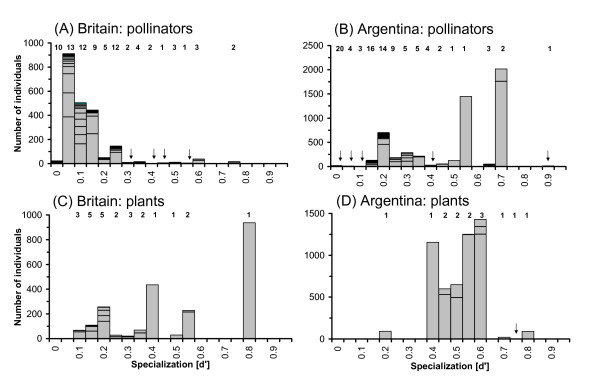
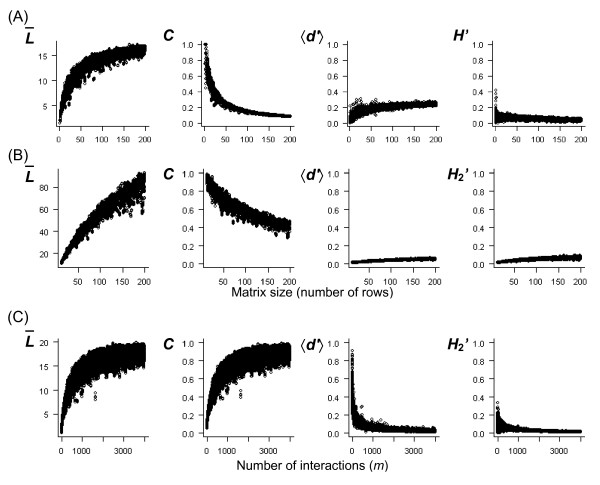
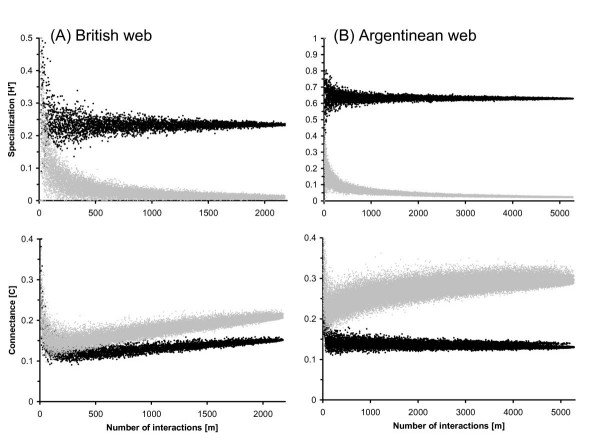
Here we introduce two quantitative indices using interaction frequencies to describe the degree of specialization, based on information theory. The first measure (d') describes the degree of interaction specialization at the species level, while the second measure (H2') characterizes the degree of specialization or partitioning among two parties in the entire network. Both indices are mathematically related and derived from Shannon entropy. The species-level index d' can be used to analyze variation within networks, while H2' as a network-level index is useful for comparisons across different interaction webs. Analyses of two published pollinator networks identified differences and features that have not been detected with previous approaches. For instance, plants and pollinators within a network differed in their average degree of specialization (weighted mean d'), and the correlation between specialization of pollinators and their relative abundance also differed between the webs. Rarefied sampling effort in both networks and null model simulations suggest that H2' is not affected by network size or sampling intensity.
Quantitative analyses reflect properties of interaction networks more appropriately than previous qualitative attempts, and are robust against variation in sampling intensity, network size and symmetry. These measures will improve our understanding of patterns of specialization within and across networks from a broad spectrum of biological interactions.
植物 - 动物相互作用的网络分析蕴含着宝贵的生物学信息。它们常被用于量化伙伴之间的专业化程度,但通常基于诸如“连通度”或连接数等定性指标。这些度量忽略了相互作用频率或采样强度,并且强烈依赖于网络规模。
在此,我们基于信息论引入两个使用相互作用频率来描述专业化程度的定量指标。第一个度量(d')描述了物种水平上的相互作用专业化程度,而第二个度量(H2')表征了整个网络中双方之间的专业化或划分程度。这两个指标在数学上相互关联且均源自香农熵。物种水平指标d'可用于分析网络内的变异,而作为网络水平指标的H2'对于跨不同相互作用网络的比较很有用。对两个已发表的传粉者网络的分析揭示了以前方法未检测到的差异和特征。例如,一个网络内的植物和传粉者在其平均专业化程度(加权平均d')上存在差异,并且传粉者专业化与其相对丰度之间的相关性在不同网络中也有所不同。两个网络中的稀疏采样努力和空模型模拟表明,H2'不受网络规模或采样强度的影响。
定量分析比以前的定性尝试更能恰当地反映相互作用网络的特性,并且对采样强度、网络规模和对称性的变化具有鲁棒性。这些度量将增进我们对来自广泛生物相互作用的网络内部和跨网络专业化模式的理解。