Veiga Nicolás, Torres Julia, Domínguez Sixto, Mederos Alfredo, Irvine Robin F, Díaz Alvaro, Kremer Carlos
Cátedra de Química Inorgánica, Departamento Estrella Campos, Facultad de Química, Universidad de la República, Montevideo, Uruguay.
J Inorg Biochem. 2006 Nov;100(11):1800-10. doi: 10.1016/j.jinorgbio.2006.06.016. Epub 2006 Jul 20.
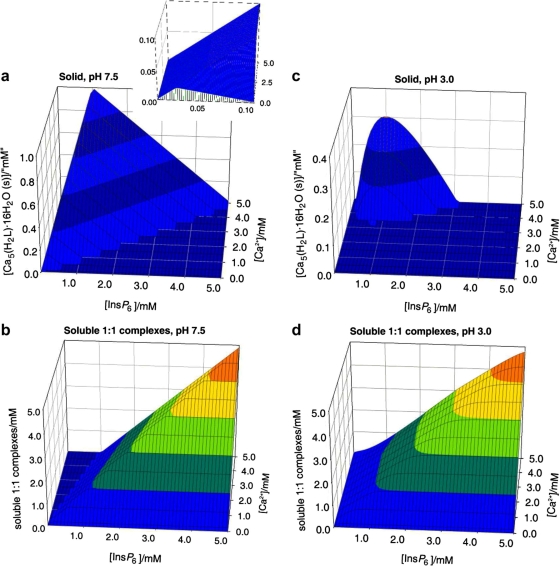
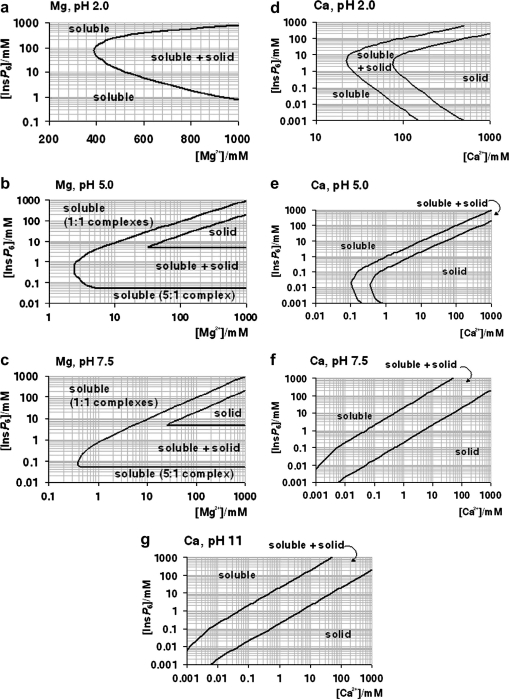
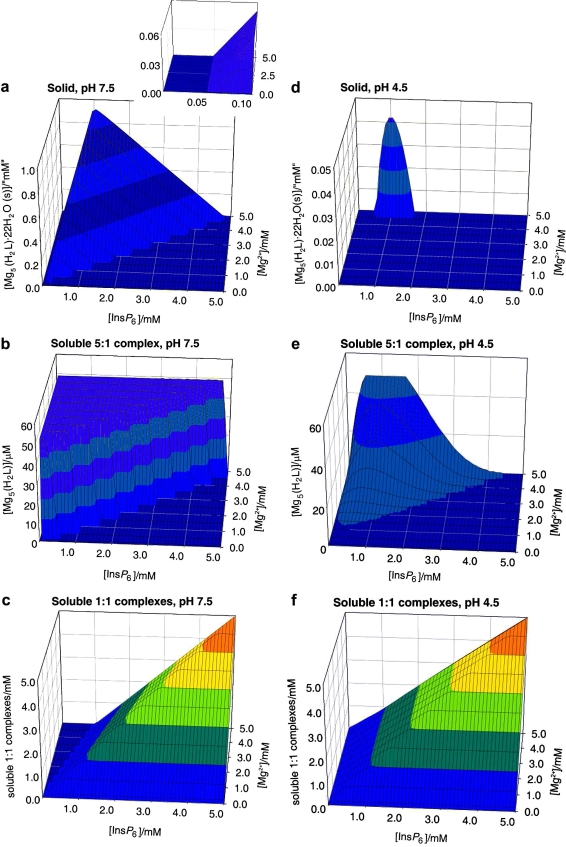
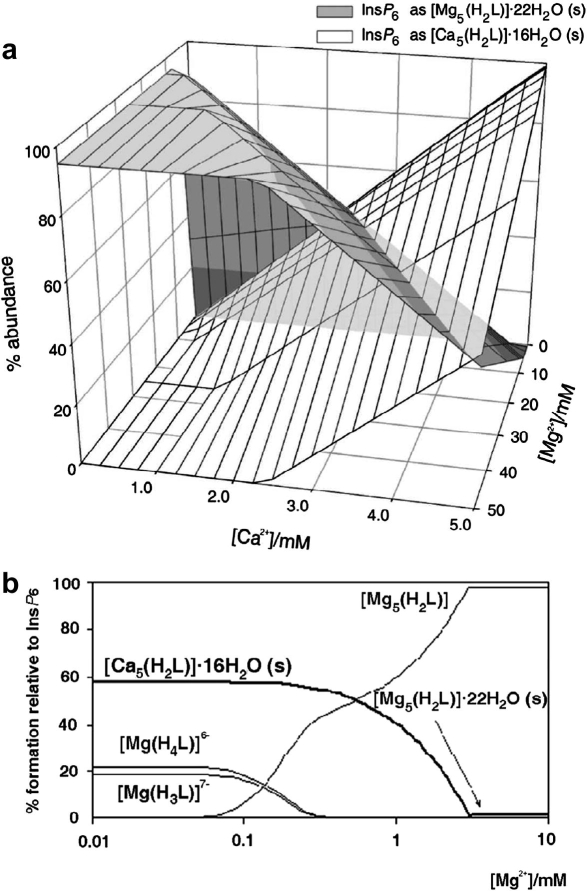
Progress in the biology of myo-inositol hexakisphosphate (InsP(6)) has been delayed by the lack of a quantitative description of its multiple interactions with divalent cations. Our recent initial description of these [J. Torres, S. Dominguez, M.F. Cerda, G. Obal, A. Mederos, R.F. Irvine, A. Diaz, C. Kremer, J. Inorg. Biochem. 99 (2005) 828-840] predicted that under cytosolic/nuclear conditions, protein-free soluble InsP(6) occurs as Mg(5)(H(2)L), a neutral complex that exists thanks to a significant, but undefined, window of solubility displayed by solid Mg(5)(H(2)L).22H(2)O (L is fully deprotonated InsP(6)). Here we complete the description of the InsP(6)-Mg(2+)-Ca(2+) system, defining the solubilities of the Mg(2+) and Ca(2+) (Ca(5)(H(2)L).16H(2)O) solids in terms of K(s0)=M(2+)[H(2)L(10-)], with pK(s0)=32.93 for M=Mg and pK(s0)=39.3 for M=Ca. The concentration of soluble Mg(5)(H(2)L) at 37 degrees C and I=0.15M NaClO(4) is limited to 49muM, yet InsP(6) in mammalian cells may reach 100muM. Any cytosolic/nuclear InsP(6) in excess of 49muM must be protein- or membrane-bound, or as solid Mg(5)(H(2)L).22H(2)O, and any extracellular InsP(6) (e.g. in plasma) is surely protein-bound.
由于缺乏对肌醇六磷酸(InsP(6))与二价阳离子多种相互作用的定量描述,其生物学研究进展一直滞后。我们最近对这些相互作用的初步描述[J. Torres, S. Dominguez, M.F. Cerda, G. Obal, A. Mederos, R.F. Irvine, A. Diaz, C. Kremer, J. Inorg. Biochem. 99 (2005) 828 - 840]预测,在胞质/核条件下,无蛋白的可溶性InsP(6)以Mg(5)(H(2)L)形式存在,这是一种中性复合物,其存在得益于固体Mg(5)(H(2)L).22H(2)O(L为完全去质子化的InsP(6))所显示的显著但未明确的溶解度窗口。在此,我们完善了InsP(6)-Mg(2+)-Ca(2+)系统的描述,根据K(s0)=M(2+)[H(2)L(10-)]定义了Mg(2+)和Ca(2+)(Ca(5)(H(2)L).16H(2)O)固体的溶解度,M = Mg时pK(s0)=32.93,M = Ca时pK(s0)=39.3。在37℃和I = 0.15M NaClO(4)条件下,可溶性Mg(5)(H(2)L)的浓度限制为49μM,但哺乳动物细胞中的InsP(6)可能达到100μM。任何超过49μM的胞质/核InsP(6)必定与蛋白质或膜结合,或以固体Mg(5)(H(2)L).22H(2)O形式存在,而任何细胞外InsP(6)(如血浆中的)肯定与蛋白质结合。