Maezawa Izumi, Zaja-Milatovic Snjezana, Milatovic Dejan, Stephen Christina, Sokal Izabela, Maeda Nobuyo, Montine Thomas J, Montine Kathleen S
Department of Pathology, University of Washington, Seattle, WA, USA.
J Neuroinflammation. 2006 Aug 25;3:21. doi: 10.1186/1742-2094-3-21.
Innate immune activation, including a role for cluster of differentiation 14/toll-like receptor 4 co-receptors (CD14/TLR-4) co-receptors, has been implicated in paracrine damage to neurons in several neurodegenerative diseases that also display stratification of risk or clinical outcome with the common alleles of the apolipoprotein E gene (APOE): APOE2, APOE3, and APOE4. Previously, we have shown that specific stimulation of CD14/TLR-4 with lipopolysaccharide (LPS) leads to greatest innate immune response by primary microglial cultures from targeted replacement (TR) APOE4 mice and greatest p38MAPK-dependent paracrine damage to neurons in mixed primary cultures and hippocampal slice cultures derived from TR APOE4 mice. In contrast, TR APOE2 astrocytes had the highest NF-kappaB activity and no neurotoxicity. Here we tested the hypothesis that direct activation of CD14/TLR-4 in vivo would yield different amounts of paracrine damage to hippocampal sector CA1 pyramidal neurons in TR APOE mice.
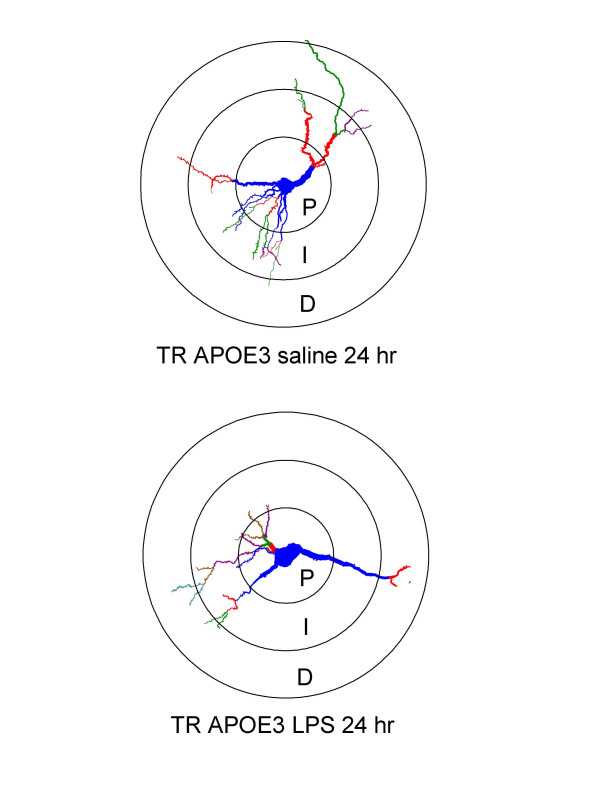
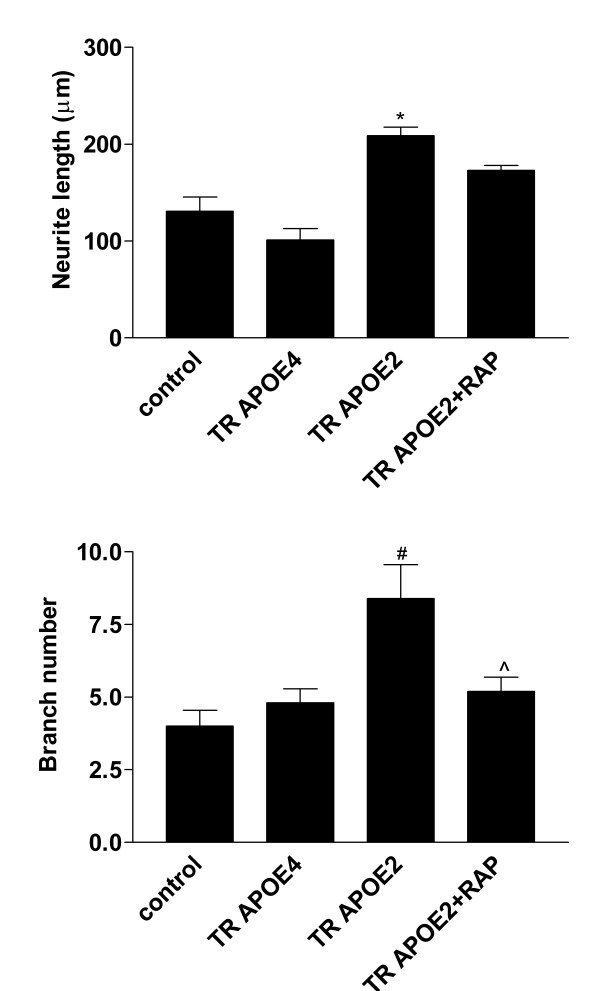
We measured in vivo changes in dendrite length in hippocampal CA1 neurons using Golgi staining and determined hippocampal apoE levels by Western blot. Neurite outgrowth of cultured primary neurons in response to astrocyte conditioned medium was assessed by measuring neuron length and branch number.
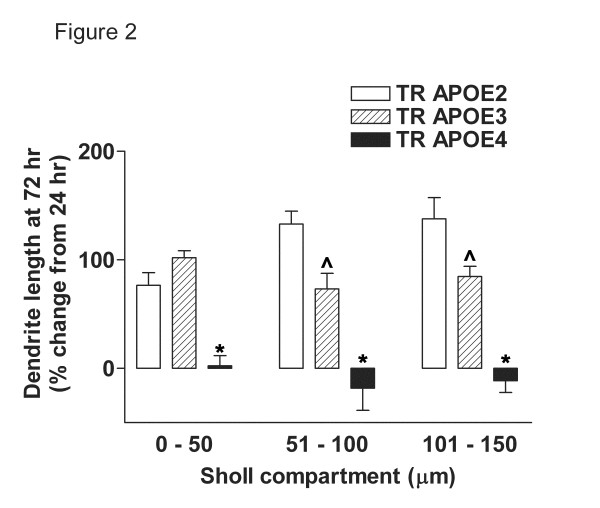
Our results showed that TR APOE4 mice had slightly but significantly shorter dendrites at 6 weeks of age. Following exposure to intracerebroventricular LPS, there was comparable loss of dendrite length at 24 hr among the three TR APOE mice. Recovery of dendrite length over the next 48 hr was greater in TR APOE2 than TR APOE3 mice, while TR APOE4 mice had failure of dendrite regeneration. Cell culture experiments indicated that the enhanced neurotrophic effect of TR APOE2 was LDL related protein-dependent.
The data indicate that the environment within TR APOE2 mouse hippocampus was most supportive of dendrite regeneration while that within TR APOE4 hippocampus failed to support dendrite regeneration in this model of reversible paracrine damage to neurons from innate immune activation, and suggest an explanation for the stratification of clinical outcome with APOE seen in several degenerative diseases or brain that are associated with activated innate immune response.
先天性免疫激活,包括分化簇14/ toll样受体4共受体(CD14/TLR-4)共受体的作用,已被认为在几种神经退行性疾病中对神经元产生旁分泌损伤,这些疾病在载脂蛋白E基因(APOE)的常见等位基因:APOE2、APOE3和APOE4方面也表现出风险分层或临床结果差异。此前,我们已经表明,用脂多糖(LPS)特异性刺激CD14/TLR-4会导致来自靶向替换(TR)APOE4小鼠的原代小胶质细胞培养物产生最大的先天性免疫反应,并且在来自TR APOE4小鼠的混合原代培养物和海马切片培养物中对神经元产生最大的p38MAPK依赖性旁分泌损伤。相比之下,TR APOE2星形胶质细胞具有最高的NF-κB活性且无神经毒性。在这里,我们测试了一个假设,即在体内直接激活CD14/TLR-4会对TR APOE小鼠海马CA1区锥体神经元产生不同程度的旁分泌损伤。
我们使用高尔基染色测量海马CA1神经元树突长度的体内变化,并通过蛋白质印迹法测定海马apoE水平。通过测量神经元长度和分支数量来评估培养的原代神经元对星形胶质细胞条件培养基的神经突生长情况。
我们的结果表明,TR APOE4小鼠在6周龄时树突略短但显著缩短。在脑室内注射LPS后,三种TR APOE小鼠在24小时时树突长度的损失相当。在接下来的48小时内,TR APOE2小鼠的树突长度恢复比TR APOE3小鼠更大,而TR APOE4小鼠的树突再生失败。细胞培养实验表明,TR APOE2增强的神经营养作用与低密度脂蛋白相关蛋白有关。
数据表明,在这种先天性免疫激活对神经元的可逆旁分泌损伤模型中,TR APOE2小鼠海马内的环境最有利于树突再生,而TR APOE4海马内的环境则无法支持树突再生,并为在几种与先天性免疫反应激活相关的退行性疾病或大脑中观察到的APOE临床结果分层提供了解释。