Beurel Eléonore, Jope Richard S
Department of Psychiatry and Behavioral Neurobiology, Sparks Center 1057, University of Alabama at Birmingham, Birmingham, AL 35294-0017, USA.
Prog Neurobiol. 2006 Jul;79(4):173-89. doi: 10.1016/j.pneurobio.2006.07.006. Epub 2006 Aug 28.
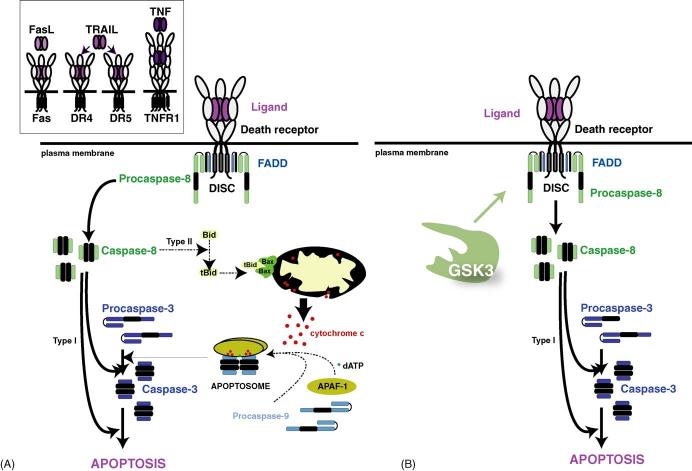
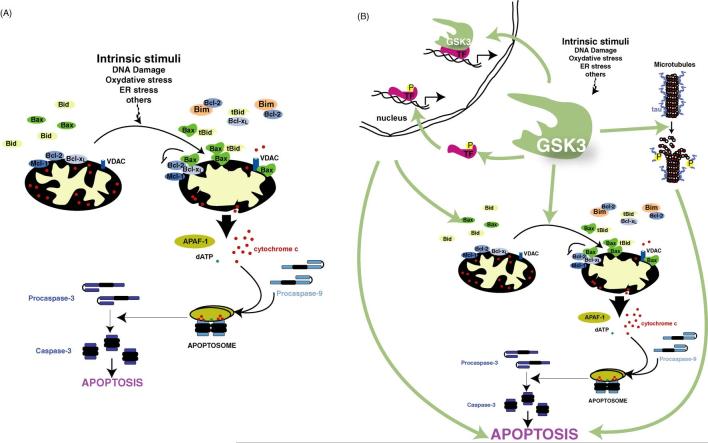
Few things can be considered to be more important to a cell than its threshold for apoptotic cell death, which can be modulated up or down, but rarely in both directions, by a single enzyme. Therefore, it came as quite a surprise to find that one enzyme, glycogen synthase kinase-3 (GSK3), has the perplexing capacity to either increase or decrease the apoptotic threshold. These apparently paradoxical effects now are known to be due to GSK3 oppositely regulating the two major apoptotic signaling pathways. GSK3 promotes cell death caused by the mitochondrial intrinsic apoptotic pathway, but inhibits the death receptor-mediated extrinsic apoptotic signaling pathway. Intrinsic apoptotic signaling, activated by cell damage, is promoted by GSK3 by facilitation of signals that cause disruption of mitochondria and by regulation of transcription factors that control the expression of anti- or pro-apoptotic proteins. The extrinsic apoptotic pathway entails extracellular ligands stimulating cell-surface death receptors that initiate apoptosis by activating caspase-8, and this early step in extrinsic apoptotic signaling is inhibited by GSK3. Thus, GSK3 modulates key steps in each of the two major pathways of apoptosis, but in opposite directions. Consequently, inhibitors of GSK3 provide protection from intrinsic apoptosis signaling but potentiate extrinsic apoptosis signaling. Studies of this eccentric ability of GSK3 to oppositely influence two types of apoptotic signaling have shed light on important regulatory mechanisms in apoptosis and provide the foundation for designing the rational use of GSK3 inhibitors for therapeutic interventions.
对细胞而言,几乎没有什么比其凋亡性细胞死亡阈值更重要的了,凋亡阈值可通过单一酶上调或下调,但很少能双向调节。因此,发现一种酶——糖原合酶激酶-3(GSK3)具有增加或降低凋亡阈值这种令人困惑的能力,着实令人惊讶。现在已知这些明显矛盾的效应是由于GSK3对两条主要凋亡信号通路的调节作用相反。GSK3促进由线粒体内在凋亡途径引起的细胞死亡,但抑制死亡受体介导的外在凋亡信号通路。由细胞损伤激活的内在凋亡信号传导,通过促进导致线粒体破坏的信号以及通过调节控制抗凋亡或促凋亡蛋白表达的转录因子,由GSK3促进。外在凋亡途径需要细胞外配体刺激细胞表面死亡受体,这些受体通过激活半胱天冬酶-8引发凋亡,而GSK3抑制外在凋亡信号传导的这一早期步骤。因此,GSK3调节凋亡的两条主要途径中每一条的关键步骤,但方向相反。因此,GSK3抑制剂可提供对内在凋亡信号传导的保护,但增强外在凋亡信号传导。对GSK3这种反常能力的研究,即相反地影响两种类型的凋亡信号传导,揭示了凋亡中的重要调节机制,并为合理设计用于治疗干预的GSK3抑制剂奠定了基础。