Lluri Gentian, Langlois Garret D, McClellan Brian, Soloway Paul D, Jaworski Diane M
Department of Anatomy and Neurobiology, University of Vermont College of Medicine, Burlington, Vermont 05405, USA.
J Neurobiol. 2006 Oct;66(12):1365-77. doi: 10.1002/neu.20315.
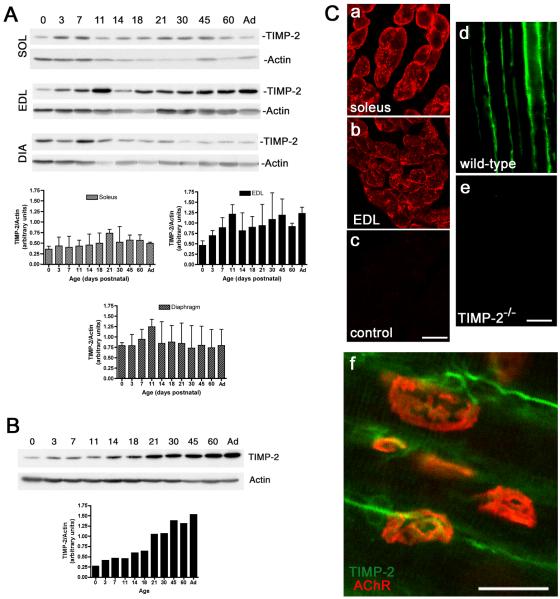
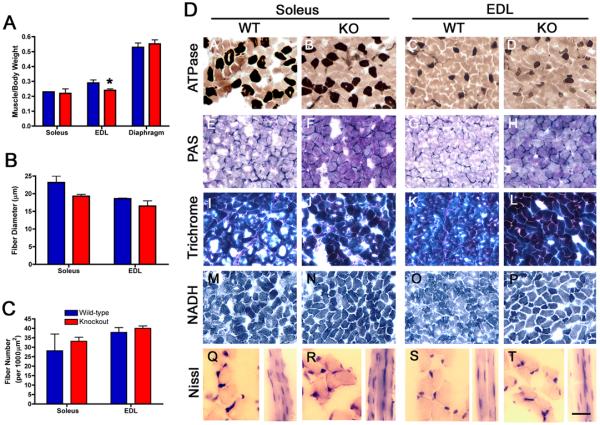
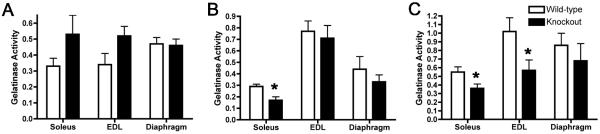
Extracellular matrix (ECM) molecules play critical roles in muscle function by participating in neuromuscular junction (NMJ) development and the establishment of stable, cytoskeleton-associated adhesions required for muscle contraction. Matrix metalloproteinases (MMPs) are neutral endopeptidases that degrade all ECM components. While the role of MMPs and their inhibitors, the tissue inhibitor of metalloproteinases (TIMPs), has been investigated in many tissues, little is known about their role in muscle development and mature function. TIMP-2 -/- mice display signs of muscle weakness. Here, we report that TIMP-2 is expressed at the NMJ and its expression is greater in fast-twitch (extensor digitorum longus, EDL) than slow-twitch (soleus) muscle. EDL muscle mass is reduced in TIMP-2-/- mice without a concomitant change in fiber diameter or number. The TIMP-2-/- phenotype is not likely due to increased ECM proteolysis because net MMP activity is actually reduced in TIMP-2-/- muscle. Most strikingly, TIMP-2 colocalizes with beta1 integrin at costameres in the wild-type EDL and beta1 integrin expression is significantly reduced in TIMP-2-/- EDL. We propose that reduced beta1 integrin in fast-twitch muscle may be associated with destabilized ECM-cytoskeletal interactions required for muscle contraction in TIMP-2-/- muscle; thus, explaining the muscle weakness. Given that fast-twitch fibers are lost in muscular dystrophies and age-related sarcopenia, if TIMP-2 regulates mechanotransduction in an MMP-independent manner it opens new potential therapeutic avenues.
细胞外基质(ECM)分子通过参与神经肌肉接头(NMJ)发育以及肌肉收缩所需的稳定的、与细胞骨架相关的黏附的建立,在肌肉功能中发挥关键作用。基质金属蛋白酶(MMPs)是降解所有ECM成分的中性内肽酶。虽然MMPs及其抑制剂金属蛋白酶组织抑制剂(TIMPs)在许多组织中的作用已得到研究,但它们在肌肉发育和成熟功能中的作用却知之甚少。TIMP-2基因敲除小鼠表现出肌肉无力的迹象。在此,我们报告TIMP- 在NMJ处表达,且其在快肌(趾长伸肌,EDL)中的表达高于慢肌(比目鱼肌)。TIMP-2基因敲除小鼠的EDL肌肉质量降低,而肌纤维直径或数量没有相应变化。TIMP-2基因敲除小鼠的表型不太可能是由于ECM蛋白水解增加,因为在TIMP-2基因敲除的肌肉中,MMP的净活性实际上是降低的。最引人注目的是,在野生型EDL中,TIMP-2与β1整合素在肌小节处共定位,而在TIMP-2基因敲除的EDL中,β1整合素的表达显著降低。我们提出,快肌中β1整合素的减少可能与TIMP-2基因敲除肌肉中肌肉收缩所需的ECM-细胞骨架相互作用不稳定有关;因此,解释了肌肉无力的现象。鉴于快肌纤维在肌肉营养不良和与年龄相关的肌肉减少症中会丢失,如果TIMP-2以不依赖MMP的方式调节机械转导,那么它将开辟新的潜在治疗途径。