Haynes Robin, Jones Andrew P, Sauerzapf Violet, Zhao Hongxin
School of Environmental Sciences, University of East Anglia, Norwich NR4 7TJ, UK.
Int J Health Geogr. 2006 Sep 19;5:40. doi: 10.1186/1476-072X-5-40.
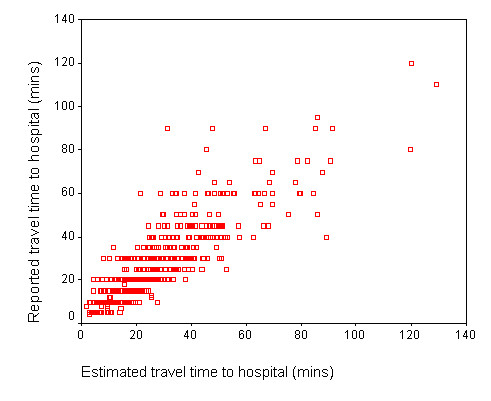
An increasing number of studies use GIS estimates of car travel times to health services, without presenting any evidence that the estimates are representative of real travel times. This investigation compared GIS estimates of travel times with the actual times reported by a sample of 475 cancer patients who had travelled by car to attend clinics at eight hospitals in the North of England.
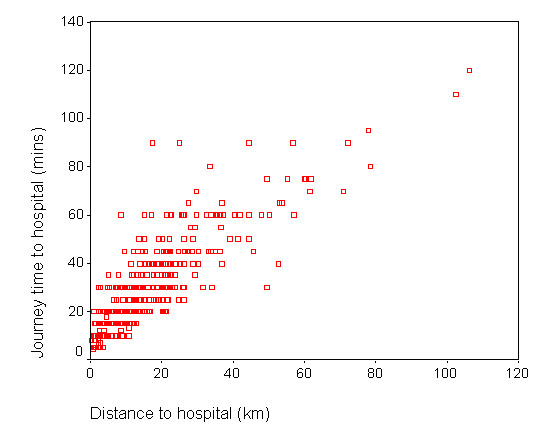
Car travel times were estimated by GIS using the shortest road route between home address and hospital and average speed assumptions. These estimates were compared with reported journey times and straight line distances using graphical, correlation and regression techniques.
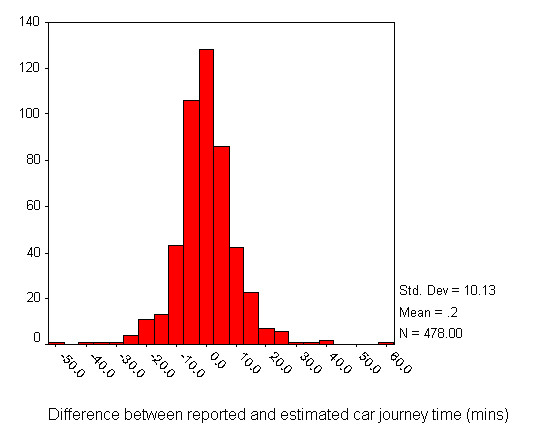
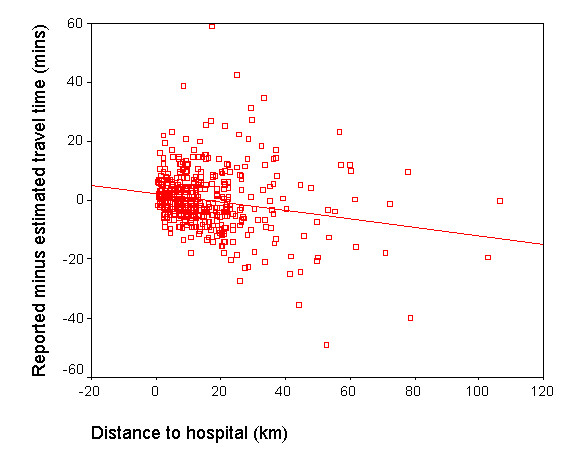
There was a moderately strong association between reported times and estimated travel times (r = 0.856). Reported travel times were similarly related to straight line distances. Altogether, 50% of travel time estimates were within five minutes of the time reported by respondents, 77% were within ten minutes and 90% were within fifteen minutes. The distribution of over- and under-estimates was symmetrical, but estimated times tended to be longer than reported times with increasing distance from hospital. Almost all respondents rounded their travel time to the nearest five or ten minutes. The reason for many cases of reported journey times exceeding the estimated times was confirmed by respondents' comments as traffic congestion.
GIS estimates of car travel times were moderately close approximations to reported times. GIS travel time estimates may be superior to reported travel times for modelling purposes because reported times contain errors and can reflect unusual circumstances. Comparison with reported times did not suggest that estimated times were a more sensitive measure than straight line distance.
越来越多的研究使用地理信息系统(GIS)估算前往医疗服务机构的驾车出行时间,但却没有提供任何证据表明这些估算是实际出行时间的代表。本调查将475名乘坐汽车前往英格兰北部八家医院就诊的癌症患者样本报告的实际出行时间与GIS估算的出行时间进行了比较。
GIS通过使用家庭住址与医院之间的最短道路路线和平均速度假设来估算驾车出行时间。使用图形、相关性和回归技术将这些估算值与报告的出行时间和直线距离进行比较。
报告时间与估算出行时间之间存在中等强度的关联(r = 0.856)。报告的出行时间与直线距离也有类似的关系。总体而言,50%的出行时间估算值与受访者报告的时间相差在五分钟内,77%相差在十分钟内,90%相差在十五分钟内。高估和低估的分布是对称的,但随着与医院距离的增加,估算时间往往比报告时间长。几乎所有受访者都将出行时间四舍五入到最接近的五分钟或十分钟。受访者的评论证实,许多报告的出行时间超过估算时间的情况是由于交通拥堵。
GIS对驾车出行时间的估算与报告时间较为接近。出于建模目的,GIS出行时间估算可能优于报告的出行时间,因为报告时间包含误差且可能反映特殊情况。与报告时间的比较并未表明估算时间比直线距离更敏感。