Qian Xiang, Niu Xiaowei, Magleby Karl L
Department of Physiology and Biophysics, University of Miami Miller School of Medicine, Miami, FL 33101, USA.
J Gen Physiol. 2006 Oct;128(4):389-404. doi: 10.1085/jgp.200609486.
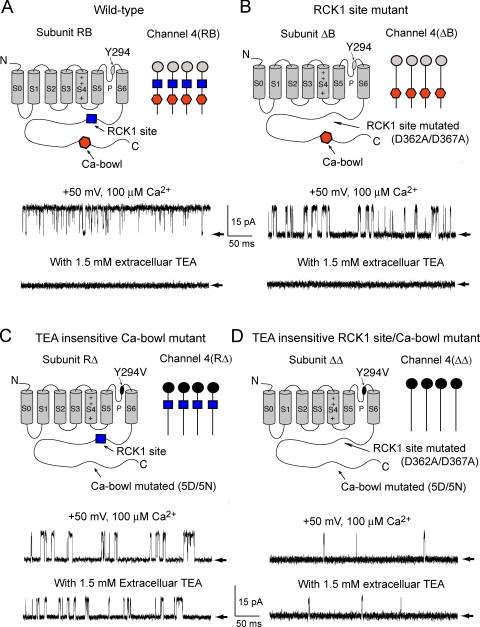
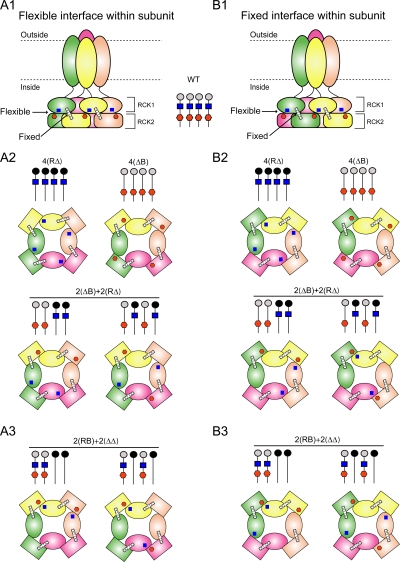
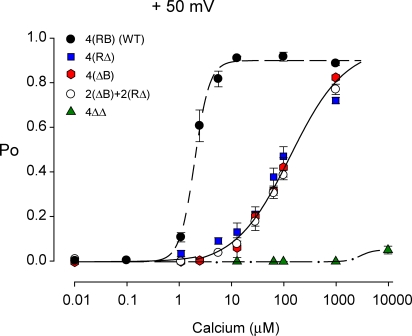
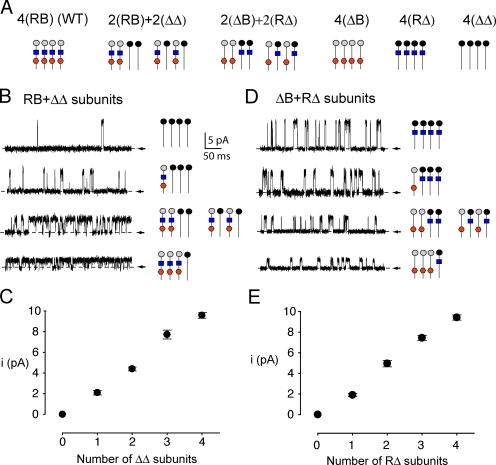
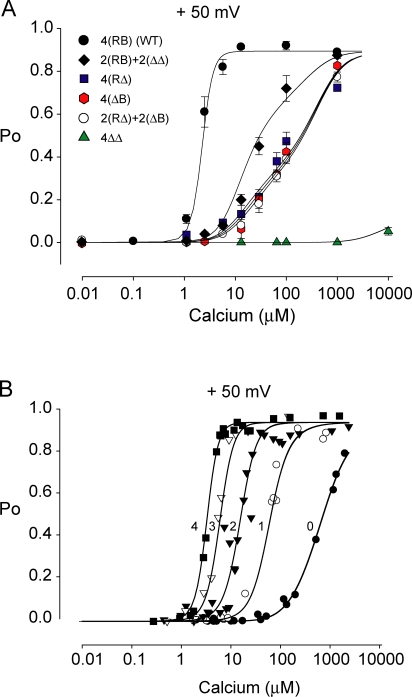
The activation of BK channels by Ca(2+) is highly cooperative, with small changes in intracellular Ca(2+) concentration having large effects on open probability (Po). Here we examine the mechanism of cooperative activation of BK channels by Ca(2+). Each of the four subunits of BK channels has a large intracellular COOH terminus with two different high-affinity Ca(2+) sensors: an RCK1 sensor (D362/D367) located on the RCK1 (regulator of conductance of K(+)) domain and a Ca-bowl sensor located on or after the RCK2 domain. To determine interactions among these Ca(2+) sensors, we examine channels with eight different configurations of functional high-affinity Ca(2+) sensors on the four subunits. We find that the RCK1 sensor and Ca bowl contribute about equally to Ca(2+) activation of the channel when there is only one high-affinity Ca(2+) sensor per subunit. We also find that an RCK1 sensor and a Ca bowl on the same subunit are much more effective in increasing Po than when they are on different subunits, indicating positive intrasubunit cooperativity. If it is assumed that BK channels have a gating ring similar to MthK channels with alternating RCK1 and RCK2 domains and that the Ca(2+) sensors act at the flexible (rather than fixed) interfaces between RCK domains, then a comparison of the distribution of Ca(2+) sensors with the observed responses suggest that the interface between RCK1 and RCK2 domains on the same subunit is flexible. On this basis, intrasubunit cooperativity arises because two high-affinity Ca(2+) sensors acting across a flexible interface are more effective in opening the channel than when acting at separate interfaces. An allosteric model incorporating intrasubunit cooperativity nested within intersubunit cooperativity could approximate the Po vs. Ca(2+) response for eight possible subunit configurations of the high-affinity Ca(2+) sensors as well as for three additional configurations from a previous study.
Ca(2+)对大电导钙激活钾(BK)通道的激活具有高度协同性,细胞内Ca(2+)浓度的微小变化会对开放概率(Po)产生很大影响。在此,我们研究了Ca(2+)对BK通道协同激活的机制。BK通道的四个亚基各自都有一个大的细胞内COOH末端,带有两种不同的高亲和力Ca(2+)传感器:一个位于RCK1(钾电导调节因子)结构域上的RCK1传感器(D362/D367)和一个位于RCK2结构域上或之后的钙碗传感器。为了确定这些Ca(2+)传感器之间的相互作用,我们研究了四个亚基上具有八种不同功能性高亲和力Ca(2+)传感器配置的通道。我们发现,当每个亚基只有一个高亲和力Ca(2+)传感器时,RCK1传感器和钙碗对通道的Ca(2+)激活贡献大致相同。我们还发现,同一亚基上的RCK1传感器和钙碗在增加Po方面比它们位于不同亚基上时更有效,表明存在亚基内正协同性。如果假设BK通道具有类似于MthK通道的门控环,其RCK1和RCK2结构域交替排列,并且Ca(2+)传感器作用于RCK结构域之间的灵活(而非固定)界面,那么将Ca(2+)传感器的分布与观察到的反应进行比较表明,同一亚基上RCK1和RCK2结构域之间的界面是灵活的。在此基础上,亚基内协同性的产生是因为两个高亲和力Ca(2+)传感器跨灵活界面起作用时,比它们在单独界面起作用时更有效地打开通道。一个包含亚基内协同性嵌套在亚基间协同性中的变构模型,可以近似八个可能的高亲和力Ca(2+)传感器亚基配置以及先前研究中的另外三个配置的Po与Ca(2+)的响应关系。