Moncany Maurice L J, Dalet Karine, Courtois Pascal R R
Laboratoire de biologie cellulaire et moléculaire, UFR de sciences, Université de La Rochelle, av. Michel-Crépeau, 17042 La Rochelle cedex 1, France.
C R Biol. 2006 Oct;329(10):751-64. doi: 10.1016/j.crvi.2006.07.001. Epub 2006 Aug 8.
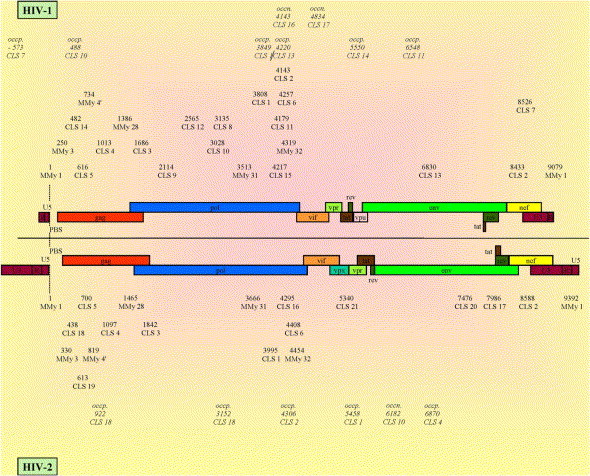
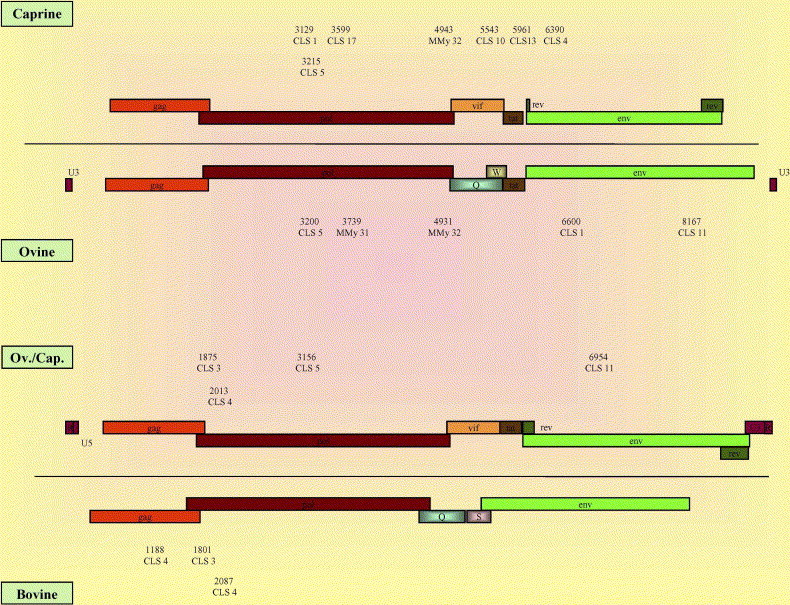
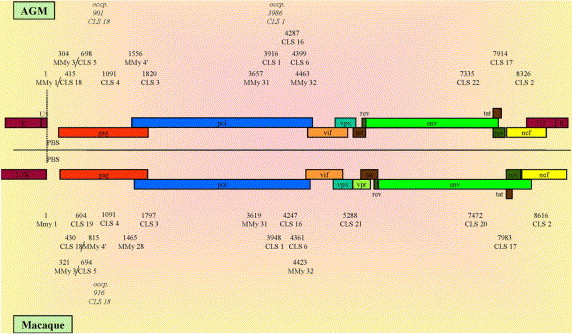
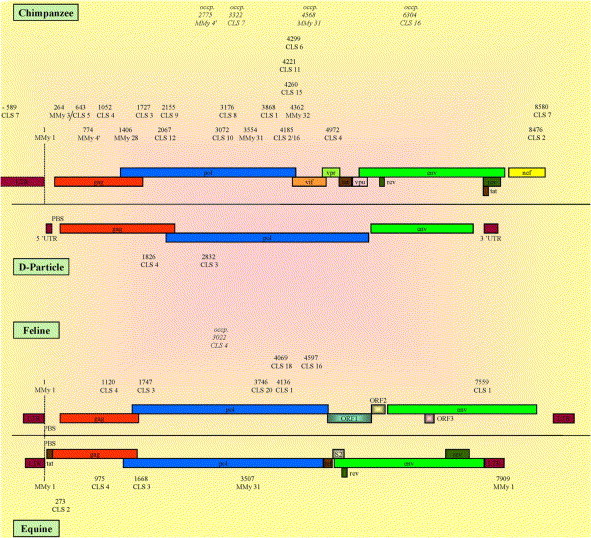
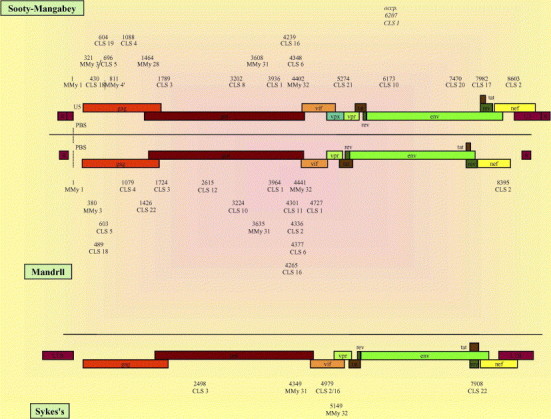
Considering that recombinations produce quasispecies in lentivirus spreading, we identified and localized highly conserved sequences that may play an important role in viral ontology. Comparison of entire genomes, including 237 human, simian and non-primate mammal lentiviruses and 103 negative control viruses, led to identify 28 Conserved Lentiviral Sequences (CLSs). They were located mainly in the structural genes forming hot spots particularly in the gag and pol genes and to a lesser extent in LTRs and regulatory genes. The CLS pattern was the same throughout the different HIV-1 subtypes, except for some HIV-1-O strains. Only CLS 3 and 4 were detected in both negative control HTLV-1 oncornaviruses and D-particle-forming simian viruses, which are not immunodeficiency inducers and display a genetic stability. CLSs divided the virus genomes into domains allowing us to distinguish sequence families leading to the notion of 'species self' besides that of 'lentiviral self'. Most of acutely localized CLSs in HIV-1s (82%) corresponded to wide recombination segments being currently reported.
鉴于重组在慢病毒传播过程中产生准种,我们鉴定并定位了可能在病毒本体论中起重要作用的高度保守序列。对包括237种人类、猿猴和非灵长类哺乳动物慢病毒以及103种阴性对照病毒在内的全基因组进行比较,从而鉴定出28个保守慢病毒序列(CLS)。它们主要位于构成热点的结构基因中,特别是在gag和pol基因中,在LTR和调控基因中的程度较小。除了一些HIV-1-O毒株外,不同HIV-1亚型的CLS模式相同。在阴性对照HTLV-1肿瘤病毒和形成D颗粒的猿猴病毒中仅检测到CLS 3和4,这些病毒不是免疫缺陷诱导剂且具有遗传稳定性。CLS将病毒基因组划分为多个结构域,这使我们能够区分序列家族,从而引出了“物种自身”以及“慢病毒自身”的概念。HIV-1中大多数急性定位的CLS(82%)对应于目前报道的广泛重组片段。